
Why Does Eyebrow Pencil Fade on Oily Skin? What Brands Should Test
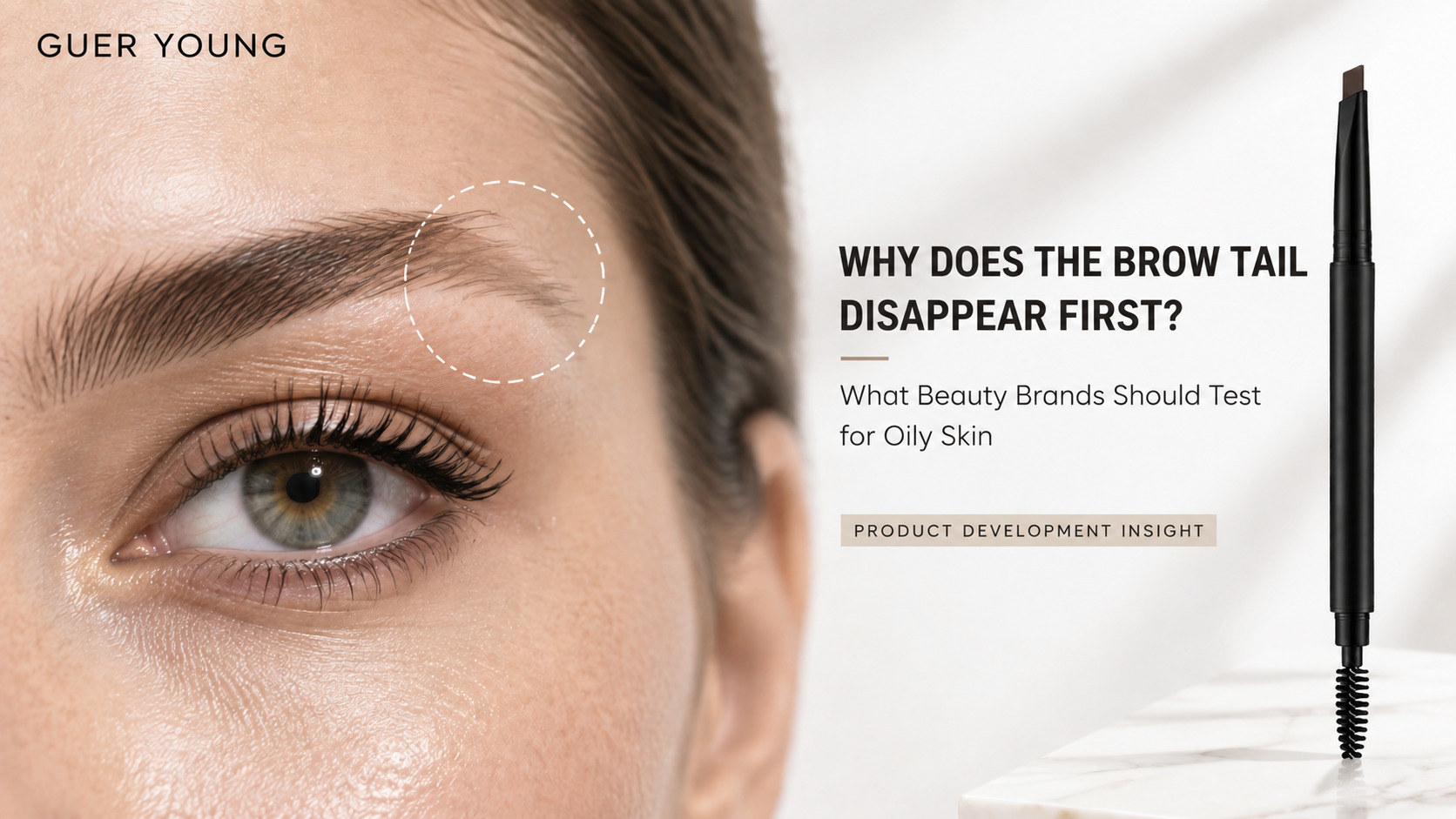
Your eyebrow pencil looks good in the morning. The color is right, the glide feels smooth, and the brow tail looks clean and precise.
Then oily-skin consumers report:
“The rest of my brow is still there, but the tail disappears by the afternoon.”
For a beauty brand developing an eyebrow pencil for oily skin, this is more than a general wear complaint.
It can be a sign that sebum is affecting how well the deposited color remains attached to the skin—especially when facial oils are combined with touching, wiping, hair contact, and friction.
For product development teams, the key relationship is:
Sebum Exposure → Adhesion Behavior → Friction Response → Brow-Tail Retention
So instead of simply asking how to make an eyebrow pencil “last longer,” brands should ask a more specific question:
Where does the line begin to fail—and what should we test to understand why?
Why Does Eyebrow Pencil Fade Faster on Oily Skin?
An eyebrow pencil deposits a controlled layer of pigments, waxes, oils, powders, and other formula components onto the skin.
Immediately after application, the line may look stable.
But oily skin is not a static surface.
As sebum accumulates around the brow area, the environment around the deposited color changes. Depending on the formulation, the line may become easier to transfer, smudge, or remove when friction is introduced.
This creates an important distinction:
Color Retention ≠ Adhesion Retention
A line can remain visible after sebum exposure while becoming less stable.
That difference may not be obvious until the consumer touches the brow, wipes away sweat, moves hair across the area, or creates another form of light friction.
A typical failure pathway may look like:
Pigment Deposition → Initial Adhesion → Sebum Exposure → Reduced Line Stability → Friction → Visible Fading
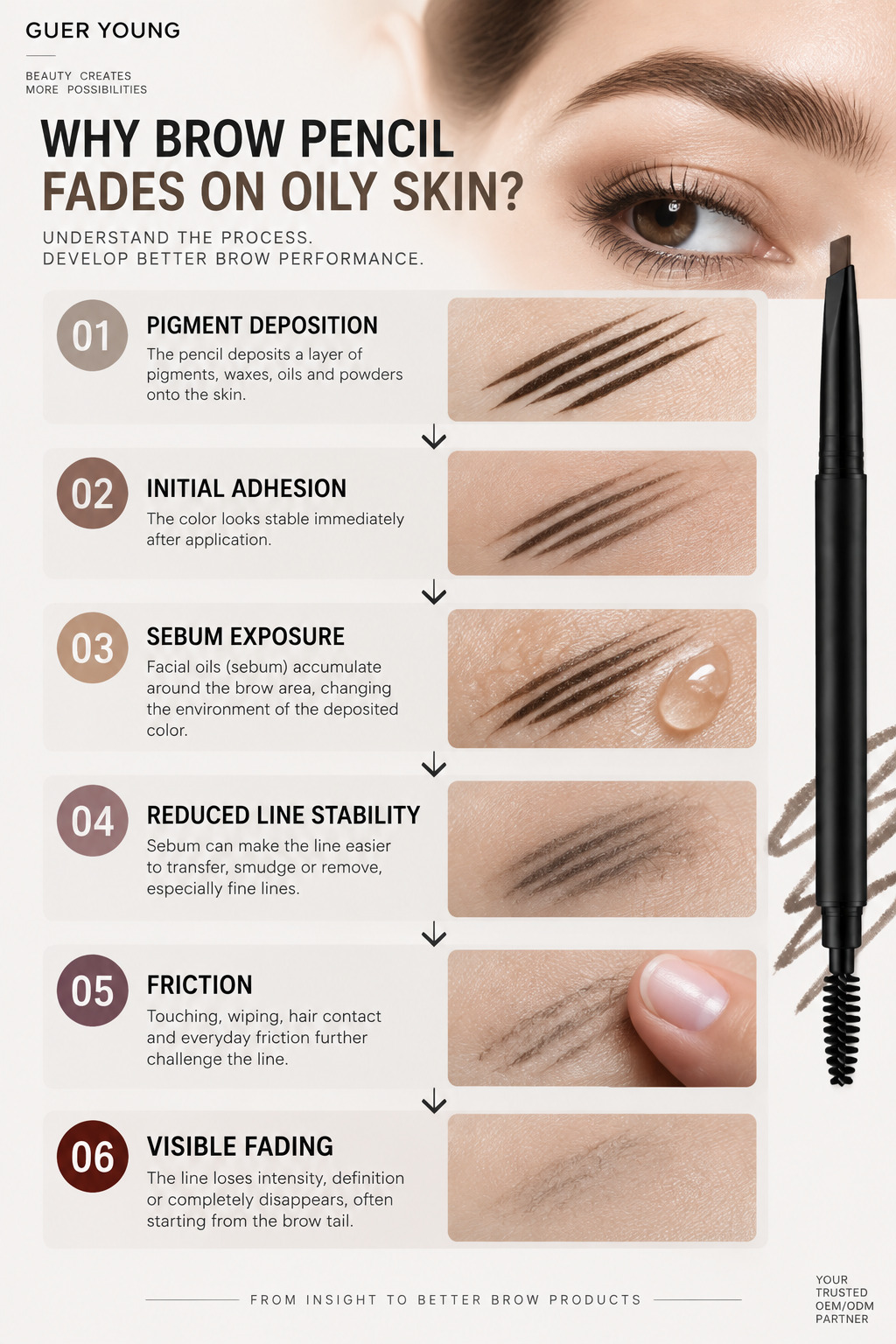
For oily-skin brow products, the goal is therefore not simply to keep pigment somewhere on the skin.
The original line needs to maintain its position, edge, and definition as the skin becomes oilier.
Why Does the Brow Tail Disappear First?
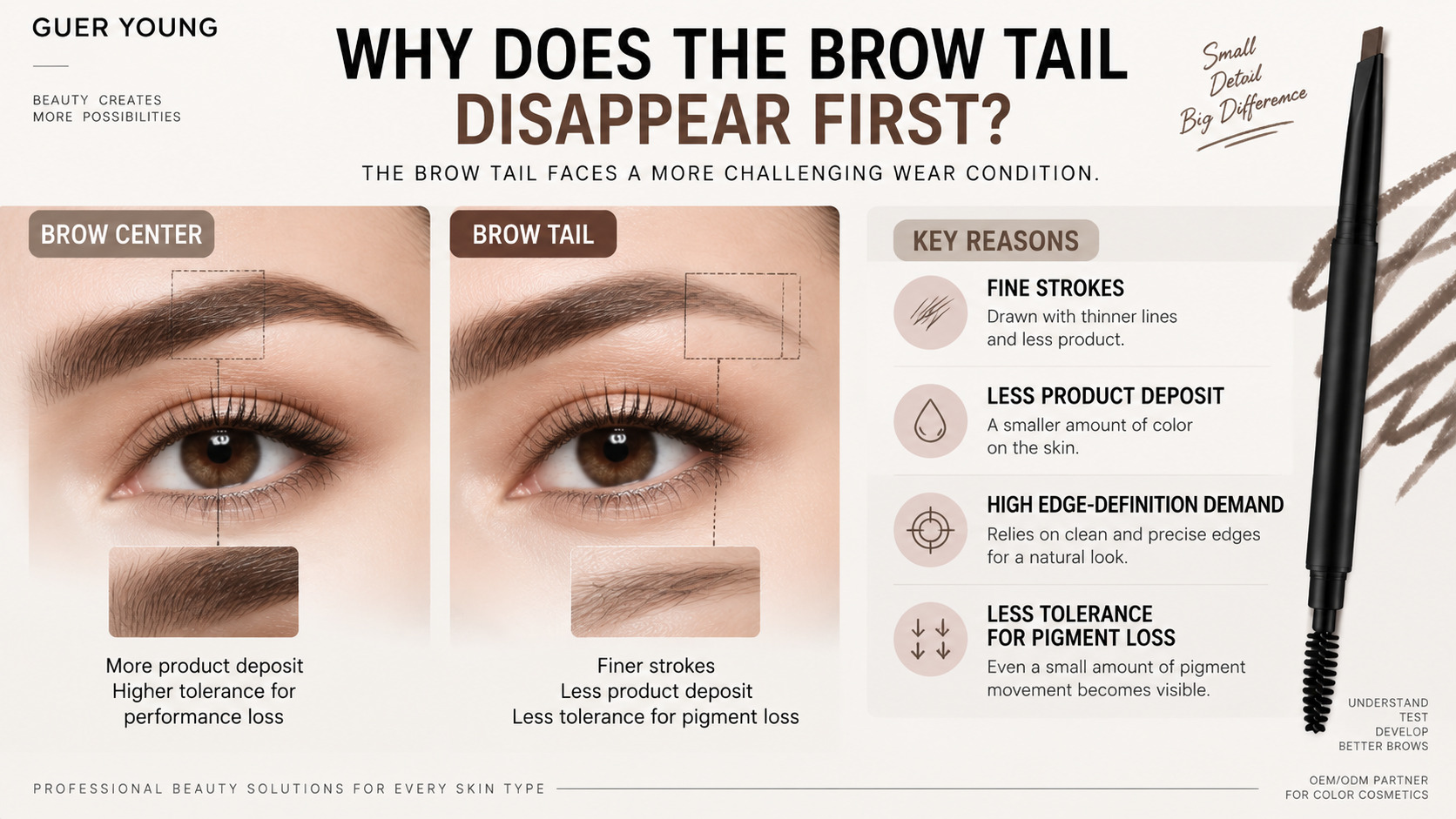
The brow tail creates a particularly demanding wear condition.
Compared with the center of the brow, it is usually drawn with finer strokes and less deposited product. It also depends more heavily on clean edge definition.
That gives it less tolerance for performance loss.
If sebum changes the stability of the deposited layer, even a small amount of pigment movement can become visible.
Then friction adds another challenge.
Hair may repeatedly touch the brow. Fingers may touch the face. Consumers may wipe away sweat or excess oil. Tissues, hats, or other everyday contact can affect the area.
The result may be:
a blurred brow tail;
softer edges;
broken fine lines;
reduced color intensity;
color that remains visible but moves more easily.
A heavily filled section of the brow may still look acceptable after losing some pigment.
A fine brow tail may not.
That is why brow-tail retention can reveal oily-skin performance differences that an overall color check may miss.
Development Case: The Brow Still Had Color, but the Tail Was Gone
A beauty brand approached GUER YOUNG with a Benchmark Sample for an eyebrow pencil targeting oily and combination-oily consumers.
At first, the sample looked promising.
The glide was suitable. Pigmentation was close to target. The pencil created a clean makeup result immediately after application.
But the brand had received a specific consumer complaint:
“The brow still has color, but the tail disappears by the afternoon.”
That changed the development question.
The issue was no longer simply:
“Does enough pigment remain?”
It became:
“Why does the fine-line structure fail before the rest of the brow?”
What We Re-Evaluated
Instead of focusing mainly on initial payoff, the Benchmark Sample was examined around four questions.
1. What happens after sebum exposure?
Does the line remain defined, or do the edges begin to soften?
2. Does sebum increase transfer?
The color may still be visible while becoming easier to move.
3. What happens when friction follows sebum exposure?
This can reveal whether the deposited layer becomes more vulnerable after contact with oil.
4. Does the brow tail behave differently from a larger filled area?
This connects the evaluation directly to the consumer complaint.
The development target became more specific:
Maintain fine-line and brow-tail definition after sebum and friction without sacrificing controlled application and natural pigmentation.
Now the team had something more useful to evaluate than simply whether the next sample was “more long-lasting.”
What Should Brands Test for Sebum Resistance?
For a sebum resistant eyebrow pencil, a simple before-and-after color comparison may not provide enough information.
Different failure patterns should be evaluated separately.
| Test Focus | What Brands Should Observe | Possible Failure Signal |
Color Retention | How much visible pigment remains after sebum exposure? | Overall fading |
Edge Definition | Does the original line remain sharp? | Softening or spreading |
Transfer After Sebum | Does pigment become easier to transfer? | Reduced line stability |
Smudge After Sebum | Does movement change the original line shape? | Blurring or migration |
Friction After Sebum | How much color remains after controlled rubbing? | Adhesion-related loss |
Brow-Tail Retention | Do fine lines remain continuous and defined? | Broken or disappearing tail |
These measurements answer different questions.
For example, two formulas may retain a similar amount of visible color immediately after sebum exposure.
But after controlled friction, one may maintain a relatively clean edge while the other quickly loses definition.
If the consumer complaint is:
“My brow tail disappears,”
that difference matters.
The testing principle is straightforward:
Test the failure your consumer is actually reporting.
Why Test Sebum and Friction Together?
Real consumers rarely experience facial oil without physical contact.
Throughout the day, brow makeup may encounter hair movement, fingers, tissues, sweat wiping, hats, or other forms of light friction.
This means sebum exposure alone may not reveal the full performance difference between two formulas.
Consider:
Sample A
Sebum exposure → line remains visible → controlled friction → line remains relatively defined
Sample B
Sebum exposure → line remains visible → controlled friction → significant edge and color loss
If evaluation stopped immediately after sebum exposure, the samples might appear more similar than they actually are.
A more useful oily-skin evaluation sequence can therefore be:
Sebum Exposure → Adhesion Stability → Controlled Friction → Brow-Tail Retention
This helps connect product testing with what the consumer actually experiences several hours after application.
Strong Pigmentation Doesn't Always Mean Better Oily-Skin Performance
Initial pigmentation can make a sample look impressive.
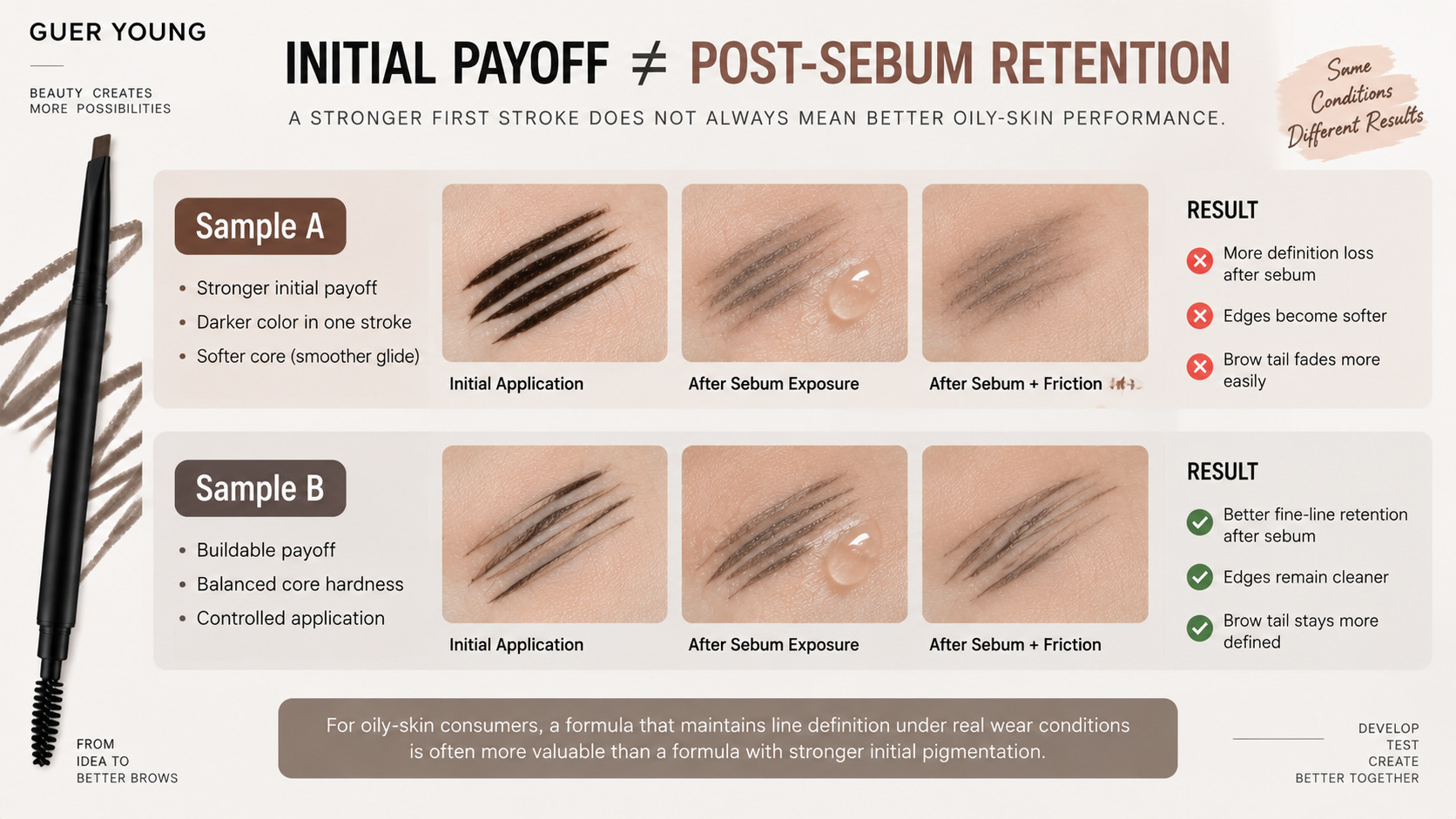
But stronger first-stroke color does not necessarily mean stronger post-sebum performance.
Imagine two eyebrow pencil samples.
Sample A creates a darker line in one stroke but loses more definition after sebum and friction.
Sample B has more buildable pigmentation but maintains a cleaner fine line under the same conditions.
For an oily-skin target consumer, Sample B may provide more relevant performance—even if Sample A looks stronger in the first swatch.
Brands should therefore distinguish:
Initial Payoff ≠ Post-Sebum Line Retention
The same principle applies to pencil hardness.
A softer core may provide smooth glide and stronger immediate payoff. A firmer core may provide more precision and control.
But simply making the core harder can create dragging, weaker payoff, or the need for repeated strokes.
The real development balance is:
Core Hardness × Pigment Deposition × Adhesion × Fine-Line Precision × Sebum Performance
The goal is not maximum hardness or maximum pigmentation.
The goal is a line that applies the way the brand wants—and remains stable under the intended wear conditions.
How Should Brands Evaluate an Oily-Skin Benchmark?
When sending a Benchmark Sample to an eyebrow pencil manufacturer, visual similarity alone may not explain why the benchmark succeeds or fails on oily skin.
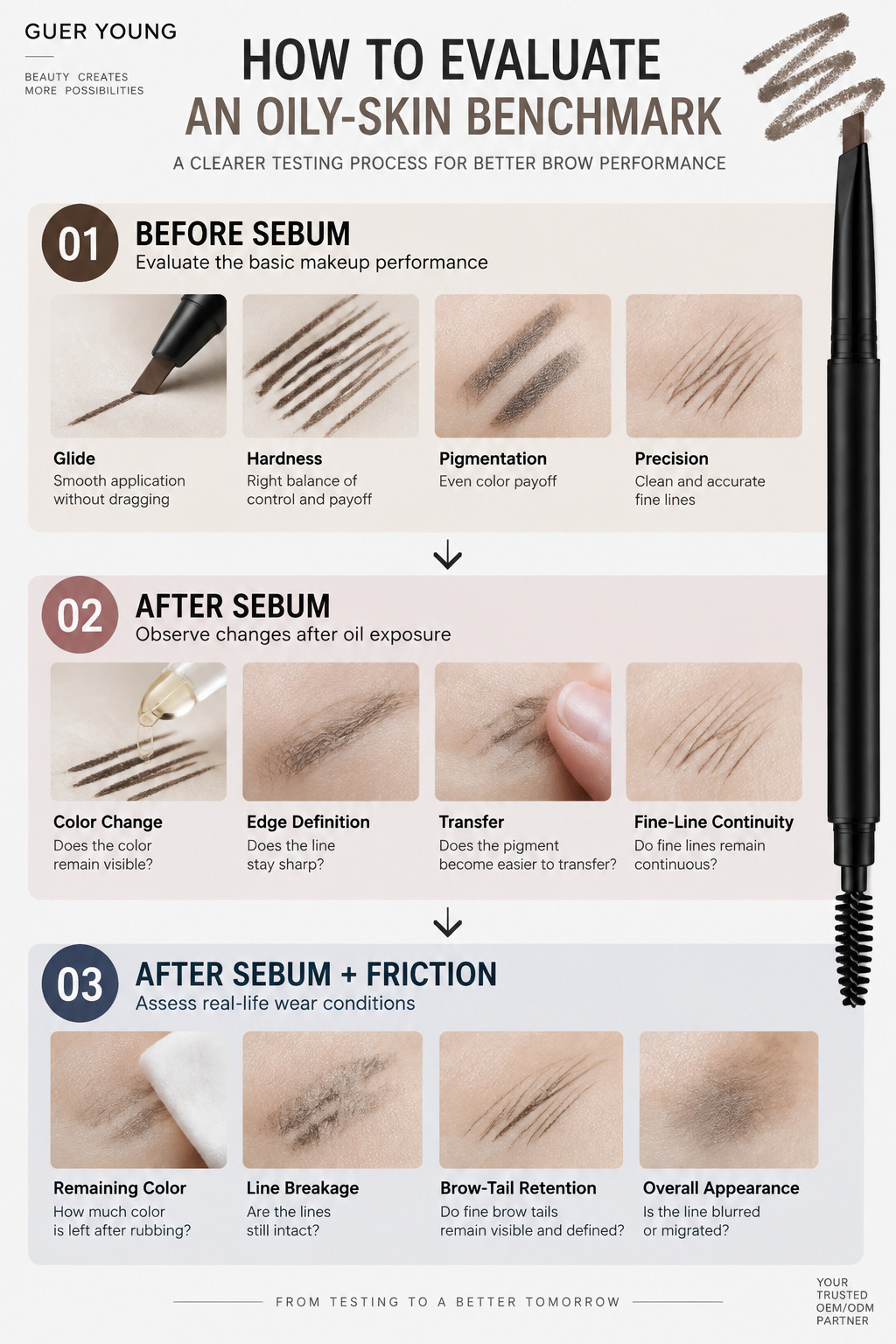
A more useful evaluation can follow three stages.
Before Sebum
Evaluate:
Glide · Hardness · Pigmentation · Buildability · Fine-Line Precision
After Sebum
Observe:
Color Change · Edge Definition · Transfer · Fine-Line Continuity
After Sebum + Friction
Compare:
Remaining Color · Line Breakage · Edge Definition · Brow-Tail Retention
This makes it easier to identify where the performance difference begins.
Instead of saying:
“Please copy this benchmark, but make it last longer.”
the brand can identify a much more specific development target.
For example:
“We want to retain the benchmark's glide and natural pigmentation, but improve brow-tail retention after sebum and friction.”
That gives the development team clearer information to work from.
The Benchmark Sample shows where development starts.
The failure pattern shows what needs to change.
When Should Brands Look More Closely at Sebum Performance?
A more focused evaluation may be useful when:
oily or combination-oily consumers are a key target group;
reviews repeatedly mention afternoon brow fading;
the brow tail disappears before the rest of the brow;
the color remains visible but becomes easier to smudge;
fine lines lose definition faster than filled areas;
performance changes noticeably after several hours of facial oil buildup.
In these situations, the most useful question is not simply:
“Did the eyebrow pencil last?”
Ask:
“Where and how did the line fail?”
That question can reveal much more about what should be evaluated next.
FAQ: Eyebrow Pencil Development for Oily Skin
Why does eyebrow pencil fade faster on oily skin?
As sebum accumulates, it changes the environment around the deposited brow color. Depending on the formulation, this can affect adhesion stability, transfer, smudging, and resistance to friction.
Why does the brow tail disappear before the rest of the brow?
The brow tail is usually created with finer lines and less deposited product. Small changes in adhesion or pigment movement can therefore become visible sooner than in more heavily filled areas.
What should brands test when developing an eyebrow pencil for oily skin?
Depending on the product target, brands can evaluate color retention, edge definition, transfer after sebum exposure, smudging, friction response, fine-line continuity, and brow-tail retention.
Developing an Eyebrow Pencil for Oily Skin?
If consumers are telling your brand:
“The color is still there, but my brow tail is gone,”
don't look only at initial pigmentation.
Look at where the line begins to fail.
Then evaluate what happens to adhesion, transfer, edge definition, and fine-line retention after sebum + friction.
As a color cosmetics OEM/ODM partner, GUER YOUNG can work with your Benchmark Sample, desired makeup effect, core preference, pigmentation target, and oily-skin wear concerns to evaluate eyebrow pencil performance from initial application through post-sebum wear.
If you're developing an eyebrow pencil for oily skin or sebum resistant eyebrow pencil, send us your Benchmark Sample and the specific consumer problem you're trying to solve.
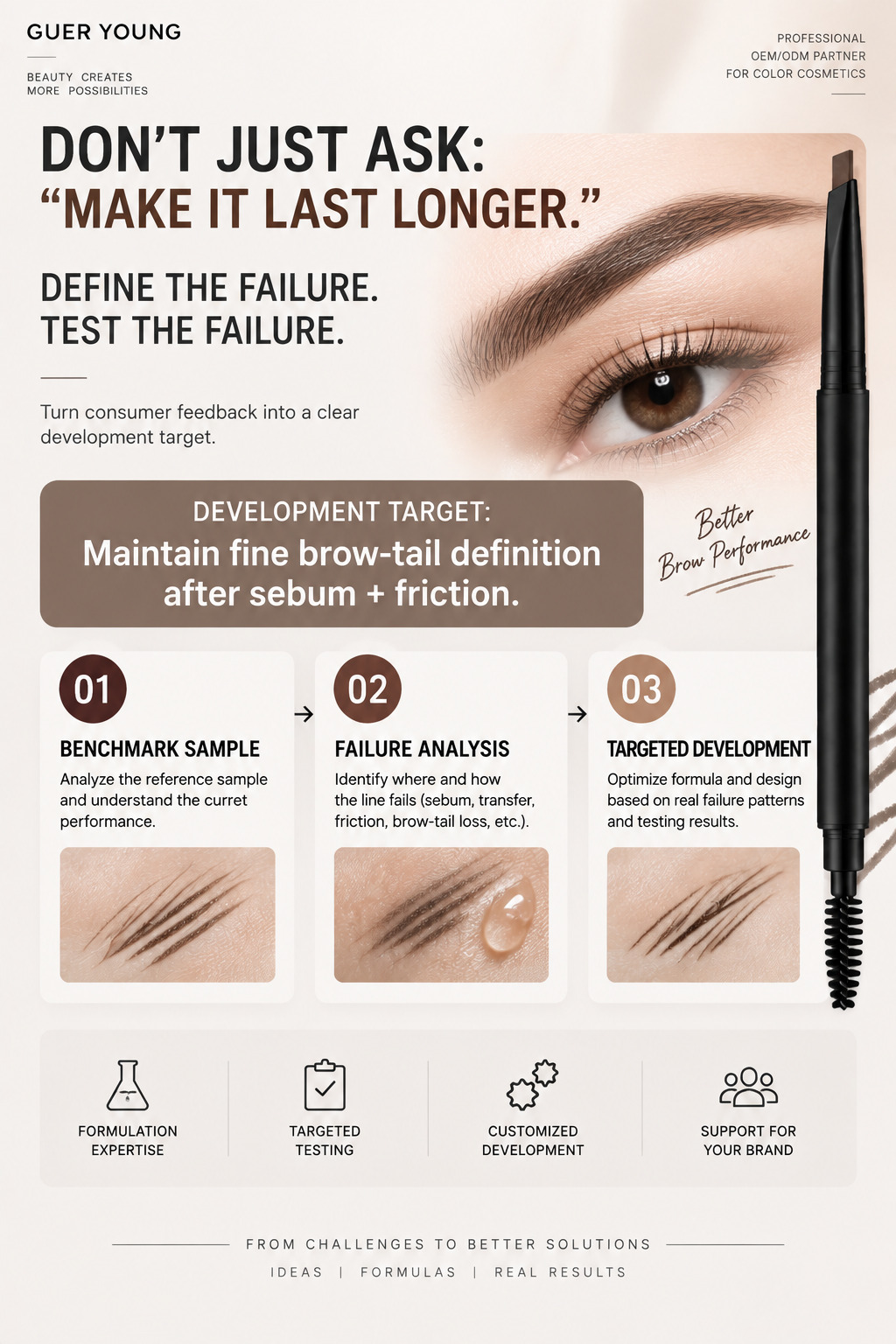
Instead of:
“Make it last longer.”
a more useful development target may be:
“After sebum and friction, we need the fine brow tail to remain visible and defined.”
That gives the development process a much clearer place to start.


andy.li@gueryoung.com

We have 10 years of experience, focusing on the development and sales of high quality eyelash growth serum, mascara, eyebrow gel, eyebrow color and other products. We also offer custom services, from tube
design to cosmetic fillings and packaging


Room 1, C3 Factory Building, No.8803 Zhuhai Avenue, Lianwan Industrial Zone, Pingsha Town, Gaolan Port Economic Zone, Zhuhai, Guangdong,China
QUICK LINKS
D Zone,5/F, NO.8 CuiZhu 5th Street,
Qianshan Xiangzhou District,Zhuhai,
Guangdong,China,519070

lynn.zhou@gueryoung.com
winnie.zhong@gueryoung.com
niki.xu@gueryoung.com