Product
Article
NameDescriptionContent
How Emerging Beauty Brands Test Overseas Markets Without Big Budgets or Teams
Source:
|
作者:selina
|
Release time:2026-01-29
|
283 Second visit:
|
🔊 Click to read aloud
❚❚
▶
|
Share:
This article outlines 3 low-cost, low-risk strategies for emerging beauty brands to test the international cosmetic market, including small batch trial orders, local retail partnerships, and TikTok seeding. It also provides 15 differentiation tips and encourages collaboration with B2B suppliers like GUER YOUNG.
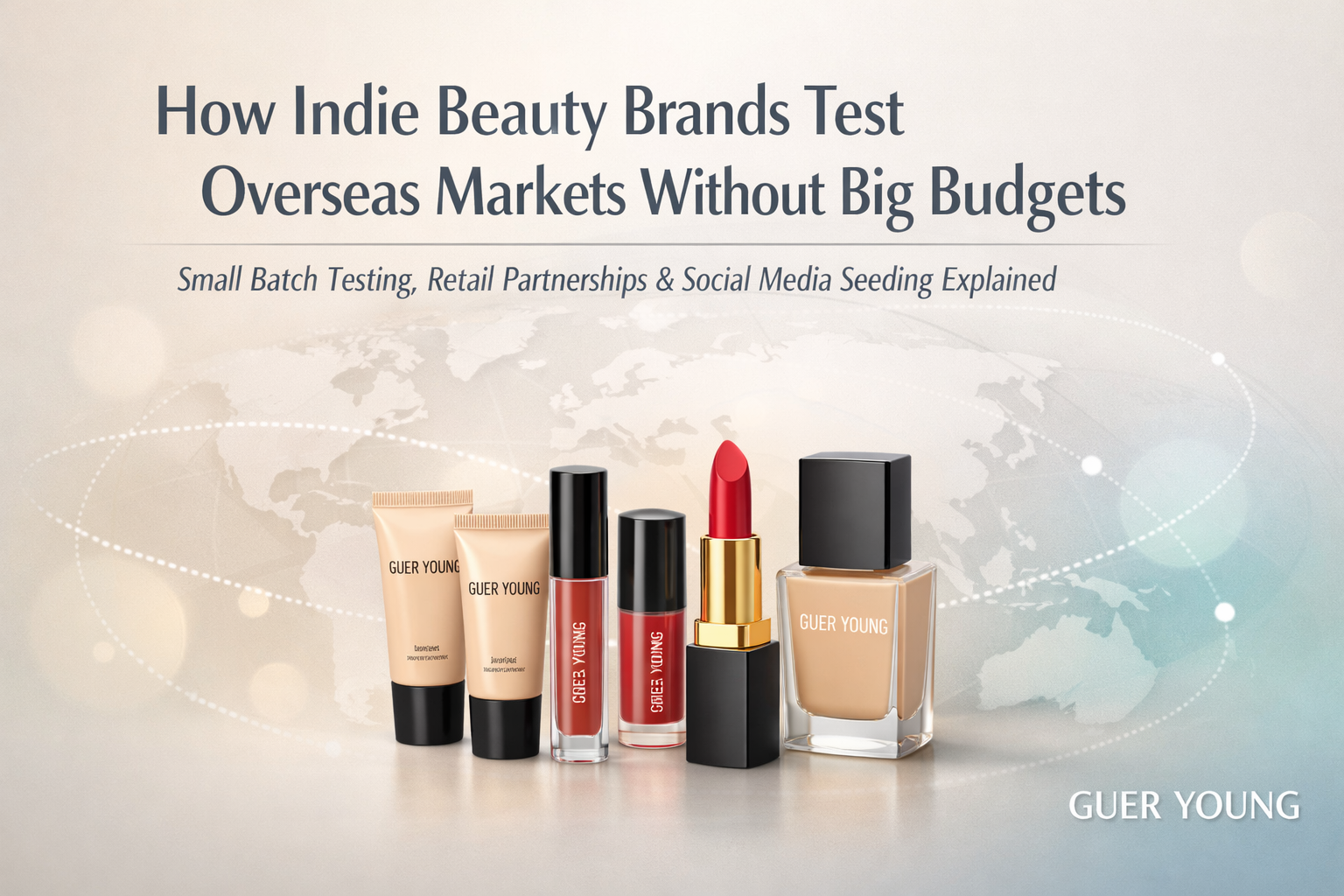
As an emerging beauty brand or indie seller, the cosmetic market overseas is undeniably full of opportunity — but also packed with risk. You might be asking yourself:
“How can I quickly break into the international beauty products space without overspending?”
“I don’t have a local team or channels — how do I build market presence?”
“I’m on a budget. I can’t afford to make a wrong move with high inventory.”
These are common concerns from rising beauty startups. The global cosmetic market is booming, yet building a sustainable, profitable business abroad still feels out of reach for many small teams.
At GUER YOUNG, as a B2B cosmetic supplier, we specialize in supporting low-cost overseas testing for startup beauty brands. We’ve helped dozens of founders minimize risk while gaining real overseas market feedback using quick market testing techniques for new cosmetics.
3 Smart Ways to Run Low-Cost Testing in the Cosmetic Market
1. Small Batch Testing – Launch with Low MOQ and Test for Real Demand
Instead of producing thousands of units and hoping it works, opt for a small batch cosmetic trial order strategy — launching with as few as 100–300 units to collect early market feedback through your website, influencer seeding, or social media ads.
💡 Case in point: A beauty seller from Australia worked with GUER YOUNG to produce a custom concealer palette in just 300 pieces. By sending products to a few Instagram beauty creators, they generated over 300+ comments in a week. Based on the feedback, they refined the color shades and texture — leading to repeat orders in three months.
📌 Industry Insight: According to the State of Fashion 2023 report by Business of Fashion and McKinsey, “real-world product testing” and “social proof” are key to new beauty brand adoption, especially in the crowded cosmetic market.
2. Local Retail Partnerships – Co-Sell Through Small Boutiques or Concept Stores
A low-risk local distribution partnership with multi-brand beauty stores or small local retailers allows you to test without owning inventory-heavy operations or hiring sales teams.
💡 Case in point: A Singapore-based founder partnered with a buyer store in Chiang Mai, Thailand, through GUER YOUNG’s network. 200 lip gloss units were placed in-store — 178 were sold within 30 days, and 13 pages of consumer feedback were collected. This startup beauty brand overseas market feedback guided their next product line.
3. TikTok Seeding – Build Hype with Micro-Influencers
A social media cosmetic seeding strategy is one of the fastest ways to gain attention and trial from your ideal audience. Platforms like TikTok offer direct engagement with users who care about beauty authenticity.
💡 Case in point: A new cosmetics brand partnered with five UK-based TikTok creators (each with 50–100K followers). For $100 per creator, they released real-use videos that generated over 1,300+ clicks per post — selling out their initial batch and validating their product's appeal.
15 Ways to Create Differentiation as an Emerging Beauty Brand
Define your niche (sensitive skin, Gen Z, eco-friendly, etc.)
Localize your packaging design
Translate product copy and claims for local markets
Offer custom formulas and colors
Launch new SKUs frequently (build freshness)
Bundle products to raise AOV
Create collabs or limited editions
Incentivize UGC (user-generated content)
Build micro-communities on Telegram or Discord
Support local payment gateways
Mix independent site + platform (Amazon, Etsy)
Offer multilingual customer service
Pre-launch with KOL feedback
Tell your founder/brand story consistently
Prioritize video-first marketing across platforms
Conclusion: Smart Testing + Brand Differentiation = Global Growth
Entering the cosmetic market internationally doesn’t have to be risky or expensive. By using a small batch cosmetic trial order strategy, pursuing a low-risk local distribution partnership, and leveraging a social media cosmetic seeding strategy, your brand can achieve international cosmetic product market validation faster and smarter.
At GUER YOUNG, we support brands through every step of the B2B cosmetic supplier collaboration plan, empowering them to move from product idea to market-ready with minimal risk and maximum feedback.
📩 Interested in small-batch samples or custom sourcing for your next product?
Reach out to GUER YOUNG — we’ll help you tap into international beauty products markets with flexible supply solutions and a proven track record in helping brands scale smart.
Hashtags:
#cosmeticmarket #smallbatchtesting #internationalbeautyproducts #beautystartup #indiebeautybrand #beautyproductlaunch #lowMOQcosmetics #tiktokmarketing #beautyinfluencers #beautybusiness #beautyretailstrategy #UGCmarketing #productmarketfit #customcosmetics #readytocosmetics #beautysupplier #b2bcosmetics #beautyexport #microinfluencers #independentbrand #beautydistribution #cosmetictrends #globalbeauty #testthemarket #startupcosmetics #beautysourcing #beautymanufacturing #beautycollaboration #fastbeauty #beautyfounder #readytosellcosmetics #beautycontentmarketing #KOCstrategy #brandpositioning #beautyfeedback #consumerinsight #beautymarkettesting #quickproductlaunch #goglobalbeauty #GUERYOUNG
Other language editions of this article
• Arabic version: https://www.gueryoungcosmetics.com/article/ar-news-how-emerging-beauty-brands-test-overseas-markets
• Spanish version: https://www.gueryoungcosmetics.com/article/es-news-how-emerging-beauty-brands-test-overseas-markets


+86 13825629636
winnie.zhong@gueryoung.com

We have 10 years of experience, focusing on the development and sales of high quality eyelash growth serum, mascara, eyebrow gel, eyebrow color and other products. We also offer custom services, from tube
design to cosmetic fillings and packaging


+86 13825629606

Room 1, C3 Factory Building, No.8803 Zhuhai Avenue, Lianwan Industrial Zone, Pingsha Town, Gaolan Port Economic Zone, Zhuhai, Guangdong,China
PRODUCTS
QUICK LINKS

andy.li@gueryoung.com
lynn.zhou@gueryoung.com
+86 13825629985
+86 13825629619
niki.xu@gueryoung.com