
Why Your Makeup Products Don't Get Repeat Orders — and How OEM/ODM Product Design Solves It
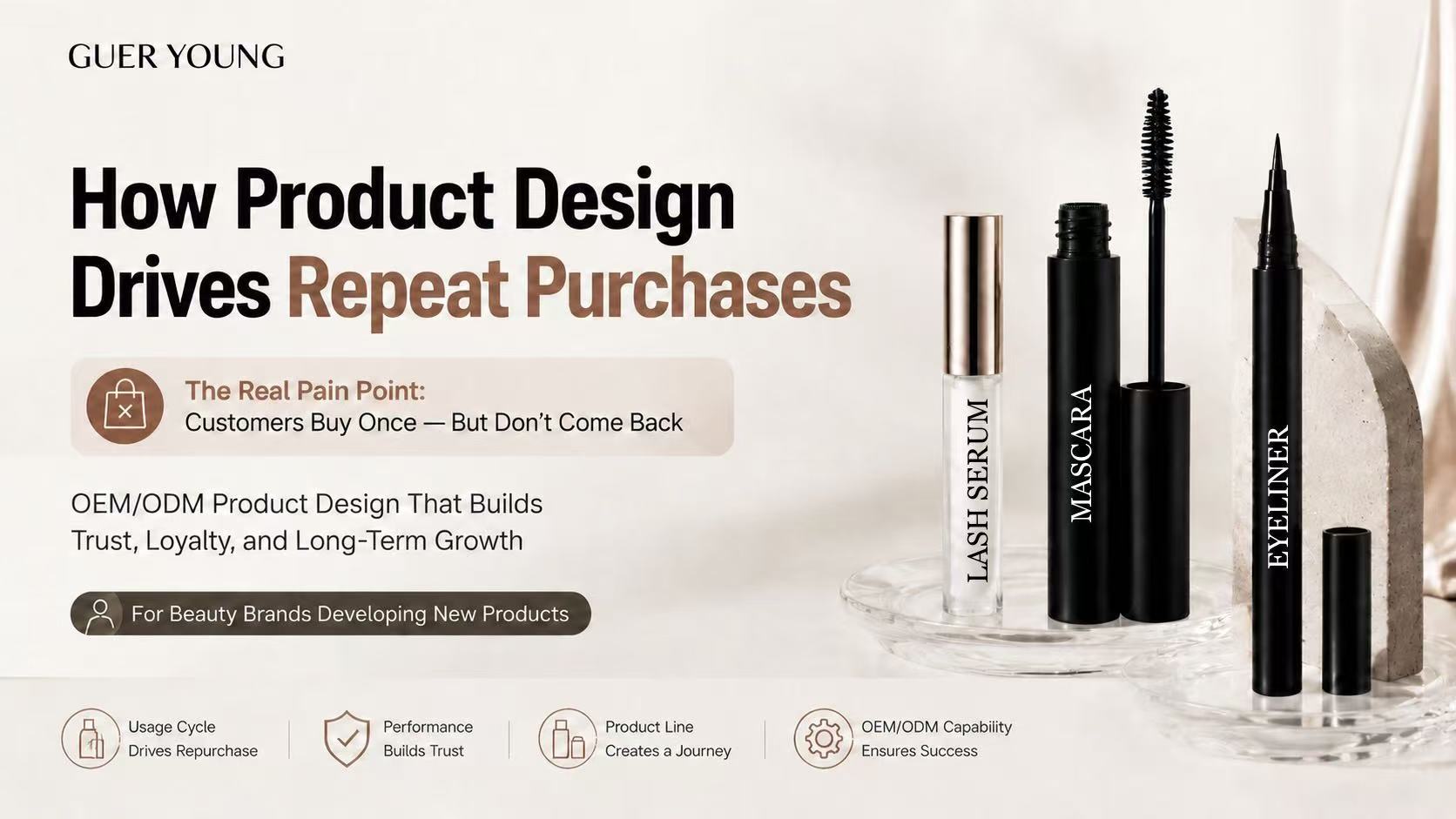
In the development of new makeup products, many brands face a common challenge: the product sells once, but customers do not come back to repurchase. From an OEM/ODM perspective, this “one-time purchase” issue is usually not caused by marketing or distribution—it is rooted in product design and supply chain execution from the very beginning.
As a long-term developer and manufacturer of products such as Eyelash Serum, Mascara, and Eyeliner, GUER YOUNG has consistently observed one key fact: repurchase is not an after-sales result, but a product architecture outcome.
In other words, whether a beauty brand can achieve sustainable growth is largely determined at the product development stage.
1. The Real Brand Pain Point: Products Sell, But Don’t Re-sell
In real OEM/ODM projects, “one-time purchase” problems usually come from the product itself, not marketing efforts:
The user experience does not build long-term dependency
Product performance is unclear or inconsistent
Usage cycles are not aligned with consumer behavior
Lack of product upgrade or extension pathways
Packaging fails to create brand memory
For brands, this means the product can enter the market—but cannot become a long-term customer asset.
Therefore, product development should not only focus on “creating a product,” but on building a structure that naturally drives repurchase.
2. How Product Design Directly Impacts Repurchase Behavior
From a product logic perspective, repurchase is mainly driven by three structural elements:
1) Usage Cycle Design: Making “Use Up → Repurchase” Natural
Repurchase starts with one condition: the product must be used up within a predictable timeframe.
In Eyelash Serum, Mascara, and Eyeliner development, usage cycle design is critical:
Align product volume with a 3–8 week usage cycle
Design for daily or high-frequency usage scenarios
Optimize dispensing systems for controlled and efficient use
For example:
Eyelash Serum: builds a consistent nightly care routine
Mascara: supports daily makeup habits with frequent usage
Eyeliner: ensures smooth, continuous application without interruption
When the usage cycle matches consumer behavior, repurchase becomes natural rather than forced.
2) Perceived Performance Design: Making the Product Worth Repurchasing
In beauty products, repurchase is ultimately driven by trust in results.
During formulation development, the focus is placed on “perceptible performance”:
Eyelash Serum: visible lash condition improvement over time
Mascara: curl, volume, and long-wear consistency
Eyeliner: smudge resistance and stable all-day performance
Within GUER YOUNG’s development process, formulation stability and batch consistency are prioritized to ensure users experience the same results every time.
When performance is predictable, repurchase becomes a natural decision rather than a risky choice.
3) Product Line Architecture: Turning Repurchase into a Journey
A single product rarely builds long-term repurchase behavior, but a system of products can.
In product planning, brands typically develop:
Entry-level → upgraded performance → professional use versions
Daily makeup line → enhanced look line → high-performance line
For example:
Eyelash Serum + Mascara build a complete lash system
Mascara + Eyeliner create a full eye makeup ecosystem
In GUER YOUNG’s experience, structured product lines often generate stronger long-term brand retention than standalone products.
3. Why OEM/ODM Capability Directly Impacts Repurchase
Repurchase is not only a marketing result—it depends heavily on supply chain execution and product consistency.
1) R&D Capability: Ensuring Long-Term Market Viability
Key development priorities include:
Clear functional direction (growth / volume / long-wear)
Ingredient stability and safety compliance
Multi-market regulatory compatibility
In GUER YOUNG’s R&D process, the focus is on ensuring products are built for long-term market performance—not just first-launch success.
2) Packaging & Structural Design: Shaping User Experience Consistency
Packaging directly affects usability and repurchase behavior:
Mascara brush design impacts application efficiency
Eyeliner tip design affects ink flow stability
Serum dropper design impacts dosing precision
Stable structural design leads to consistent user experience, which strengthens repurchase intent.
3) Manufacturing Stability: Maintaining Trust Across Batches
Repurchase depends on trust, and trust depends on consistency.
Key requirements include:
Batch-to-batch consistency
Stable raw material supply chain
Consistency between samples and mass production
Reliable delivery and production efficiency
GUER YOUNG focuses heavily on minimizing batch variation to protect brand reputation and user trust.
4) One-Stop OEM/ODM System: Reducing Development Risk
In product development, the biggest cost is not production—it is trial and error.
A complete OEM/ODM workflow typically includes:
Product concept and positioning
Formula development and sampling
Packaging design and structural engineering
Compliance and testing support
Mass production and delivery
This system allows brands to validate products faster while reducing development risk.
4. Role in Product Development Projects
In most OEM/ODM collaborations, GUER YOUNG acts as a product development and manufacturing partner rather than just a production facility.
Across core categories such as Eyelash Serum, Mascara, and Eyeliner, involvement typically includes:
Product structure optimization
Formulation stability improvement
Packaging usability refinement
Scalable manufacturing execution
The focus is on transforming concepts into stable, market-ready products.
5. Conclusion: Repurchase Is Decided at the Development Stage
For beauty brands, long-term growth is not determined by the first sale—but by whether customers return to buy again.
Repurchase is not a marketing outcome. It is the result of product structure + OEM/ODM capability working together.
When a product is designed with the right usage cycle, stable performance, and scalable product architecture, repurchase becomes a natural behavior.
At the same time, manufacturing and development capabilities determine whether this experience can be consistently delivered to the market.
OEM/ODM Development Support
If your brand is planning new product development or aiming to improve repurchase performance in existing products, we provide full OEM/ODM support from concept to mass production, including:
Eyelash Serum / Mascara / Eyeliner product development
Custom formulation and performance optimization
Packaging structure design and sampling
Mass production and quality control
Full product line development strategy support
We welcome discussions on your product needs and development goals, and can support your brand in building competitive, market-ready cosmetic products from development to production.


andy.li@gueryoung.com

We have 10 years of experience, focusing on the development and sales of high quality eyelash growth serum, mascara, eyebrow gel, eyebrow color and other products. We also offer custom services, from tube
design to cosmetic fillings and packaging


Room 1, C3 Factory Building, No.8803 Zhuhai Avenue, Lianwan Industrial Zone, Pingsha Town, Gaolan Port Economic Zone, Zhuhai, Guangdong,China
QUICK LINKS
D Zone,5/F, NO.8 CuiZhu 5th Street,
Qianshan Xiangzhou District,Zhuhai,
Guangdong,China,519070

lynn.zhou@gueryoung.com
winnie.zhong@gueryoung.com
niki.xu@gueryoung.com