

Product
Article
NameDescriptionContent
Why do mascara compliance costs differ by up to 22% across the EU, US, Middle East, and ASEAN—and how can importers control them
Source:
|
作者:selina
|
Release time:2026-02-09
|
246 Second visit:
|
🔊 Click to read aloud
❚❚
▶
|
Share:
This article explains why mascara compliance costs can differ by as much as 22% across the EU, US, Middle East, and ASEAN markets. Through real market cases and practical strategies, it helps importers, distributors, and B2B buyers sourcing from China reduce regulatory risk, control costs, and achieve sustainable growth.
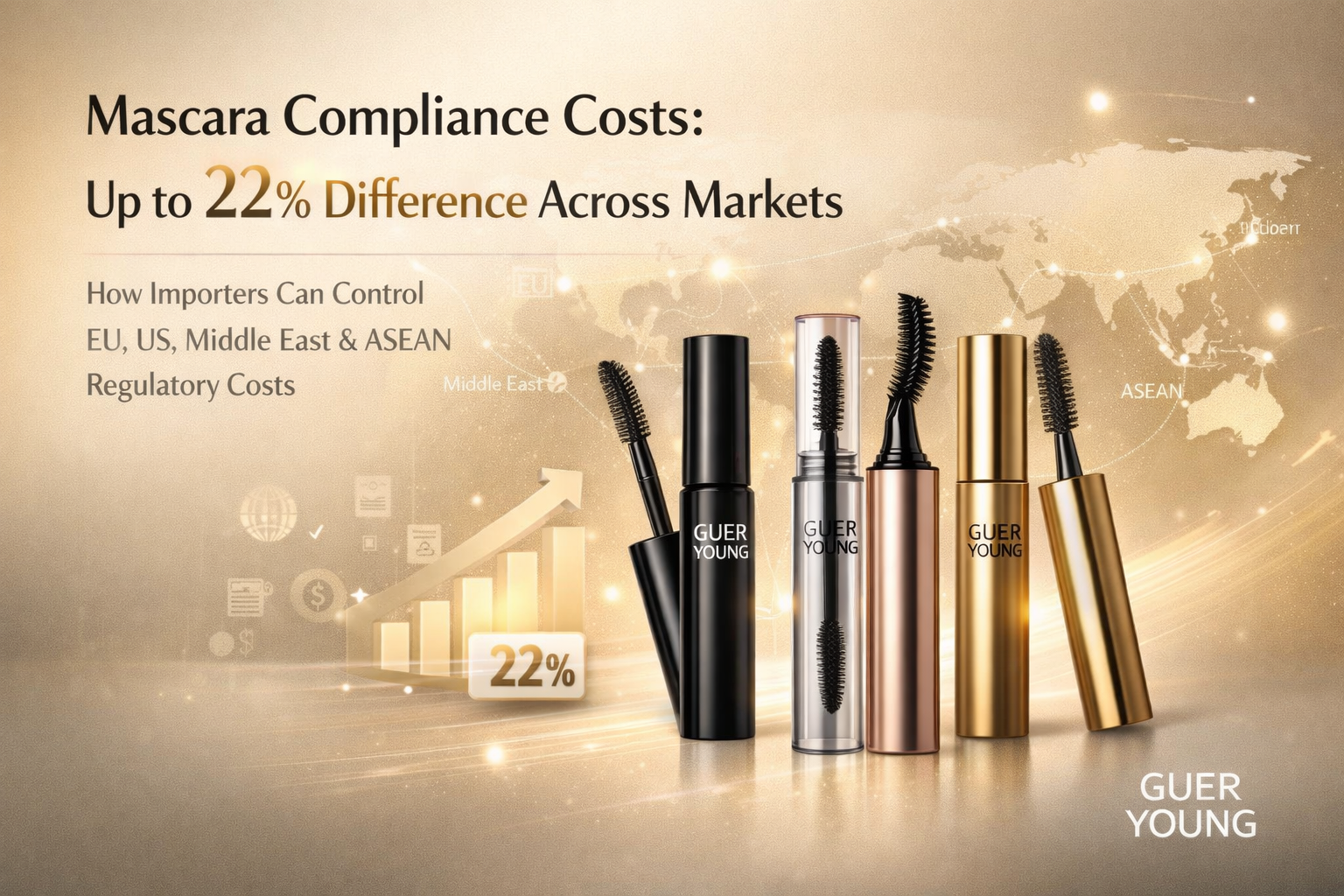
90% of New Importers Don’t Know This: Mascara Compliance Costs Can Vary by Up to 22% Across Different Markets
If you are an importer, wholesaler, or distributor dealing with finished cosmetic products—especially mascara sourced from China—you may already feel the pressure:
the same product, the same factory, yet completely different landing costs depending on the target market.
For many international traders, the biggest challenge is not price negotiation, but regulatory misunderstanding. In fact, industry data shows that due to regulatory structure, documentation, testing, and labeling requirements, international mascara compliance cost differences can reach as high as 22% between markets. This gap directly affects profit margins, time-to-market, and even market access.
For buyers focused on Cross-border beauty product sourcing from China, regulatory clarity is no longer optional—it is a core competitiveness factor.
Real Market Cases: How Regulatory Differences Directly Impact Cost and Risk
Case 1: European Union (EU)
Regulatory reality: Strict compliance with EC 1223/2009, mandatory CPSR, PIF documentation, and CPNP notification
Cost impact: Testing and compliance documentation can account for 15–20% of total landed cost
Industry insight: Cosmetics Business consistently reports that incomplete documentation is the top reason for EU product rejection
Strategy: Finalize EU-compliant formulations and files at the China source to avoid duplicate testing later
Case 2: United States (US)
Regulatory reality: FDA does not require pre-market approval, but imposes strict post-market liability on labeling and claims
Cost impact: Hidden risk costs related to recalls, re-labeling, and legal exposure
Industry insight: Global Cosmetics News highlights that US compliance failures often occur after products reach the market
Strategy: Design FDA-compliant labeling and claims from the beginning, even when manufacturing overseas
Case 3: Middle East
Regulatory reality: GSO and SFDA frameworks, Halal requirements, and lengthy product registration
Cost impact: Certification fees and extended approval timelines increase cash flow pressure
Industry insight: Euromonitor notes that regulatory trust is critical for cosmetics success in this region
Strategy: Work with Chinese suppliers experienced in Halal and Middle East registrations
Case 4: ASEAN Markets
Regulatory reality: ASEAN Cosmetic Directive with country-level enforcement differences
Cost impact: Repeated submissions and localized requirements add 8–12% extra cost
Strategy: Use a unified ASEAN compliance file to streamline multi-country entry
These examples show exactly how to import mascara legally to multiple markets—and why preparation matters.
15 Practical Ways Importers Can Build Differentiation and Control Compliance Costs
Choose Chinese suppliers with proven multi-market compliance experience
Develop EU and US-ready formulations at the source
Centralize compliance files to reduce duplication
Optimize SKU structure to focus on high-margin products
Use modular packaging designs for different markets
Digitize regulatory document management
Enter markets sequentially instead of simultaneously
Conduct one-time third-party regulatory audits
Combine ready-stock and ODM models for flexibility
Negotiate regional exclusivity to secure volume advantages
Localize marketing claims instead of using global messaging
Optimize cross-border logistics and customs planning
Use bundled product strategies to increase order value
Accelerate new product launches to improve cash flow
Partner with suppliers like GUER YOUNG who understand global compliance systems and B2B buyer realities
These approaches are core B2B mascara sourcing strategies for importers and help create differentiated mascara products for international buyers.
Conclusion: Compliance Is No Longer a Cost—It’s a Competitive Advantage
Regulatory differences don’t just affect paperwork—they directly determine profitability and market access. Importers who understand Mascara import regulations EU US Middle East ASEAN early gain a structural advantage over competitors still focused only on unit price.
Choosing a reliable Chinese supply partner that integrates compliance, cost control, and speed-to-market is critical. As a GUER YOUNG finished-makeup independent website supplier and B2B seller, we work closely with international buyers to reduce risk, shorten learning curves, and build sustainable margins. GUER YOUNG believes that compliance is not a barrier, but a long-term moat. GUER YOUNG focuses on stable, repeatable, and compliant growth for global partners.
Which market’s regulations are currently your biggest challenge?
Feel free to share your experience or connect for a deeper discussion.
#Mascara#Cosmetics#FinishedMakeup#B2BCosmetics#CosmeticImporter#CosmeticDistributor#WholesaleCosmetics#ChinaSupplyChain#BeautySourcing#CrossBorderTrade#InternationalTrade#RegulatoryCompliance#EUcosmetics#FDAcosmetics#MiddleEastCosmetics#ASEANCosmetics#ComplianceCost#MarketEntry#ODMcosmetics#OEMcosmetics#PrivateLabel#WhiteLabelBeauty#SupplyChainManagement#CostControl#ProfitMargin#ImportRisk#BeautyBusiness#GUERYOUNG
Other language editions of this article
• French version: https://www.gueryoungcosmetics.com/article/fr-news-why-mascara-compliance-costs-differ-eu-us-middle-east-asean
• Spanish version: https://www.gueryoungcosmetics.com/article/es-news-why-mascara-compliance-costs-differ-eu-us-middle-east-asean


+86 13825629636
winnie.zhong@gueryoung.com

We have 10 years of experience, focusing on the development and sales of high quality eyelash growth serum, mascara, eyebrow gel, eyebrow color and other products. We also offer custom services, from tube
design to cosmetic fillings and packaging


+86 13825629606

Room 1, C3 Factory Building, No.8803 Zhuhai Avenue, Lianwan Industrial Zone, Pingsha Town, Gaolan Port Economic Zone, Zhuhai, Guangdong,China
PRODUCTS
QUICK LINKS

andy.li@gueryoung.com
lynn.zhou@gueryoung.com
+86 13825629985
+86 13825629619
niki.xu@gueryoung.com