
Why OEM Projects Fail in Cosmetic Development (and How to Fix It Step by Step)
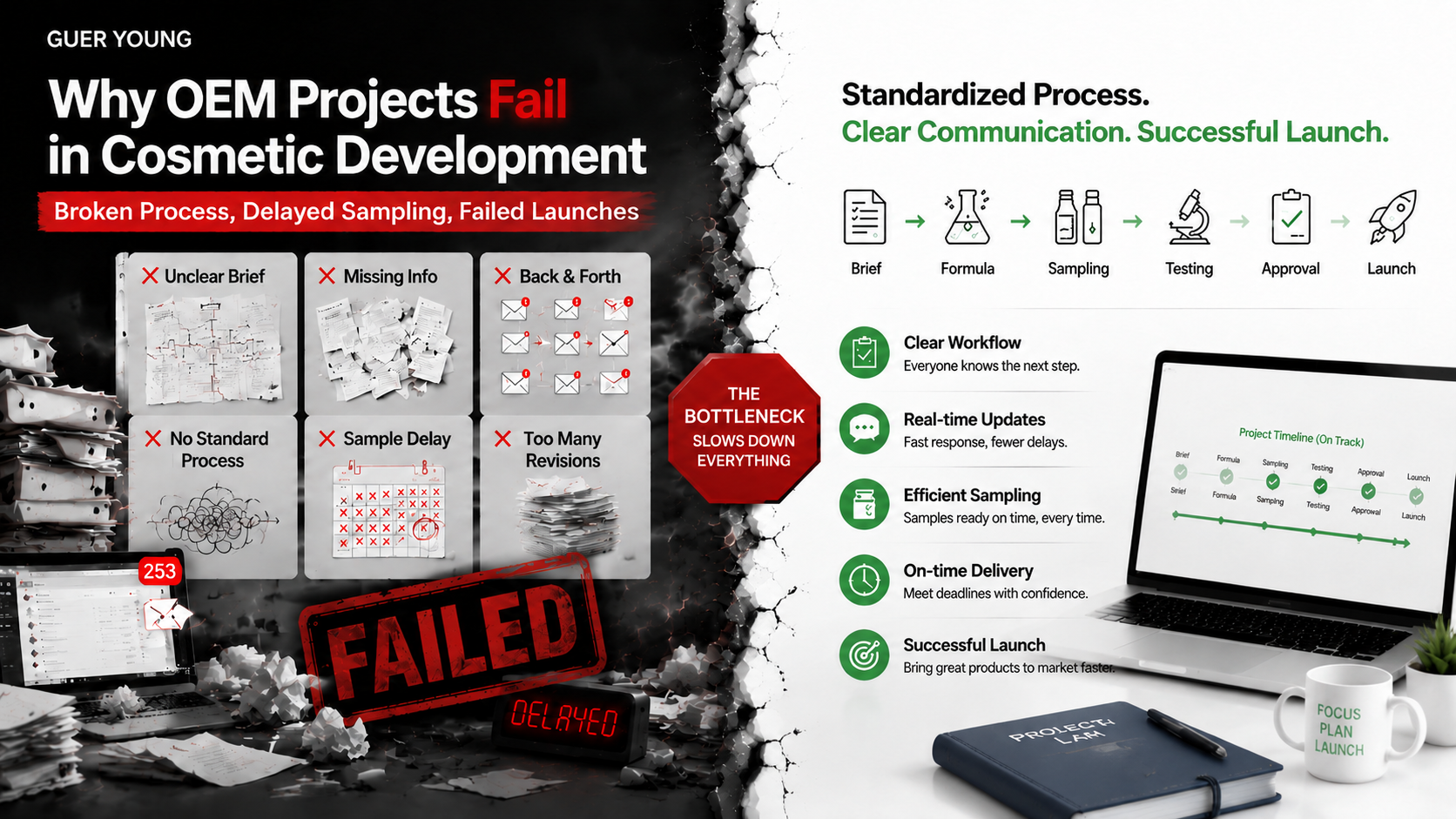
In the beauty and cosmetics industry, more and more brands are partnering with OEM manufacturers to accelerate product development and bring products to market faster. However, for brands that have already started working with OEMs, a common issue often arises: inefficient collaboration—repeated communication, delayed sampling cycles, slow revisions, and even stalled project progress.
These problems are not simply about “finding a manufacturer.” In most cases, they stem from whether the OEM provides a complete, structured, and executable development support system.
GUER YOUNG, a manufacturer specializing in cosmetic and skincare product development, has long supported brands in categories such as eyelash growth serums, mascaras, eyeliners, and eyebrow gels. Based on real project experience, we’ve identified the key types of support brands should require from OEM partners to ensure smooth development.
1. A Clear and Structured Product Development Process
One of the most common reasons for project delays is a lack of process clarity.
At the beginning of cooperation, brands should require OEMs to clearly define:
Full development stages (formulation → sampling → testing → packaging → mass production)
Timeline and deliverables for each stage
Revision and feedback workflow (how feedback is submitted, who responds, turnaround time)
Dedicated project management and communication structure
Without a transparent process, projects often fall into inefficient cycles of waiting, re-confirmation, and repeated revisions.
A professional OEM system should standardize the entire workflow so that brands always know what is happening and what comes next.
2. Strong Formulation R&D and Customization Capability
In products such as eyelash growth serums, mascaras, eyeliners, and eyebrow gels, formulation capability is the core competitive advantage.
Brands should evaluate whether an OEM has:
Independent R&D capability (not just formula copying)
Ability to develop performance-driven products (growth, curl, waterproof, smudge-proof, etc.)
Experience adapting formulations for different regulatory markets
Comprehensive safety and stability testing systems
Especially for eye-area products, strict requirements on irritation control and stability are critical. Weak R&D capability often leads to repeated sampling failures or inability to scale production.
3. Efficient Sampling and Fast Feedback Mechanism
A frequent pain point for brands is long sampling cycles, slow revisions, and lack of structured feedback loops.
Before starting a project, OEMs should clearly define:
First sample turnaround time (and whether it is controlled and reliable)
Revision response time
Whether parallel sample optimization is supported
Whether comparative analysis or improvement suggestions are provided
Without a standardized system, sampling can easily turn into an endless revision loop.
In a mature development system, sampling is not guesswork—it is a structured process driven by data and optimization logic.
4. Packaging Design and Brand Identity Support
For brands already working with OEMs, products are no longer just functional items—they are brand assets.
Therefore, OEMs should provide:
Packaging structure design support (bottles, brush types, tubes, etc.)
Market-specific aesthetic guidance (Western vs. Asian preferences)
Cost optimization while maintaining visual impact
Mold development and prototyping capabilities
For example, mascara brush design and eyeliner tip structure directly influence user experience and repeat purchase rates.
Without packaging support, an OEM can only deliver a “product,” not a “brand-ready solution.”
5. Regulatory Compliance and Market Entry Support
Many collaboration issues occur after product development is already completed.
Brands should require OEMs to provide:
Regulatory guidance for different markets (EU, US, Southeast Asia, etc.)
Ingredient safety documentation (MSDS, COA, etc.)
Formulation compliance recommendations
Support for product registration and documentation
Without early compliance involvement, brands may later face delays, reformulation, or even market entry failure.
6. Production Stability and Delivery Assurance
Successful product launch ultimately depends on stable manufacturing.
Brands should confirm:
Flexible MOQ options
Controlled and reliable production timelines
Raw material supply chain stability
Consistent quality inspection standards
Many “collaboration issues” are actually caused by instability in production capacity and supply chain management.
7. Data Feedback and Product Optimization Support
A strong OEM is not just a manufacturer—it is a partner in product growth.
Brands should expect OEMs to provide:
User experience feedback (texture, wear performance, irritation levels, etc.)
Market trend insights
Cost optimization strategies
Suggestions for next-generation product development
This type of input helps brands evolve from simply “making products” to building scalable product lines.
Conclusion
If your brand is developing eyelash growth serums, mascaras, eyeliners, or eyebrow gels, but is facing issues such as repeated sampling revisions, slow communication, delayed R&D progress, or unstable mass production, the root cause is often not a lack of manufacturers—but a lack of a system that integrates formulation development, sampling efficiency, packaging design, regulatory compliance, and production stability.
In these cases, GUER YOUNG provides end-to-end support from product development to mass production. We optimize formulation systems for unstable eyelash growth performance, improve mascara formulations to reduce clumping and smudging, and refine eyeliner and eyebrow gel textures and applicator designs for better user experience. At the same time, we provide regulatory documentation and global market entry support to help brands shorten development cycles, reduce trial-and-error costs, and accelerate product launch.
If you are currently working on an OEM project or looking to bring a new product to market more efficiently, feel free to share your product needs and development challenges. We can provide a practical, tailored development roadmap based on your brand positioning.


andy.li@gueryoung.com

We have 10 years of experience, focusing on the development and sales of high quality eyelash growth serum, mascara, eyebrow gel, eyebrow color and other products. We also offer custom services, from tube
design to cosmetic fillings and packaging


Room 1, C3 Factory Building, No.8803 Zhuhai Avenue, Lianwan Industrial Zone, Pingsha Town, Gaolan Port Economic Zone, Zhuhai, Guangdong,China
QUICK LINKS
D Zone,5/F, NO.8 CuiZhu 5th Street,
Qianshan Xiangzhou District,Zhuhai,
Guangdong,China,519070

lynn.zhou@gueryoung.com
winnie.zhong@gueryoung.com
niki.xu@gueryoung.com