
How Many Eyebrow Pencil Shades Should Your Brand Launch
Read in English | Lire en Français | Lesen auf Deutsch | Leer en Español
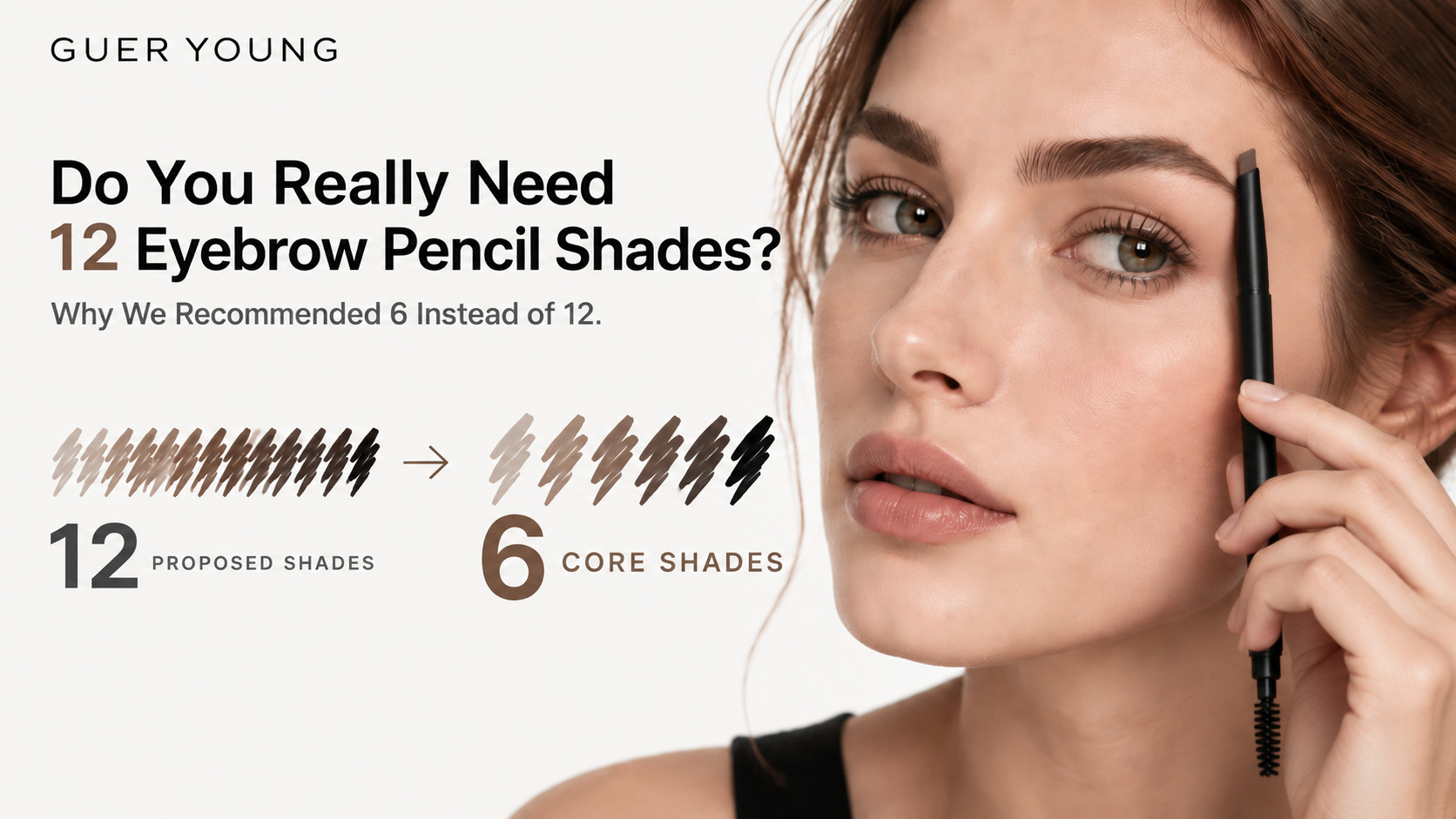
Why we recommended 6 core shades instead of 12 for one beauty brand
How many eyebrow pencil shades should you launch with a new brow collection?
Four? Six? Ten? Twelve?
For beauty brands developing a new eyebrow pencil, more shades can feel like the safer choice. A wider range seems to mean better consumer coverage.
But every additional shade also means another SKU to forecast, purchase, stock, and replenish. And if several shades look almost identical once applied to the brows, are they really helping you reach more consumers—or simply creating more inventory complexity?
We recently worked with a beauty brand that had already planned 12 eyebrow pencil shades.
After reviewing its target consumers, comparing shade overlap, refining undertones, and testing the colors on brows, we recommended launching with just 6 core shades.
Why?
Because a strong eyebrow pencil shade range isn't about offering the most colors.
It's about making sure every shade serves a clear consumer need.
Case Study: Why We Recommended 6 Shades Instead of 12
The brand approached us while preparing to expand its brow category.
The team had studied several established beauty brands and noticed that many offered 10 or more brow pencil shades.
Their initial thinking made sense:
More shades = more consumer coverage.
But before moving all 12 colors forward, we compared the proposed shades more closely.
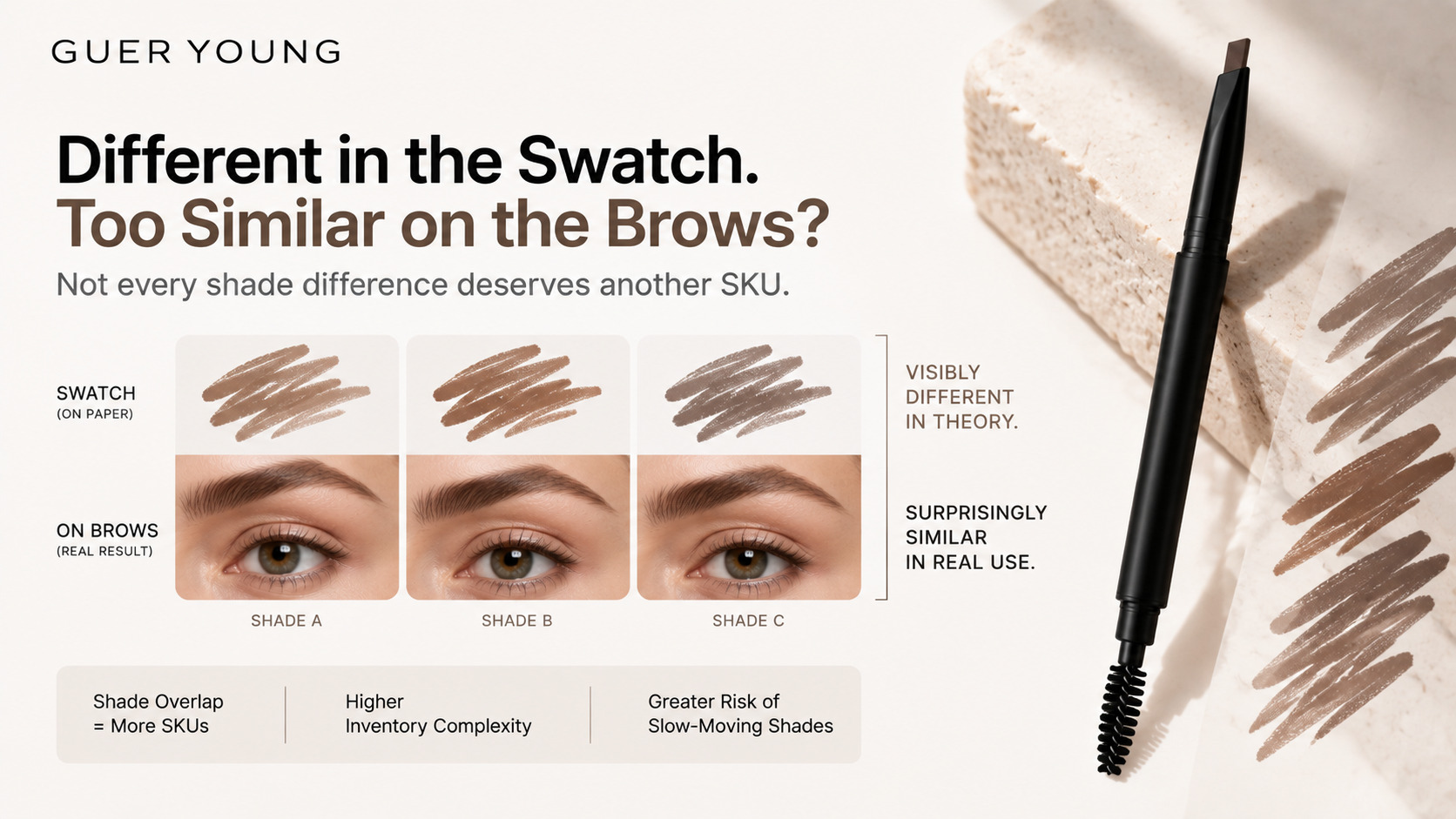
Several browns were visibly different when placed side by side as samples. Once applied to the brows, however, some of those differences became much harder to see.
That raised an important question:
Were all 12 shades serving different consumers—or were some simply creating additional SKUs?
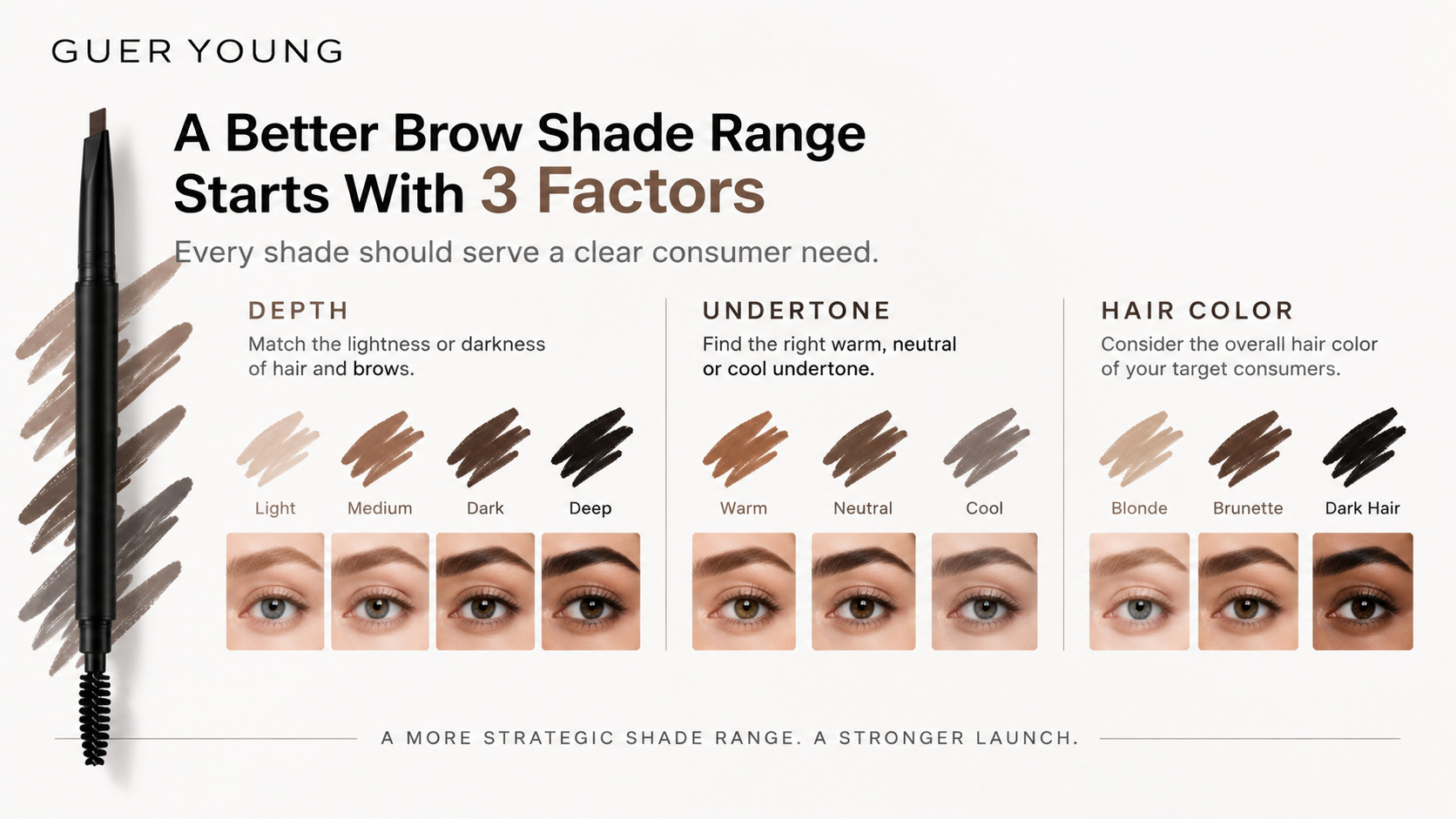
Instead of immediately moving the full range forward, we went back to the target consumer and reorganized the shades around three factors:
Depth × Undertone × Hair Color
We then adjusted overlapping shades and compared multiple custom eyebrow pencil colors on the brows.
After several rounds of evaluation, we recommended 6 Core Shades for the initial launch.
The other shade directions were not discarded. They were kept as potential Extension Shades that could be introduced later if sales data and customer feedback showed a clear need.
The result wasn't simply a smaller range.
It was a more structured eyebrow pencil shade system.
Why More Eyebrow Pencil Shades Don't Always Mean Better Coverage
A larger shade range only improves consumer coverage when the additional shades fill meaningful gaps.
Imagine three medium browns.
If one is clearly warm, one neutral, and one cool—and each shade matches a relevant consumer group—there may be a good reason to keep all three.
But what if all three look nearly identical once applied?
For the brand, they are still three separate SKUs.
That can mean inventory spread across more colors, more complicated forecasting, more slow-moving shade risk, and a harder choice for consumers.
This is why shade count alone is a poor measure of how inclusive or commercially effective a range will be.
The better question is:
How many meaningfully different consumers does your shade range cover?
Start With Your Target Consumer, Not Your Competitor's Shade Count
Competitive research is useful during eyebrow pencil shade development, but copying another brand's shade count is not a shade strategy.
A mature global beauty brand may have years of sales history and customer data supporting 12 or 15 shades.
A brand launching its first eyebrow pencil—or entering a new market—may have very different needs.
Before deciding how many shades to launch, consider:
Where will the product be sold?
What hair colors are most common among your target consumers?
What skin-tone range do you need to serve?
Are warm, neutral, or cool brow tones more relevant?
Does your customer prefer soft, natural brows or stronger definition?
At GUER YOUNG, these questions help guide shade planning before the final number of colors is determined.
The goal isn't to ask:
“How many shades can we make?”
It's to understand:
“Which shades does this market actually need?”
Build Your Shade Range Around Depth × Undertone × Hair Color
When planning custom eyebrow pencil colors, simply dividing the collection into Blonde, Brown, and Black is often not enough.
A more useful framework is:
Depth
Depth determines how light or dark the brow shade appears.
Your range may need to cover light, medium, dark, and very dark hair. But adding another level of depth only makes sense if consumers can actually see and use the difference.
If two neighboring shades perform almost identically on the brows, both may not need to become Core Shades.
Undertone
Eyebrow pencil undertone can be just as important as depth.
A Medium Brown might be warm, neutral, ash, or cool. Consumers with similar hair depth can still need different undertones to achieve a natural-looking result.
This is why effective eyebrow pencil color matching should go beyond basic names such as Light Brown, Medium Brown, and Dark Brown.
Hair Color
Hair color helps define who each shade is actually intended for.
Instead of creating as many variations as possible, the objective is to make the range easy to understand.
A consumer should be able to look at your shade selection and quickly think:
“That one is for me.”
When Depth, Undertone, and Hair Color are evaluated together, both shade gaps and unnecessary overlap become easier to identify.
How Do You Know If Two Brow Pencil Shades Are Too Similar?
This is one of the most important questions when building an eyebrow pencil shade range.
Don't judge a shade only by looking at the pencil lead or a heavy swatch.
Brow pencils are usually applied in fine strokes over natural brow hairs. Two colors that look noticeably different in a concentrated swatch may appear surprisingly similar in actual use.
When comparing neighboring shades, ask:
Can consumers clearly see the difference once both shades are applied to the brows?
Do the two shades serve different hair colors, depths, or undertones?
Would removing one create a genuine gap for the target consumer?
If the answer is no, you may be looking at shade overlap.
This was one of the main issues we identified in the original 12-shade proposal. Some colors were technically different, but their on-brow differences were not strong enough to justify separate Core Shade positions.
Core Shades vs. Extension Shades: You Don't Need Every Color on Day One
Reducing your initial shade count doesn't mean limiting the collection forever.
Instead, separate potential colors into two groups.
Core Shades should cover the largest and most commercially important groups within your target audience.
Extension Shades can address more specific hair colors, depths, undertones, or regional preferences after the product reaches the market.
For example, a brand may be better positioned to launch six clearly differentiated shades instead of 12 partially overlapping colors.
The remaining shades can still be developed later.
This gives the brand an opportunity to learn from real consumer behavior before expanding the range.
Test Shade Acceptance Before Finalizing Your Range
Once you have a proposed Core Shade range, test it with people who resemble your target consumers.
Don't only ask:
“Which shade do you like?”
Ask questions that reveal whether the range actually works:
Which shade would you choose for yourself?
Can you find a suitable match quickly?
Is there a hair color or undertone that seems to be missing?
Do any two shades look too similar?
Does your closest match look too warm, too cool, too light, or too dark?
These answers can be much more valuable during eyebrow pencil shade development than general color preference.
They help distinguish between a genuine gap in the range and a shade that simply needs further eyebrow pencil color matching.
When Should Your Brand Add More Eyebrow Pencil Shades?
Your launch assortment does not have to be your final assortment.
After launch, you gain access to something more useful than assumptions: real sales and consumer feedback.
Perhaps customers repeatedly ask for a cooler Medium Brown.
Maybe a particular market needs a lighter Taupe.
Or consumers with very dark hair may want something deeper than Dark Brown but softer than a true black.
These are meaningful reasons to develop additional custom eyebrow pencil colors.
A practical shade expansion strategy can look like this:
Launch Core Shades → Collect Sales & Consumer Feedback → Identify Real Shade Gaps → Add Extension Shades
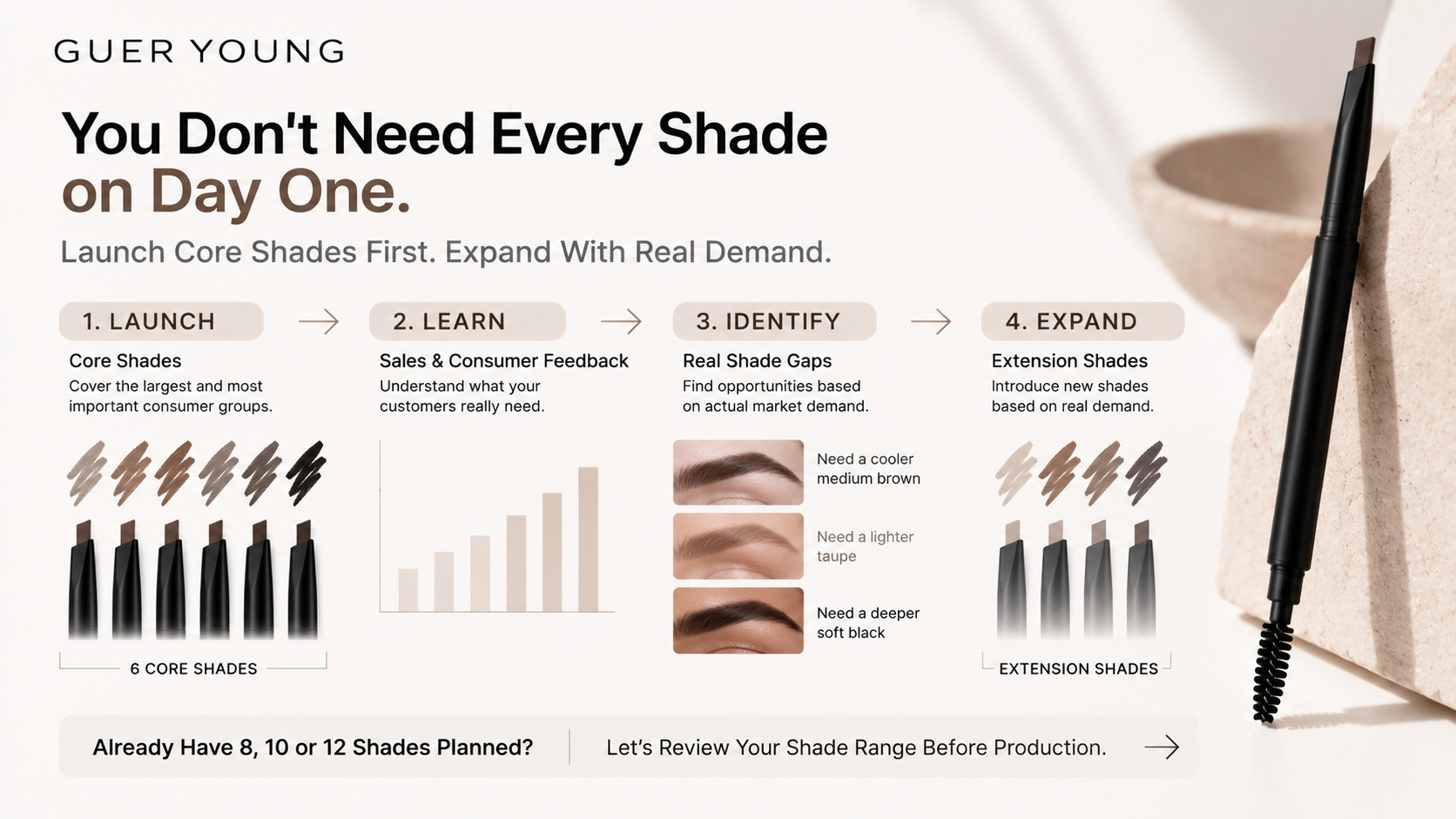
Instead of trying to predict every possible need before launch, the range grows based on actual demand.
Already Have 8, 10, or 12 Shades Planned?
You don't necessarily need to remove them.
But before turning every proposed color into a production SKU, it is worth reviewing:
Shade overlap
Depth distribution
Warm, neutral, and cool undertone coverage
Hair-color relevance
Core vs. Extension Shade potential
This is where working with an experienced eyebrow pencil manufacturer can add value beyond simply reproducing reference colors.
If you're developing a private label eyebrow pencil, GUER YOUNG can work with your existing shade references or proposed range to evaluate overlaps, undertone gaps, and consumer coverage before you finalize the assortment.
The objective isn't automatically to reduce the number of shades.
It's to make sure every SKU has a clear job to do.
So, How Many Eyebrow Pencil Shades Should Your Brand Launch?
There is no universal number.
For one brand, four well-planned shades may be enough.
For another, six or eight may provide better coverage. A broader range may also make sense when the target market and consumer data support it.
What matters isn't whether your competitor offers 6, 10, or 12 shades.
What matters is whether your own eyebrow pencil shade range covers the right consumers without unnecessary overlap.
Before finalizing your next custom brow pencil range, ask:
Who does each shade serve?
Is the difference noticeable on the brows?
Does it fill a real gap in depth or undertone?
Should it be a Core Shade now—or an Extension Shade later?
Those questions can lead to a stronger launch strategy than simply matching a competitor's shade count.
The goal isn't to give your range more shades.
It's to give every shade a reason to exist.
Already Have Your Shade Range Planned?
If you already have 6, 8, 10, or 12 shades in mind, we can help you review shade overlap, undertone coverage, and potential gaps before you finalize the range.
→ Review Your Eyebrow Pencil Shade Range With Us


andy.li@gueryoung.com

We have 10 years of experience, focusing on the development and sales of high quality eyelash growth serum, mascara, eyebrow gel, eyebrow color and other products. We also offer custom services, from tube
design to cosmetic fillings and packaging


Room 1, C3 Factory Building, No.8803 Zhuhai Avenue, Lianwan Industrial Zone, Pingsha Town, Gaolan Port Economic Zone, Zhuhai, Guangdong,China
QUICK LINKS
D Zone,5/F, NO.8 CuiZhu 5th Street,
Qianshan Xiangzhou District,Zhuhai,
Guangdong,China,519070

lynn.zhou@gueryoung.com
winnie.zhong@gueryoung.com
niki.xu@gueryoung.com