
How Much Budget Do You Need for a Private Label Cosmetics Brand? A Low-Risk Startup Guide for Amazon Sellers
Read in English | Lire en Français | Leer en Español | Lesen auf Deutsch
For many Amazon sellers entering the beauty industry, launching a Private Label cosmetics brand has become one of the most effective ways to build long-term brand value and improve profit margins.
However, before choosing products or designing packaging, most sellers face two critical questions:
How much budget is actually required to launch a private label cosmetics brand?
How can you avoid inventory risks and protect your cash flow?
These concerns are especially common in high-demand categories such as mascara, eyelash growth serums, and brow gels. Without a clear understanding of OEM manufacturing, MOQ requirements, and cost structures, many sellers delay their launch or make expensive mistakes.
In this guide, we'll break down the real costs, common risks, and practical OEM strategies that help Amazon sellers enter the beauty market with confidence.
Why Many Amazon Sellers Hesitate to Launch a Private Label Cosmetics Brand
For most new sellers, the biggest challenge isn't product development—it's uncertainty.
Unclear Startup Costs
If you've researched private label cosmetics online, you've probably seen wildly different numbers.
Some suppliers claim you can start with $3,000.
Others suggest you need $20,000 or more.
The truth is that your startup budget depends on several factors:
Product category
Minimum Order Quantity (MOQ)
Packaging complexity
Formula customization
Shipping method
Without understanding these variables, it's difficult to create an accurate budget.
Fear of Excess Inventory
Amazon success depends heavily on inventory management.
Ordering too much inventory before validating demand can lead to:
Higher FBA storage fees
Slower inventory turnover
Cash flow pressure
For new brands, excess inventory often creates bigger problems than advertising costs.
Lack of Supply Chain Support
Many manufacturers only provide production services.
They may not assist with:
Packaging design
Label compliance
Regulatory documentation
Logistics coordination
As a result, sellers are forced to manage multiple vendors, increasing complexity and extending launch timelines.
Why Most New Beauty Brands Fail Within Their First Year
Many sellers believe brands fail because of poor advertising, intense competition, or insufficient budget.
In reality, most failures follow predictable patterns.
Too Many SKUs Too Early
Many sellers attempt to launch multiple products at once, such as:
Mascara
Eyelash Growth Serum
Brow Gel
Eyeliner
Lip Gloss
Foundation
While this may seem like a growth strategy, it often leads to:
Higher procurement costs
Increased packaging expenses
More complex inventory management
Fragmented advertising budgets
For new brands, every additional SKU increases the cost of testing and validation.
The most successful beauty brands typically start with one to three hero products before expanding.
Oversized First Orders
To achieve lower unit costs, some sellers place initial orders of 3,000 to 5,000 units.
However, at this stage:
Market demand has not been validated.
Listing conversion rates are unknown.
Customer feedback has not been collected.
Large inventory purchases before validation significantly increase business risk.
In many cases, inventory problems are not caused by weak sales—they are caused by premature purchasing decisions.
Advertising Cannot Fix a Product-Market Fit Problem
Many Amazon sellers experience situations where:
Click-through rates are healthy
Ad impressions are strong
CPC remains reasonable
Yet sales remain disappointing.
The issue is often not advertising.
Instead, the real challenges may include:
Weak product differentiation
Unclear value proposition
Insufficient market demand
Incorrect product positioning
Advertising amplifies product strengths—it does not create them.
For private label cosmetics brands, product validation should always come before aggressive advertising investment.
What Does a Private Label Cosmetics Budget Actually Include?
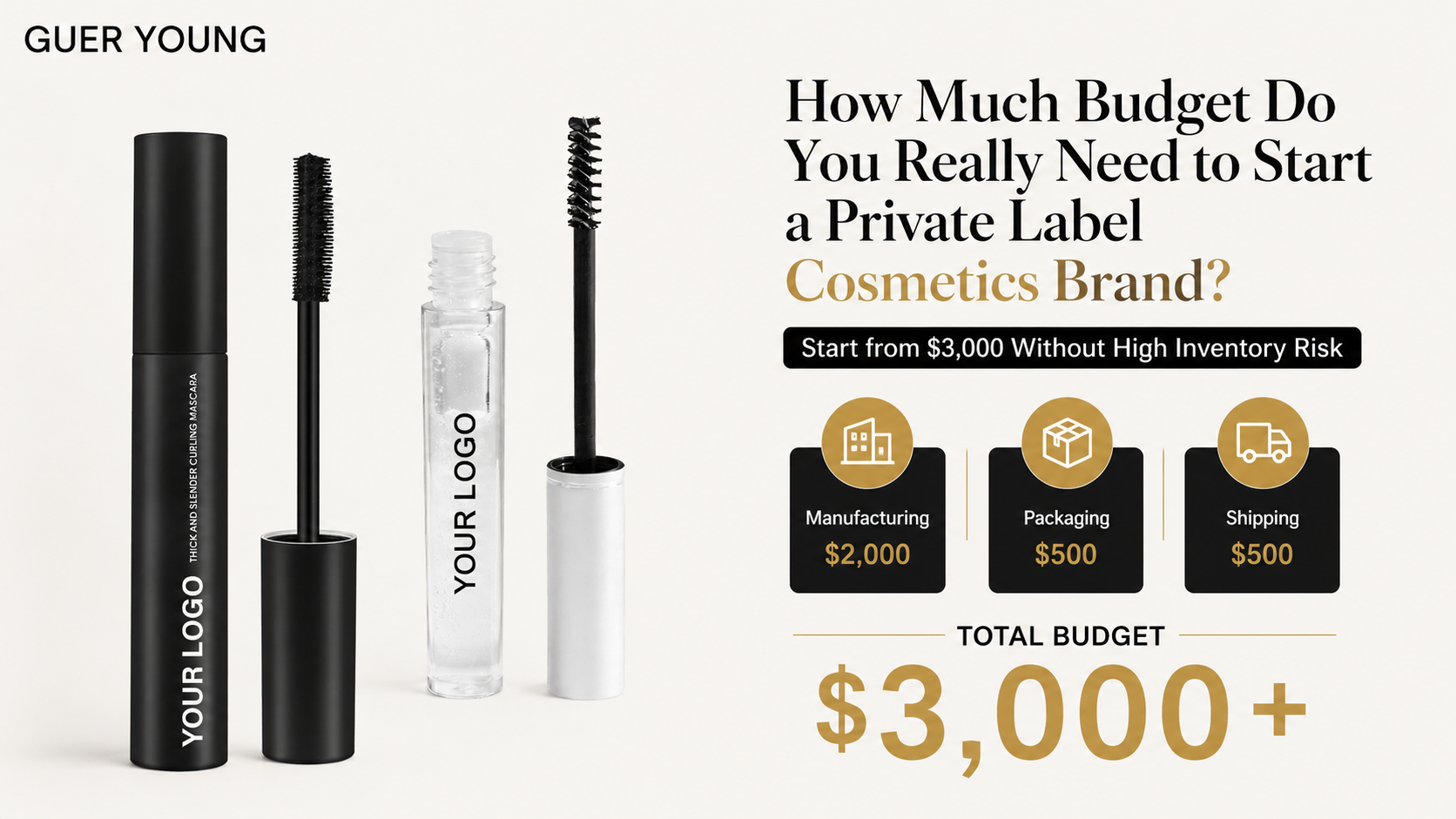
For products such as mascara, eyelash serums, and brow gels, startup costs generally fall into three categories.
Product Manufacturing Costs
These include:
Raw materials
Packaging components
Filling and production
Quality testing
Costs vary significantly depending on the formula.
For example:
Products sourced from a Private Label Mascara Manufacturer typically fall into the low-to-mid cost range.
Products from a Private Label Eyelash Serum Supplier often cost more due to active ingredients and specialized formulations.
Branding and Packaging Design
For Amazon sellers, branding is not optional.
Key expenses include:
Logo design
Label artwork
Retail packaging design
This category typically represents 10%–20% of the total startup budget.
International Shipping and Customs
Shipping costs are frequently underestimated.
Generally:
Air freight is ideal for market testing.
Ocean freight becomes more cost-effective for ongoing replenishment.
Shipping expenses directly impact profitability and should always be included in budget planning.
How OEM Manufacturing Helps Reduce Inventory and Financial Risk
For new brands, reducing risk is often more important than achieving the lowest unit price.
Experienced OEM manufacturers typically recommend the following approach.
Start with Core Products
Avoid launching ten products at once.
Instead, focus on proven categories such as:
Mascara
Eyelash Growth Serum
Brow Gel
This is one of the most common strategies used in the Amazon Private Label Cosmetics market.
Validate Demand with Small Orders
Instead of ordering 5,000 units immediately, start with 500–1,000 units.
This allows sellers to:
Test market demand
Measure listing conversion rates
Collect customer reviews
Improve product positioning
Small-batch testing significantly reduces inventory risk.
Work with a One-Stop OEM Partner
Manufacturers that provide development, design, and production under one roof can dramatically simplify the launch process.
GUER YOUNG has specialized in eyelash growth serum, mascara, and brow gel manufacturing for over a decade, offering complete OEM solutions from product planning to filling and packaging production.
What Problems Can the Right OEM Partner Solve?
For Amazon sellers, choosing an OEM partner is not simply about finding a factory.
It's about solving critical business challenges.
Better Budget Control
Using proven formulas, existing packaging resources, and flexible MOQ options helps reduce upfront investment and avoid unnecessary costs.
Lower Inventory Risk
Small trial orders, phased replenishment plans, and strategic product selection allow sellers to validate demand before scaling.
Faster Time-to-Market
A one-stop production process reduces communication delays and helps new products launch faster.
Consistent Product Quality
Strong quality control systems help reduce negative reviews, returns, and account-related risks.
Long-Term Supply Chain Stability
GUER YOUNG specializes in:
Eyelash Growth Serum OEM
Mascara OEM Manufacturing
Brow Gel Private Label
With more than 10 years of industry experience, a complete production system, and partnerships with over 100 beauty brands worldwide, the company helps sellers build scalable and reliable supply chains.
Industry Budget Models: How Much Does It Really Cost?
The following examples are based on industry averages and simulation models.
Scenario A: Market Testing Model
Product Portfolio:
Mascara × 500 Units
Estimated Budget:
Manufacturing: $1,500–$2,500
Packaging Design: $300–$800
Shipping: $500–$1,000
Total Investment:
Approximately $3,000–$5,000
Best For:
First-time Amazon beauty sellers validating a new market opportunity.
Scenario B: Brand Launch Model
Product Portfolio:
Mascara
Eyelash Growth Serum
Brow Gel
500–1,000 Units Per Product
Estimated Budget:
Manufacturing: $4,000–$7,000
Packaging Design: $1,000–$2,000
Shipping: $1,000–$3,000
Total Investment:
Approximately $6,000–$12,000
Best For:
Sellers focused on building long-term brand equity.
Industry Insights
Based on industry purchasing trends, beauty brands using a Low MOQ Cosmetics Manufacturer model typically reduce inventory risk by 30%–50% compared with traditional bulk purchasing strategies.
Additional observations include:
Brands with 1–3 core SKUs often achieve better capital efficiency.
Initial orders of 500–1,000 units provide stronger validation opportunities.
Scaling advertising after product validation typically produces more stable ROI.
For new brands, efficient use of capital is usually more important than securing the lowest unit cost.
Your Next Step as an Amazon Seller
If you're planning to enter the beauty market, consider the following roadmap:
Select your target product category.
Define a realistic startup budget.
Choose an experienced OEM cosmetics manufacturer.
Start with a low-MOQ trial order.
Collect market feedback and customer reviews.
Scale inventory gradually based on proven demand.
Remember one key principle:
Validate the product before scaling inventory. Validate the market before scaling advertising.
Most successful beauty brands are not built through massive initial purchases. They grow through controlled testing, continuous optimization, and smart supply chain decisions.
If you're evaluating a private label cosmetics project, GUER YOUNG can provide product recommendations, budget planning, packaging solutions, and OEM manufacturing support to help you enter the global beauty market with lower risk and faster execution.


andy.li@gueryoung.com

We have 10 years of experience, focusing on the development and sales of high quality eyelash growth serum, mascara, eyebrow gel, eyebrow color and other products. We also offer custom services, from tube
design to cosmetic fillings and packaging


Room 1, C3 Factory Building, No.8803 Zhuhai Avenue, Lianwan Industrial Zone, Pingsha Town, Gaolan Port Economic Zone, Zhuhai, Guangdong,China
QUICK LINKS
D Zone,5/F, NO.8 CuiZhu 5th Street,
Qianshan Xiangzhou District,Zhuhai,
Guangdong,China,519070

lynn.zhou@gueryoung.com
winnie.zhong@gueryoung.com
niki.xu@gueryoung.com