
Managing an Eyebrow Pencil OEM Project? What Risks Should Brands Consider Throughout Production?

Read in English | Lire en Français | Lesen auf Deutsch | Leer en Español | Leggi in Italiano | Lees in het Nederlands
A successful eyebrow pencil launch depends on more than product quality.
Behind every finished cosmetic product is a complex OEM development process involving multiple teams, product decisions, components, and production stages.
For European beauty brands, managing this process effectively is essential because a cosmetic project often involves many connected elements:
Product requirements;
Formula development;
Packaging coordination;
Component matching;
Production planning;
Final delivery.
Many project delays do not happen because a product cannot be manufactured.
They happen because information, decisions, and production requirements are not connected properly throughout the development journey.
For brands working with an eyebrow pencil OEM manufacturer, the key challenge is not only creating a product that meets expectations.
It is building a reliable process that allows the product concept to move smoothly from development into commercial production.
A professional OEM workflow should connect five important stages:
Approved Sample Transfer → Pre-production Alignment → Component Matching → Mass Production Execution → Final Delivery
Each stage has potential risks.
Understanding these risks helps brands communicate more effectively with suppliers and build stronger long-term cooperation.
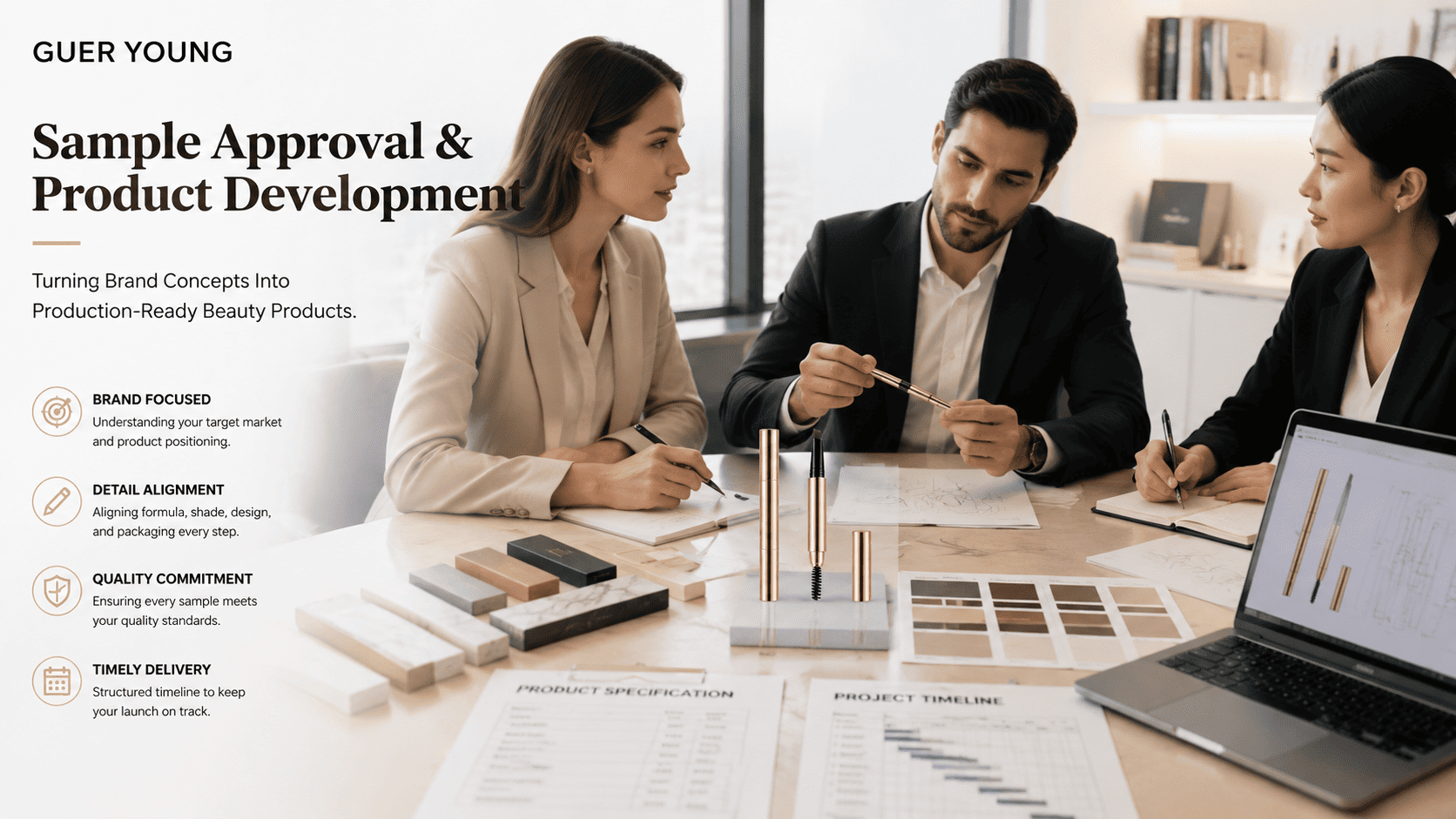
Risk 1: Approved Sample Transfer
When product expectations are not clearly transferred into production requirements
The Approved Sample represents an important milestone in product development.
It reflects the brand’s expectations for:
Product appearance;
Application experience;
Packaging direction;
Overall product positioning.
However, the challenge after approval is ensuring that the product requirements are clearly transferred into the next development stages.
A cosmetic product involves different teams, including:
Product development;
Production;
Packaging;
Quality management.
If each team does not work from the same understanding, project efficiency can be affected.
For example:
A product requirement discussed during development may not be fully reflected in production preparation.
A packaging decision may not be synchronized with component planning.
A product detail that is important to the brand may not receive enough attention during later stages.
A professional cosmetic OEM manufacturer should have a clear process to organize approved product information and ensure that all teams are working toward the same target.
The goal is not only to create a successful sample.
The goal is to create a clear foundation for the entire OEM project.
Risk 2: Pre-production Alignment
When production preparation starts before the project is fully coordinated
Pre-production is the stage where product development decisions become ready for manufacturing.
This stage requires close coordination between the brand and the supplier.
Important elements include:
Final product specifications;
Packaging preparation;
Material planning;
Production schedule;
Project timeline.
For European beauty brands, product launches are often connected with marketing campaigns, retail plans, and seasonal opportunities.
A delay in production preparation can affect the entire launch schedule.
Common challenges include:
Product information requiring further confirmation;
Packaging details not being synchronized;
Production timelines needing adjustment;
Different teams working with different versions of information.
A professional eyebrow pencil factory should help brands organize the transition from development to production preparation.
Effective pre-production management allows potential problems to be identified before they influence manufacturing.
For brands, the key is not simply asking:
“Can the supplier produce this product?”
It is understanding:
“How does the supplier prepare a project before production begins?”
Risk 3: Component Matching
When individual parts do not create the expected final product experience
An automatic eyebrow pencil is a complete product system.
It combines multiple elements:
Pencil core;
Barrel;
Retractable mechanism;
Cap;
Brush components;
Packaging.
Each component may perform correctly on its own.
However, the final product experience depends on how all components work together.
Potential risks include:
Product components not fitting together properly;
Packaging affecting usability;
Mechanical structure influencing consumer experience;
Assembly requirements not being considered early enough.
For an automatic eyebrow pencil OEM project, component matching is an important part of product development.
A professional supplier should evaluate the complete product instead of treating each component as an independent part.
This requires coordination between:
Product design;
Component selection;
Packaging development;
Manufacturing teams.
The question brands should consider is:
Does the supplier understand the complete product system, or only individual production tasks?
A successful cosmetic product is created when all elements work together.
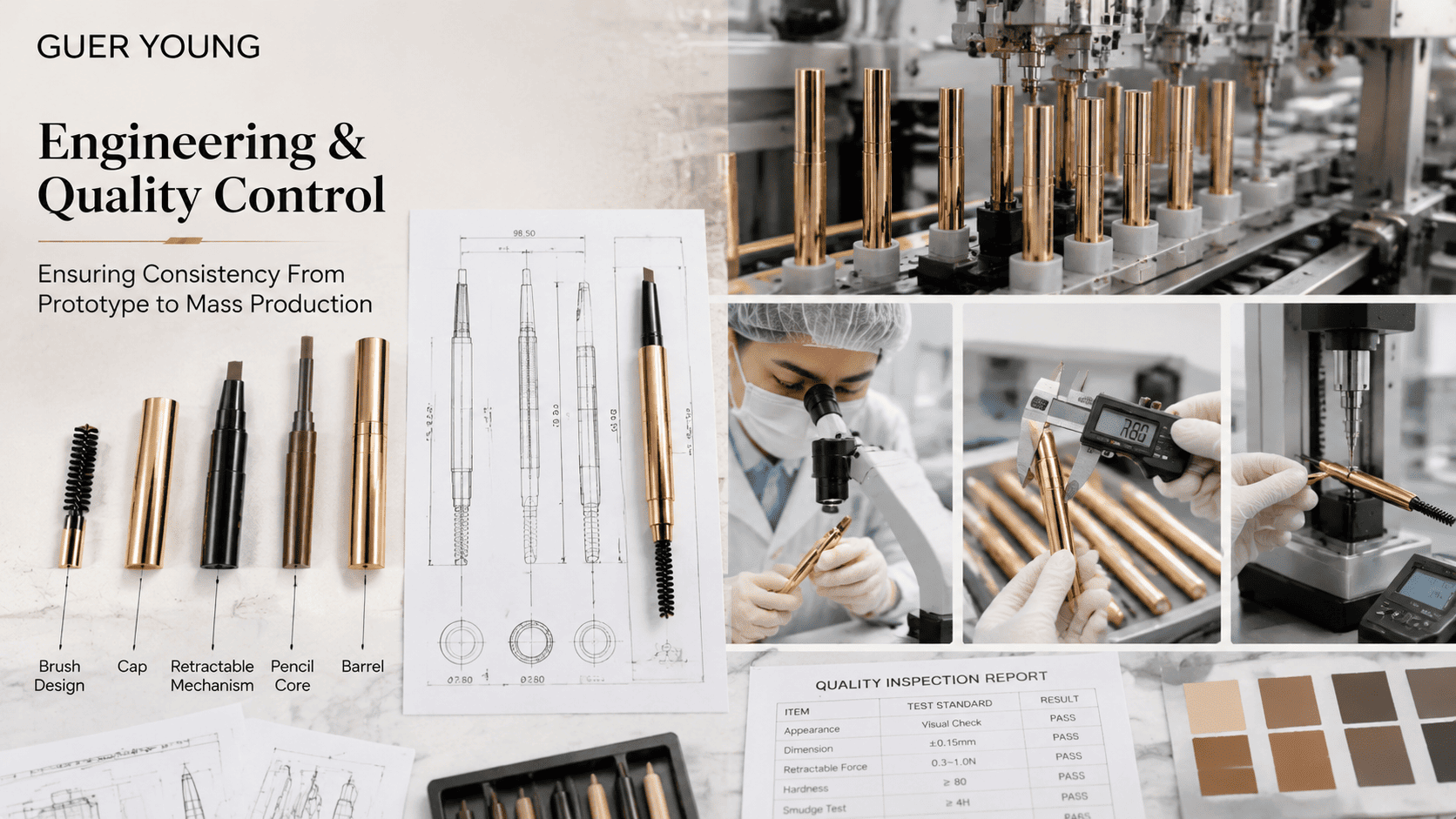
Risk 4: Mass Production Execution
When a development concept needs to become a repeatable production process
Moving from development to mass production requires strong project execution.
At this stage, the focus changes from creating the product concept to managing the production process.
A reliable OEM partner needs to coordinate:
Production progress;
Internal communication;
Manufacturing schedules;
Product information.
As production volume increases, project management becomes increasingly important.
A product that works well during development still requires effective coordination to achieve successful commercial production.
For example:
A change in one project area may influence another area.
Packaging updates may affect production preparation.
Product decisions may influence manufacturing arrangements.
This is why a professional reliable cosmetic supplier should have strong project coordination capability.
The purpose of mass production management is not only completing manufacturing.
It is ensuring that the original product vision remains consistent throughout the production journey.
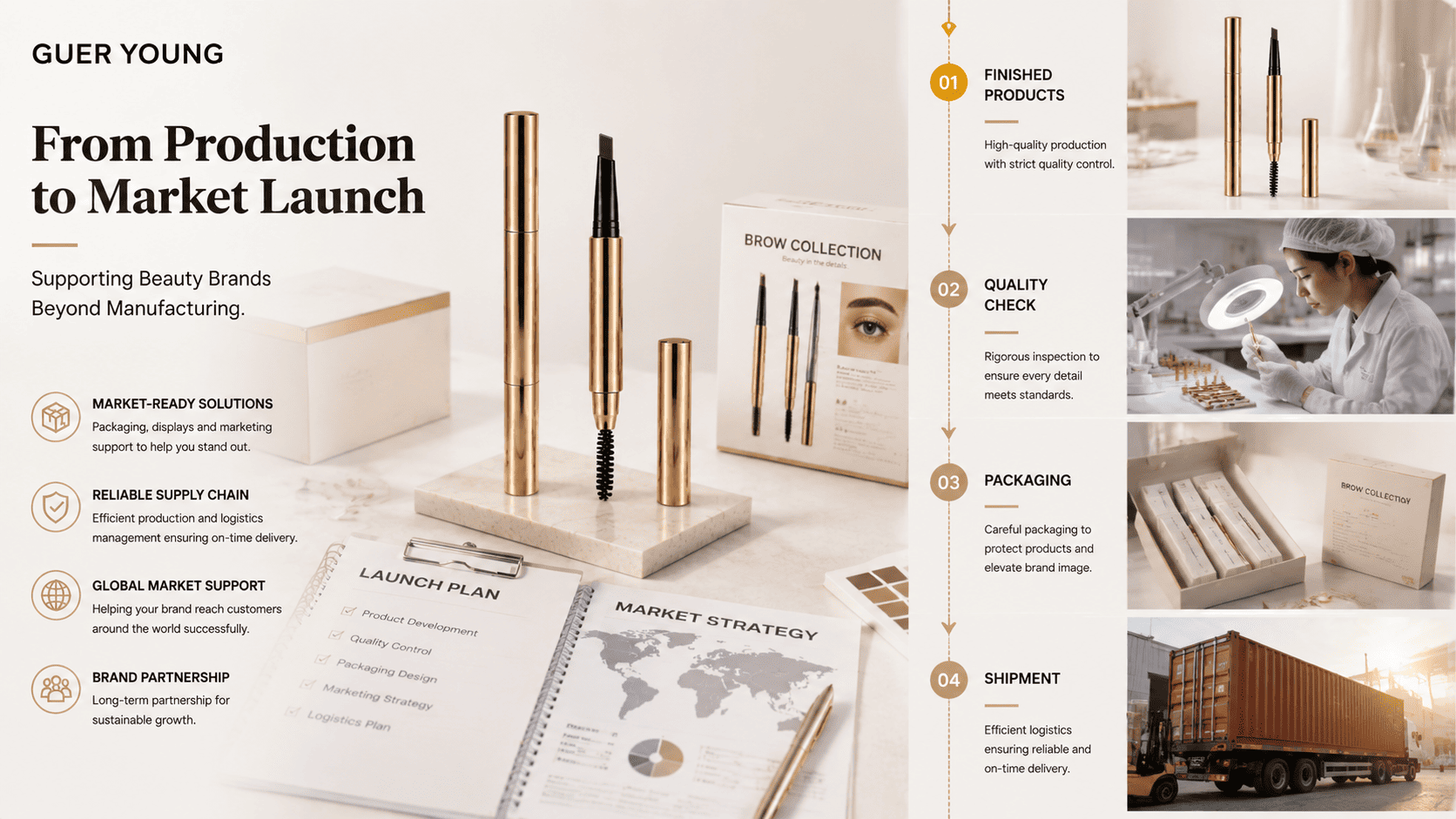
Risk 5: Final Delivery
When the last stage affects the brand launch plan
Final delivery is the connection between manufacturing completion and market launch.
For beauty brands, receiving products on time is not the only consideration.
The products also need to arrive according to the agreed project requirements.
Important areas include:
Product readiness;
Packaging completion;
Shipment coordination;
Delivery planning.
A delayed or poorly coordinated delivery can influence:
Marketing activities;
Retail schedules;
Inventory planning;
Customer expectations.
A professional makeup manufacturer understands that delivery is not simply the final logistics step.
It is part of protecting the brand’s market strategy.
A strong OEM partner supports the complete journey from initial development to final product delivery.
European Beauty Brand Eyebrow Pencil OEM Case Study: Building a More Controlled Development Process
A European independent beauty brand planned to develop a new automatic eyebrow pencil collection.
The brand wanted a product that matched its market positioning:
Natural makeup style;
Convenient application;
Premium packaging appearance;
Multiple shade options.
During the development stage, the brand focused on creating a product that matched consumer expectations.
However, as the project moved forward, the team recognized that successful product development required more than a good product idea.
They needed a partner who could help coordinate the entire OEM process.
The main challenge was connecting different project stages effectively:
Product requirements needed to be clearly communicated;
Packaging and components needed to be coordinated;
Production preparation needed to follow the development plan;
Final delivery needed to support the launch schedule.
GUER YOUNG supported the project through a structured OEM management approach.
The cooperation included:
Product Requirement Coordination
The project expectations were organized clearly to support future production.
Pre-production Planning
Product information, packaging details, and manufacturing preparation were aligned.
Component Development Support
The product structure and components were reviewed together to support the final user experience.
Production Coordination
The project progress was managed throughout the manufacturing process.
Final Delivery Preparation
The finished products were prepared according to the agreed project requirements.
Through a more organized OEM process, the brand successfully moved from product development into market-ready production.
The cooperation later expanded into additional color cosmetics projects, including:
Eyeliner;
Lip liner;
Other makeup collections.
GUER YOUNG became a long-term OEM partner supporting the brand’s future product development.
How a Structured OEM Process Creates Long-Term Brand Value
For growing European beauty brands, a successful OEM partnership is not only about manufacturing products.
The real value comes from having a partner that can help manage complexity throughout the development journey.
A structured OEM process helps brands:
Reduce Project Uncertainty
Clear communication and organized workflows help reduce unexpected changes during development and production.
Improve Development Efficiency
Better coordination between product, packaging, and manufacturing stages helps brands move faster toward market launch.
Support Future Product Expansion
A capable OEM partner can support brands as they develop additional products, such as:
Eyebrow pencils;
Eyeliners;
Lip liners;
Other color cosmetics.
Build Long-Term Cooperation
The strongest supplier relationships are built through consistent communication, reliable execution, and continuous support.
For European beauty brands, the right OEM partner is not simply a manufacturer.
It is a long-term product development partner that helps transform ideas into successful market products.
If you are developing:
Eyebrow pencils;
Eyeliners;
Lip liners;
or other color cosmetics projects, GUER YOUNG provides OEM/ODM support from product development and project coordination to production management and final delivery.


andy.li@gueryoung.com

We have 10 years of experience, focusing on the development and sales of high quality eyelash growth serum, mascara, eyebrow gel, eyebrow color and other products. We also offer custom services, from tube
design to cosmetic fillings and packaging


Room 1, C3 Factory Building, No.8803 Zhuhai Avenue, Lianwan Industrial Zone, Pingsha Town, Gaolan Port Economic Zone, Zhuhai, Guangdong,China
QUICK LINKS
D Zone,5/F, NO.8 CuiZhu 5th Street,
Qianshan Xiangzhou District,Zhuhai,
Guangdong,China,519070

lynn.zhou@gueryoung.com
winnie.zhong@gueryoung.com
niki.xu@gueryoung.com