
Mascara Clumping: How to Avoid Bad Reviews Before You Order
Read in English | Lire en Français | Lesen auf Deutsch | Leer en Español
A mascara may look great in product photos, but if customers receive a formula that creates clumpy, stuck-together lashes, the experience can quickly fall short of expectations. For e-commerce sellers and beauty brands, this can mean negative reviews, customer complaints, and additional costs associated with returns or product replacement.
The challenge is that mascara clumping is not always obvious when evaluating a product from its appearance alone. A sample may deliver a smooth finish after one coat but become difficult to control when layered. The brush may look attractive yet pick up too much formula, or the tube wiper may not remove excess product effectively.
For sellers sourcing finished mascara, the goal is not simply to find a product that looks appealing. It is to select a mascara that delivers the intended lash effect consistently and suits the expectations of the target market.
This guide explains how to identify potential clumping problems, evaluate finished mascara samples, and reduce product-selection risks before placing a bulk order.
1. Why Can Mascara Clumping Lead to Negative Reviews?
1.1 The Actual Result Does Not Match the Product Promise
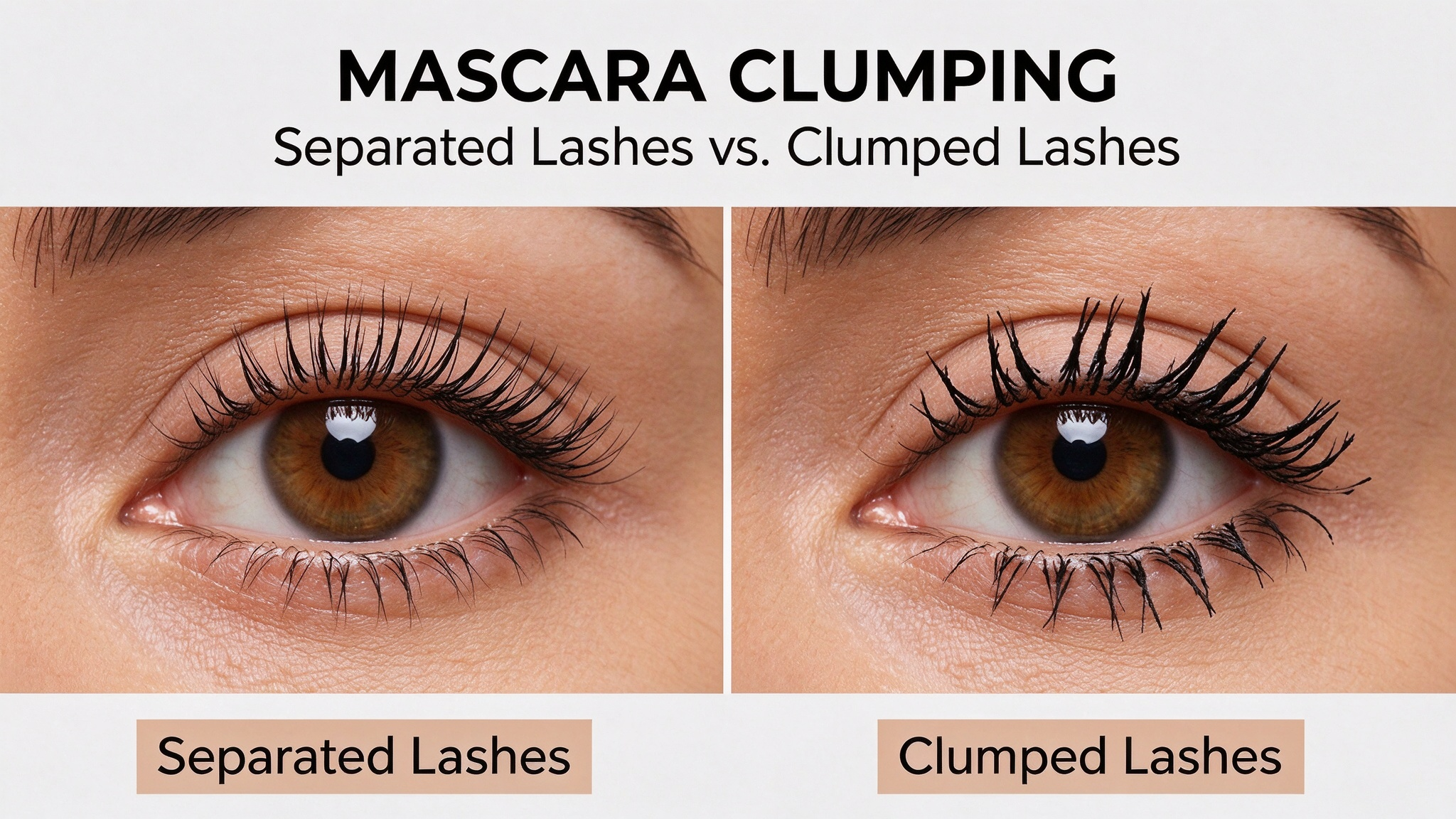
Customers choose mascara for specific results, such as longer-looking lashes, added volume, visible separation, or a natural everyday finish. When the product creates thick deposits or makes lashes stick together, the result may not match the images and claims that influenced the purchase.
For e-commerce sellers, this gap between expectation and experience can become a commercial problem. Customers may describe the product as difficult to apply, too thick, or unsuitable for everyday use.
Before selecting a finished mascara, define the result your product page will promise. A natural defining mascara should provide controlled application and visible separation, while a volumizing mascara should create fuller-looking lashes without excessive buildup.
The goal is not to eliminate every trace of product texture. It is to ensure that the actual result matches the intended product positioning.
1.2 A Good First Coat Does Not Guarantee a Good Final Result
One of the risks of evaluating mascara too quickly is judging it only after the first application.
Some formulas apply smoothly at first but become uneven when customers add another coat to increase volume or length. Others may distribute well on longer lashes but deposit too much product on shorter lashes or around the corners of the eyes.
This matters when selecting products for online stores because customers may use mascara differently from the person who tested the initial sample.
During evaluation, compare the result after one coat and after additional coats. Look for visible clumps, lashes sticking together, uneven deposits, and changes in application control.
A sample should be assessed according to its intended use, not just its best-looking first impression.
1.3 Product Complaints May Have More Than One Cause
Mascara clumping can result from several factors, including formula consistency, brush design, excessive product pickup, and application technique.
For example, a brush that carries too much formula may leave thick deposits even when the formula itself spreads reasonably well. A formula that builds up quickly may also require a brush that provides better separation.
Sellers should avoid assuming that every clumping complaint has the same cause. Instead, look for recurring patterns in customer feedback and use sample testing to investigate whether the problem is related to the formula, brush, packaging structure, or instructions for use.
Understanding the likely cause makes it easier to choose a more suitable replacement or alternative product.
2. What Should Sellers Check to Reduce Mascara Clumping?
2.1 Formula Consistency and Buildability
Formula consistency affects how mascara spreads across individual lashes. If too much product accumulates in one area, lashes may stick together and appear heavy or uneven.
A thicker formula is not automatically a poor choice. Volumizing mascaras may intentionally deposit more product to create a dramatic effect. The important question is whether the formula remains manageable during normal application.
When testing samples, check:
Whether the formula spreads evenly across the lashes
Whether individual lashes remain distinguishable
Whether the first coat creates the intended effect
Whether a second coat adds volume without excessive buildup
Whether the formula becomes difficult to control during application
Compare these results with your planned product positioning. If your customers prefer natural everyday makeup, a formula that requires considerable effort to separate the lashes may be unsuitable. For a dramatic product, stronger volume may be acceptable as long as the finish remains consistent with the product's intended claims.
2.2 Brush Design and Product Pickup
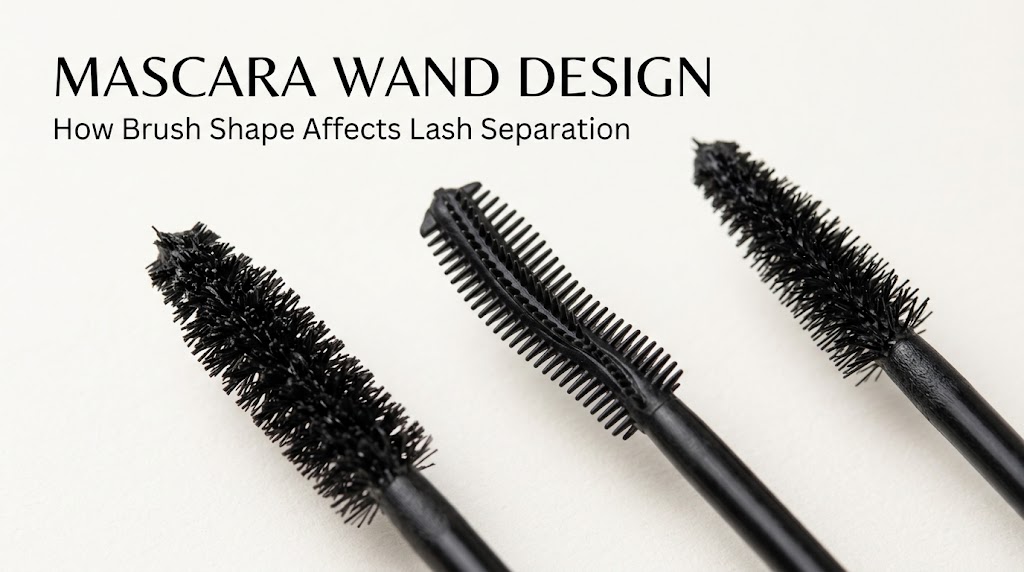
The brush influences how much formula reaches the lashes and how evenly it is distributed.
Dense brushes may help create fuller-looking lashes, while separation-focused brushes may help define individual lashes. Curved or tapered designs can support more controlled application in certain areas, depending on their dimensions and construction.
However, brush shape alone does not determine performance. Bristle density, spacing, brush diameter, formula consistency, and the amount of product carried by the wand all contribute to the final result.
| Brush design | Potential benefit | What to evaluate |
Straight brush | Broad, straightforward application | Coverage and product distribution |
Curved brush | Application along the lash line | Control and consistency across lashes |
Tapered brush | Access to shorter lashes and corners | Precision and excess product pickup |
Dense brush | Fuller-looking lashes | Volume versus lash separation |
Silicone separation brush | Defined-looking lashes | Separation and formula distribution |
When comparing finished mascara samples, evaluate the brush together with the formula rather than choosing a design based only on appearance.
2.3 The Tube Wiper and Packaging Structure
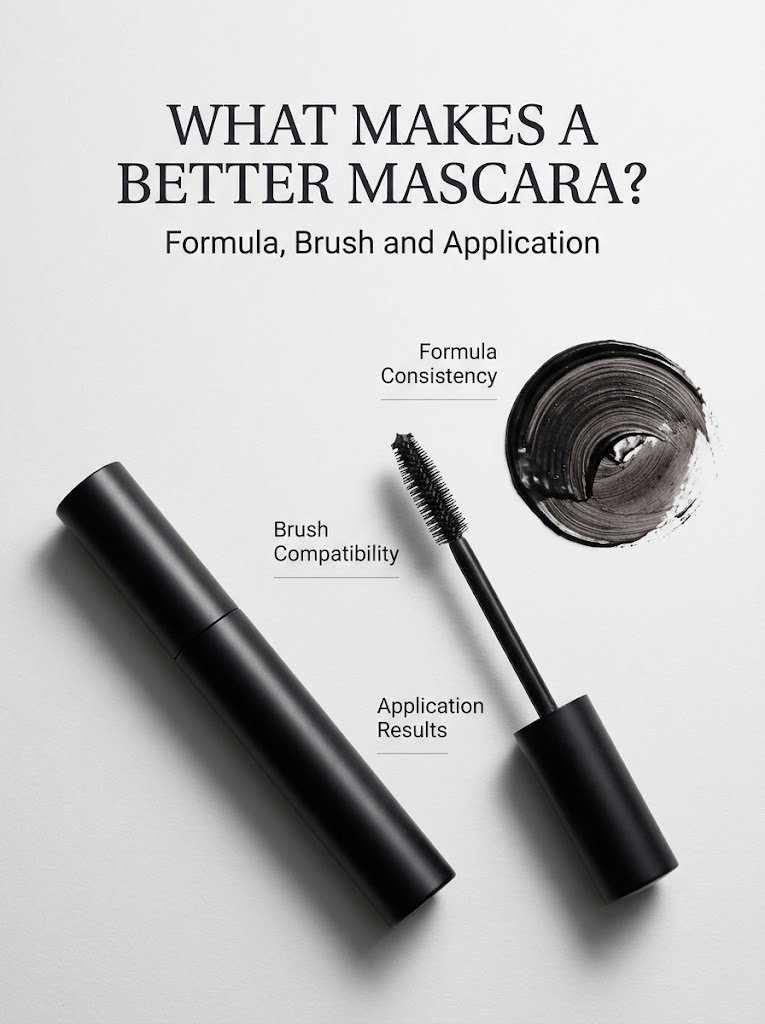
The tube opening and wiper affect how much formula remains on the brush after it is removed from the tube.
If the wiper removes too little product, the brush may carry excessive formula and deposit too much on the lashes. If it removes too much, application may become less efficient or require repeated dipping.
The appropriate balance depends on the formula, wand dimensions, and intended lash effect.
During sample testing, observe how much product remains on the wand, whether excess formula collects around the tip, and whether the amount of product appears consistent across repeated applications.
Also check the tube opening and closure for visible residue or leakage. These checks do not replace formal quality-control testing, but they can help identify issues that deserve further investigation before ordering.
For private label mascara projects, the formula, brush, wiper, and packaging should be evaluated as a complete finished product. Changing one component may affect the overall application experience.
3. How Can E-Commerce Sellers Test Mascara Samples Before Ordering in Bulk?
3.1 Use the Same Application Method for Every Sample
A consistent testing method helps sellers compare products more objectively. If samples are applied differently, it becomes difficult to determine whether one product genuinely performs better than another.
For each sample:
Apply one coat and record the initial coverage and lash separation.
Allow the product to set according to its intended use instructions.
Apply a second coat and observe whether clumping increases.
Check whether the brush deposits too much product in particular areas.
Record the final appearance and any application difficulties.
If the product is intended to be buildable, assess whether additional coats create the expected improvement in volume or length.
Where possible, repeat the test to check whether the result is reasonably consistent. Use suitable application tools and follow appropriate hygiene practices when evaluating cosmetics.
3.2 Use a Practical Clumping Evaluation Checklist
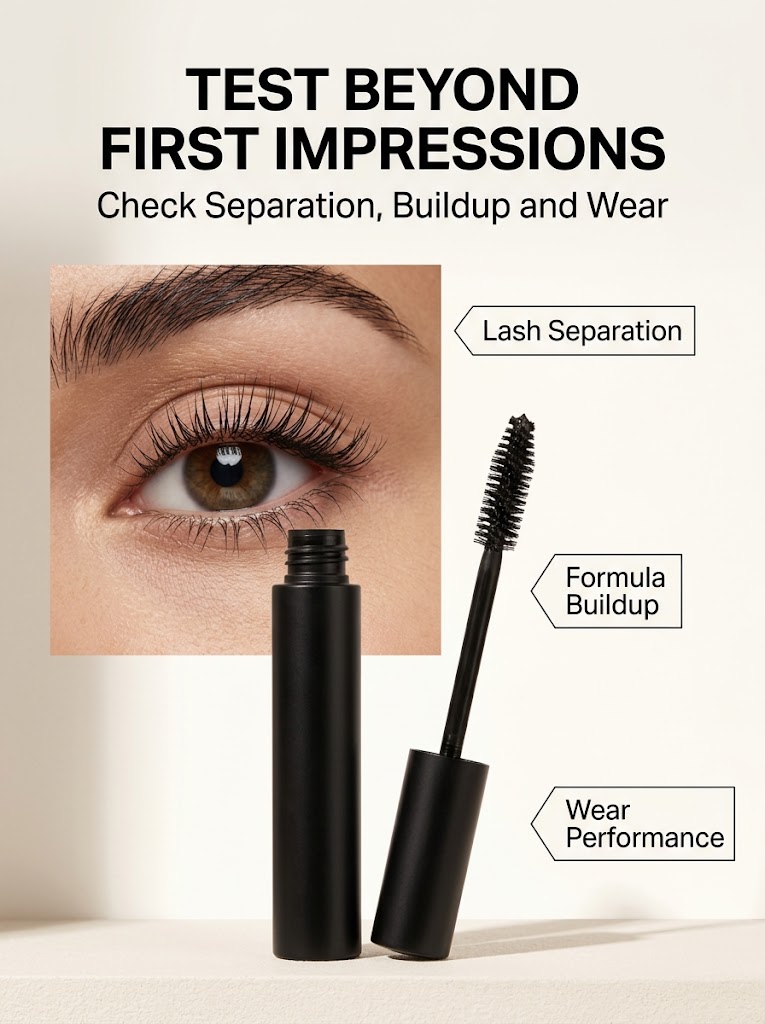
Instead of relying on a general impression, record specific observations for each sample.
| Test area | What to check | Why it matters |
First coat | Smooth application and visible separation | Establishes the initial result |
Second coat | Buildup and lashes sticking together | Reveals layering problems |
Brush pickup | Excess formula on the wand | Helps identify possible brush or wiper issues |
Lash coverage | Uneven deposits across different areas | Shows how consistently the formula is distributed |
Application control | Difficulty reaching or separating lashes | Indicates whether the product suits its intended user |
Packaging | Wiper fit, closure, and visible leakage | Helps identify structural concerns |
Product specifications | Approved formula, brush, and components | Provides a reference for the bulk order |
The purpose of this checklist is to identify potential risks, not to guarantee that future customers will never experience clumping. Actual results can vary with lash characteristics, application habits, and product use conditions.
3.3 Confirm the Approved Sample Before Production
Once a sample meets your expectations, document the version you have approved.
Record the relevant product reference, formula or product specification, brush design, tube and wiper components, and agreed customization details. Ask the supplier how these specifications will be managed during bulk production and what quality checks are available.
If any component changes after approval, clarify whether another sample or additional evaluation is needed.
This step is particularly important for private label products, where buyers may customize branding or packaging while expecting the underlying application performance to remain consistent.
A clearly documented sample provides a shared reference for both the buyer and supplier before production begins.
4. How Should Sellers Choose a Finished Mascara for Their Online Store?
4.1 Start With the Customer and Product Positioning
The best mascara is not necessarily the one with the most dramatic result or the most distinctive brush. It is the product that meets the needs of the customers you want to reach.
For example:
Everyday makeup customers may prioritize easy application and defined lashes.
Customers seeking fuller-looking lashes may prefer stronger volume and buildable coverage.
Shoppers looking for a precision effect may prefer a brush that reaches shorter lashes and corners more easily.
Define the intended effect before comparing samples. This makes it easier to judge whether a formula and brush combination supports your product positioning.
4.2 Balance Product Performance With Commercial Requirements
A mascara can perform well in testing but still be unsuitable for a particular business if the order requirements do not fit the seller's plans.
Before confirming an order, review the minimum order quantity, target price, packaging options, logo customization, production lead time, and relevant product documentation. Requirements and available options vary by product and target market, so confirm the details for the specific mascara you intend to sell.
For new sellers, a manageable initial order and a clear sample approval process may be particularly useful. For established brands expanding an existing range, consistency with the current product line may be more important.
The right choice should balance customer expectations, product performance, and commercial feasibility.
4.3 Work With a Finished Cosmetics Supplier That Supports Evaluation
For e-commerce sellers and growing beauty brands, a finished cosmetics supplier can help compare available products, discuss brush and formula options, and clarify customization requirements before production.
GUER YOUNG provides finished eye makeup solutions for beauty brands and e-commerce sellers, including mascara products and private label OEM/ODM services. Buyers can discuss their target customers, preferred lash effects, packaging choices, and order requirements before selecting a suitable product.
Rather than choosing a mascara based only on product photos, sellers can use sample evaluation and agreed specifications to make a more informed purchasing decision.
Final Thoughts
Before placing your next bulk mascara order, test samples for clumping, lash separation, product buildup, and consistency across multiple applications. Compare the results with your target customers’ expectations, and confirm that the approved sample matches the product you plan to order.
Looking for a finished mascara for your online store or private label brand? Explore the GUER YOUNG Mascara Collection to compare product options, or contact our team to discuss your target market, product requirements, and customization needs before moving forward with bulk purchasing.


andy.li@gueryoung.com

We have 10 years of experience, focusing on the development and sales of high quality eyelash growth serum, mascara, eyebrow gel, eyebrow color and other products. We also offer custom services, from tube
design to cosmetic fillings and packaging


Room 1, C3 Factory Building, No.8803 Zhuhai Avenue, Lianwan Industrial Zone, Pingsha Town, Gaolan Port Economic Zone, Zhuhai, Guangdong,China
QUICK LINKS
D Zone,5/F, NO.8 CuiZhu 5th Street,
Qianshan Xiangzhou District,Zhuhai,
Guangdong,China,519070

lynn.zhou@gueryoung.com
winnie.zhong@gueryoung.com
niki.xu@gueryoung.com