
Mascara Pricing Strategy: How to Set Prices and Profit Margins for Beauty Brands
Read in English | Lire en Français | Lesen auf Deutsch | Leer en Español | Leggi in inglese
For beauty brands, mascara pricing involves more than setting a retail price. It requires careful consideration of product positioning, production costs, profit margins, and sales channels.
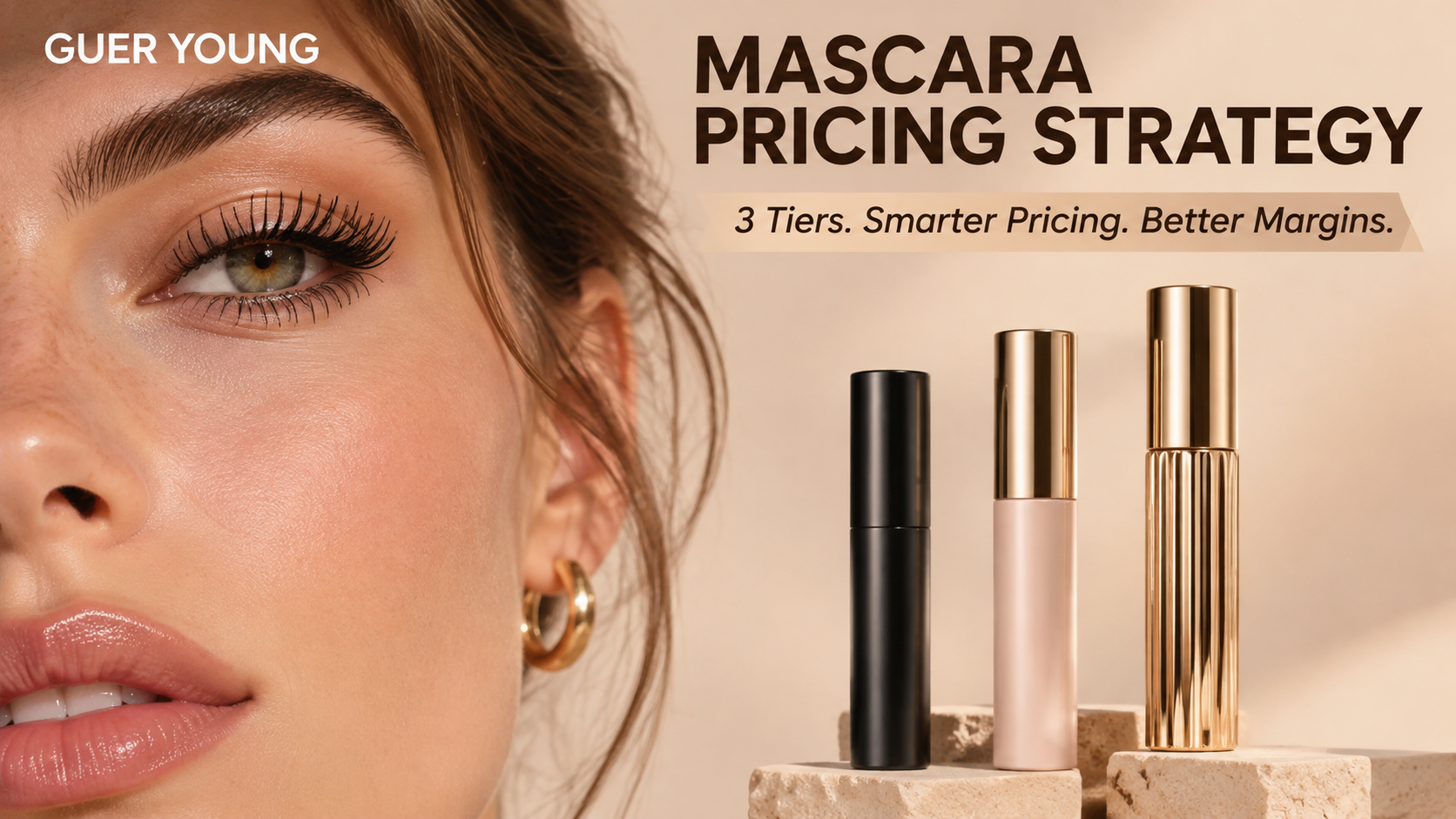
A price that is too high may discourage purchases, while a price that is too low can reduce profitability and limit future marketing and distribution opportunities. A structured three-tier pricing strategy helps brands serve different consumer budgets while maintaining clear distinctions between products.
This guide explains how to build entry-level, mid-range, and premium mascara offerings, calculate margins, and develop a more effective pricing strategy.
1. Why Do Beauty Brands Need a 3-Tier Mascara Pricing Strategy?
Mascara consumers have different priorities. Some focus on affordability and everyday performance, while others are willing to pay more for better product experiences, distinctive designs, or stronger brand value.
The 2025 Beauty Consumer Insights Report found that 38% of surveyed consumers considered price an important factor, while 30% prioritized product quality. This highlights the importance of balancing affordability and performance.
The private-label beauty market also presents opportunities. According to PLMA, U.S. private-label beauty product sales reached $3.8 billion in 2024, representing 4% growth.
These figures reflect broader beauty and private-label market trends, not mascara-specific consumer research.
A three-tier pricing structure can help brands:
Reach different budgets: Appeal to consumers with varying spending preferences.
Clarify product positioning: Give each product a distinct role and value proposition.
Improve profitability: Balance sales volume and margins across different price points.
2. Entry-Level Mascara: Meeting Everyday Needs
Entry-level mascara aims to lower the purchase barrier and appeal to price-conscious consumers.
These products do not require complex designs. The priority is to deliver reliable basic performance while controlling production and purchasing costs.
Recommended product configuration:
Formula: Focus on essential everyday application performance.
Brush: Use a standard brush design that is easy to produce consistently.
Packaging: Choose conventional tubes and basic decoration to control costs.
Performance: Focus on fundamental benefits such as volume, length, or everyday definition.
Brands should maintain reliable product quality even when controlling costs. Excessive reductions in formula or packaging quality may negatively affect the user experience and repeat purchases.
3. Mid-Range Mascara: Differentiating Through Product Performance
Mid-range products can play an important role in building consistent sales and product differentiation.
Compared with entry-level mascara, mid-range options can offer upgrades in formula, brush design, and application performance, giving consumers clear reasons to choose a higher-priced product.
Potential product upgrades include:
Formula performance: Develop options with waterproof, smudge-resistant, long-wearing, or easy-removal properties.
Brush design: Explore different shapes, sizes, and bristle arrangements for volume, length, or precise application.
Application experience: Evaluate formula consistency, drying time, clumping, and removal.
Packaging details: Use more refined tube designs and finishing techniques to improve product recognition.
Brands should prioritize upgrades that consumers can actually notice rather than adding features simply to create more selling points. Meaningful differentiation makes the price positioning easier to justify.
4. Premium Mascara: Building Brand Value Through Product Experience
Premium mascara should not rely solely on higher production costs or more elaborate packaging. Its overall experience needs to justify the price.
Brands can develop premium products through a more considered combination of formula, brush design, packaging, and brand identity.
Premium product configuration may include:
Formula: Develop formulas with clearly defined performance benefits for the target market.
Brush: Use customized brush designs to create distinctive application effects.
Packaging: Explore specialized materials, surface finishes, or structural designs.
Brand experience: Maintain consistency across product appearance, application, and brand positioning.
If a brand wants to highlight vegan, sustainable, or hypoallergenic features, relevant claims should be supported by appropriate formula documentation, testing, or certification. They should not be used as unsupported marketing labels.
The purpose of premium positioning is not simply to charge more. It is to create value that consumers can recognize and appreciate.
5. How to Build and Optimize Your Mascara Pricing Strategy
After defining product tiers, brands need to consider costs, sales channels, and supplier capabilities before setting actual prices.
5.1 Calculate Product Costs and Gross Margins
Before setting a retail price, brands should understand the total unit cost of each mascara product.
Product costs may include:
Formula costs
Packaging material costs
Manufacturing costs
Other expenses included in product cost accounting
Two useful formulas are:
Gross Margin = (Sales Revenue − Product Cost) ÷ Sales Revenue × 100%
Markup = (Selling Price − Product Cost) ÷ Product Cost × 100%
The following figures are illustrative assumptions, not market benchmarks or supplier quotations.
Product Tier | Unit Cost | Example Retail Price | Example Wholesale Price |
Entry | $2.40 | $12 | $6 |
Mid-range | $5.00 | $24 | $12 |
Premium | $10.00 | $48 | $24 |
For the mid-range product:
Retail gross margin = (24 − 5) ÷ 24 × 100% ≈ 79.2%
Wholesale gross margin = (12 − 5) ÷ 12 × 100% ≈ 58.3%
These figures represent illustrative product-level gross margins, not net profit. Platform commissions, advertising, warehousing, fulfillment, discounts, and returns should be calculated separately.
5.2 Adjust Prices Across Sales Channels
The same mascara product may have different cost structures and margin requirements across sales channels.
Direct-to-consumer (DTC): Account for advertising, payment processing fees, shipping, and customer acquisition costs.
Amazon and other marketplaces: Include platform commissions, storage and fulfillment fees, promotional discounts, and advertising expenses.
Offline retail: Allow for retailer margins, channel discounts, and promotional activities.
Wholesale and distribution: Balance the brand's own margin with the profit requirements of distributors and retailers.
Brands should avoid setting one universal selling price based only on product cost. Each channel needs its own cost and margin assessment.
5.3 Choose the Right Mascara Supplier for Each Price Tier
A supplier's product development capabilities and manufacturing consistency can directly affect a brand's cost structure and product quality.
When evaluating suppliers, consider:
Product development: Can the supplier offer different formula, brush, and packaging configurations?
Cost control: Can it recommend suitable product solutions within the target budget?
Quality management: Does it have clear inspection procedures and batch management processes?
Order flexibility: Can it accommodate purchasing quantities and order arrangements suitable for the brand's stage of development?
Sampling and delivery: Can it provide samples promptly and maintain consistency between approved samples and bulk production?
For example, GUER YOUNG offers finished mascara products as well as OEM/ODM and Private Label services. Brands can evaluate different formula, brush, and packaging configurations according to their target prices, product positioning, and purchasing requirements.
Regardless of the supplier selected, brands should review samples, quality control procedures, and batch consistency before placing an order.
5.4 Review Product Pricing and Sales Performance Regularly
Pricing should not be treated as a one-time decision. Brands need to monitor how products perform after launch.
Useful metrics include:
Sales volume and revenue by price tier
Gross margin across different channels
Conversion performance during promotions
Customer reviews and return reasons
Inventory turnover by SKU
If entry-level products generate strong sales but limited margins, brands can review purchasing costs and channel expenses. If premium products have low conversion rates, they may need to reassess whether the product differentiation justifies the current price.
Price adjustments should be based on actual sales performance rather than relying on discounts alone to increase volume.
6. FAQ: Common Questions About Mascara Pricing
Q1: How many price tiers should a beauty brand offer for mascara?
Brands serving different consumer segments can start with three tiers: entry-level, mid-range, and premium. The actual number should depend on the target market, brand positioning, and product range.
Q2: Does premium mascara always require higher production costs?
Not necessarily. Premium pricing should be supported by recognizable value, such as formula performance, customized brushes, packaging design, and overall product experience. Simply increasing production costs does not guarantee a premium position.
Q3: How should brands determine the retail price of mascara?
Start by calculating product costs, then consider the target gross margin, channel expenses, competing products, and consumer positioning. Different sales channels should be evaluated separately.
Q4: How often should brands review mascara prices?
There is no fixed schedule that works for every brand. Review sales, margins, competition, and customer feedback regularly, and reassess prices when costs or market conditions change significantly.
Conclusion
An effective mascara pricing strategy connects product positioning, cost structure, channel expenses, and consumer value.
Entry-level products address essential needs, mid-range products create differentiation through performance, and premium products strengthen brand value. With a clear three-tier structure and regular performance reviews, beauty brands can better balance product competitiveness and profitability.


andy.li@gueryoung.com

We have 10 years of experience, focusing on the development and sales of high quality eyelash growth serum, mascara, eyebrow gel, eyebrow color and other products. We also offer custom services, from tube
design to cosmetic fillings and packaging


Room 1, C3 Factory Building, No.8803 Zhuhai Avenue, Lianwan Industrial Zone, Pingsha Town, Gaolan Port Economic Zone, Zhuhai, Guangdong,China
QUICK LINKS
D Zone,5/F, NO.8 CuiZhu 5th Street,
Qianshan Xiangzhou District,Zhuhai,
Guangdong,China,519070

lynn.zhou@gueryoung.com
winnie.zhong@gueryoung.com
niki.xu@gueryoung.com