
Volumizing Mascara: How to Choose the Right Types for Your E-Commerce Store
1. Understanding Three Core Mascara Types
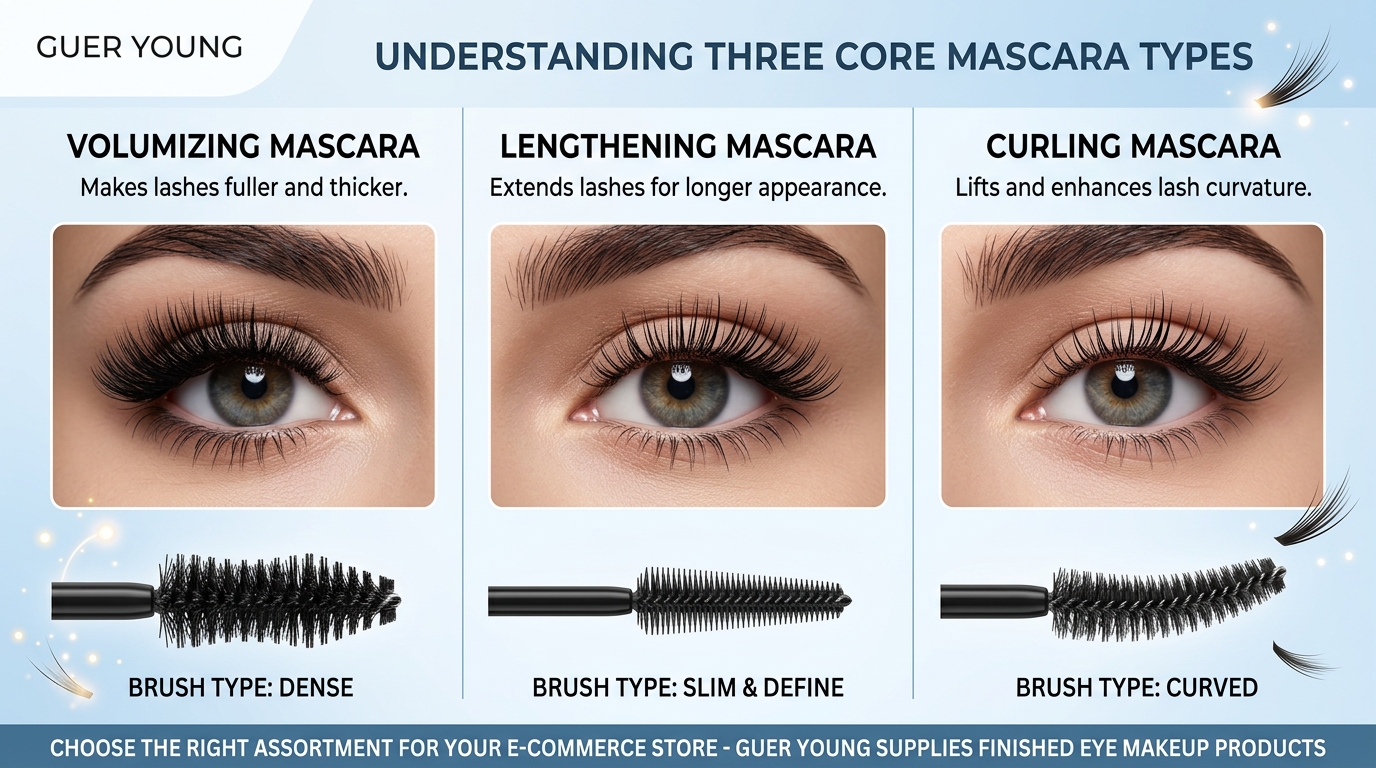
Choosing the right mascara assortment starts with understanding the differences between the main product types. Volumizing, lengthening, and curling mascaras address different lash needs, so each can serve a distinct role in an e-commerce product lineup.
1.1 Volumizing Mascara
Volumizing mascara is designed to make lashes appear fuller and thicker. Its formula and applicator work together to coat lashes and create a more noticeable lash effect.
Best suited for: Customers who prefer bold eye makeup, fuller-looking lashes, or more defined everyday looks.
Product selection considerations: Evaluate formula buildability, clumping control, brush shape, and whether the product can deliver visible volume without making lashes look excessively heavy.
1.2 Lengthening Mascara
Lengthening mascara focuses on making lashes appear longer and more defined. Depending on the formula, it may use lightweight coatings or fibers to emphasize lash length and separation.
Best suited for: Customers who want defined, elongated lashes, particularly those who prefer natural-looking or clean makeup styles.
Product selection considerations: Look for even application, good lash separation, minimal clumping, and a brush that can reach shorter lashes.
1.3 Curling Mascara
Curling mascara is designed to lift and enhance the appearance of lash curvature. Formula performance and applicator design both influence how well lashes hold their shape.
Best suited for: Customers who want lifted-looking lashes or a more open-eye effect.
Product selection considerations: Assess curl retention, formula weight, brush curvature, and compatibility with the desired makeup result.
2. Match Mascara Types to Your Target Customers
Understanding your target customers helps you decide which mascara benefits deserve priority. Instead of offering every available type, build your assortment around the needs and purchasing preferences of your intended audience.
2.1 Everyday Makeup Consumers
Customers looking for practical daily makeup may prefer mascaras that are easy to apply, comfortable to wear, and simple to remove. Natural-looking volume, length, or definition can all be relevant, depending on their preferences.
For this audience, prioritize smooth application, manageable wear, and clear product benefits. A mascara that combines moderate volume with lash separation may also appeal to customers who want more than one benefit.
2.2 Beauty Enthusiasts
Customers who experiment with different makeup styles may be interested in more noticeable volume, dramatic length, curl definition, or waterproof performance.
For this group, consider differentiated formulas and applicators that support specific looks. Product pages should clearly explain the intended effect so customers can compare options and choose the right mascara for their makeup routine.
2.3 Customers with Specific Wear or Eye-Area Needs
Some customers prioritize waterproof or sweat-resistant wear, while others look for fragrance-free formulas or products suitable for sensitive eye areas.
These needs should be evaluated separately from the main mascara effect. For example, volumizing mascara describes the desired lash appearance, whereas waterproof performance describes wear characteristics.
When selecting products, verify the relevant formula information, usage instructions, and supporting documentation rather than assuming that a particular mascara type automatically offers these features.
3. Compare Product Performance Before Purchasing
Product descriptions alone are not enough to determine whether a mascara is suitable for your assortment. Comparing samples under consistent conditions helps buyers assess differences in performance and identify products that fit their target market.
3.1 Compare the Core Performance Features
| Evaluation factor | Volumizing mascara | Lengthening mascara | Curling mascara |
Primary benefit | Fuller-looking lashes | Longer-looking lashes | Lifted, curved-looking lashes |
Formula focus | Volume and buildability | Lightweight coating and definition | Curl support and wear |
Applicator focus | Helps distribute product for fuller lashes | Helps separate and reach shorter lashes | May feature a curved or lifting brush |
Key test | Volume without excessive clumping | Length and separation | Curl retention throughout wear |
These are general product-selection guidelines. Actual performance depends on the specific formula, applicator, application technique, and individual lashes.
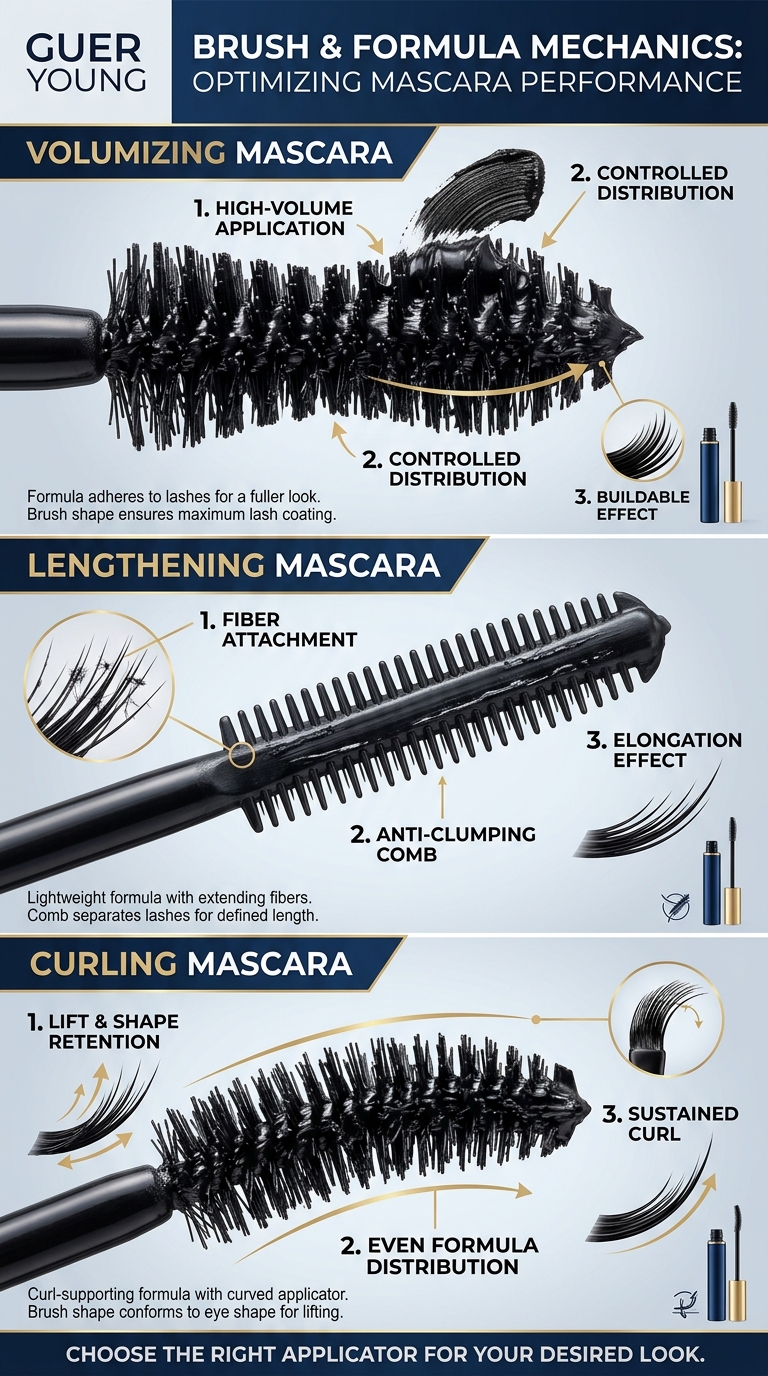
3.2 Evaluate Formula and Applicator Together
A mascara's formula and brush should be assessed as a combination. A formula that creates noticeable volume may not perform as intended if the brush deposits too much product. Likewise, a lengthening formula may not deliver clean separation when paired with an unsuitable applicator.
When testing samples, check:
Application: Does the mascara distribute evenly from root to tip?
Buildability: Can users apply additional coats without excessive clumping?
Separation: Do the lashes remain distinct rather than sticking together?
Wear: Does the product maintain its intended appearance during normal use?
Removal: Can users remove the mascara according to its stated instructions?
Record the results using the same testing method for each sample. This makes it easier to compare suppliers and choose products based on observed performance rather than packaging or claims alone.
4. How to Choose the Right Mascara Products for Your Business
Once you understand the main mascara types and their performance differences, combine customer needs, sample testing, supplier capabilities, and business costs to finalize your assortment.
4.1 Define Your Target Customers and Product Positioning
Start by identifying your main sales channel, target price range, and intended customers. These factors influence which mascara benefits should lead your assortment.
For new e-commerce sellers, a small selection of clearly differentiated core products can make inventory and product-page management more manageable. Established online retailers may expand their range based on customer feedback, sales performance, and gaps in their existing product lineup.
Beauty brands developing a private label mascara line should also consider how each product fits their brand positioning. For example, a brand focused on natural makeup may prioritize lengthening and lash definition, while a brand centered on dramatic eye looks may give greater attention to volumizing formulas.
The goal is not to stock every type of mascara. It is to select products with distinct benefits that match your intended customers.
4.2 Evaluate Samples and Product Performance
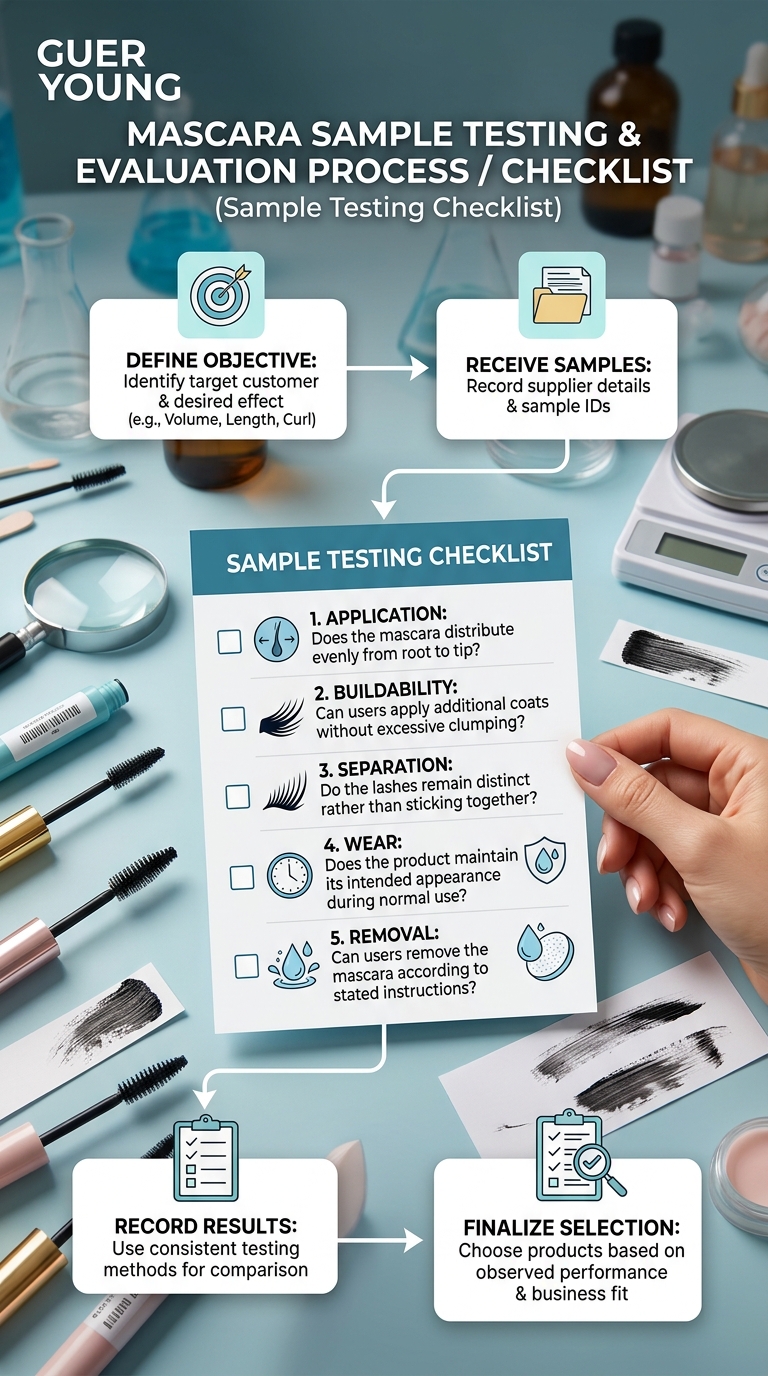
Before committing to an order, test samples from potential suppliers. Compare the key features identified in Section 3, including application, volume or length effect, separation, wear, and removal.
If you are choosing between several similar products, assess whether each offers a meaningful difference for your customers. This helps prevent an assortment from containing multiple SKUs that serve essentially the same purpose.
For private label projects, also confirm whether the supplier can support your requirements for formula selection, applicator options, packaging, logo application, and product customization.
4.3 Compare Suppliers and Total Costs
A suitable mascara supplier should meet both your product requirements and your operational needs. In addition to unit price, review:
Customization capabilities: Available formulas, brushes, packaging, and branding methods.
Minimum order quantity (MOQ): Whether the order requirements fit your budget and sales plan.
Sampling support: Whether you can evaluate samples before confirming production.
Production and delivery: Expected lead times and communication throughout the order process.
Quality control: Inspection procedures and consistency between samples and bulk production.
Documentation: Relevant product safety, quality, and market-compliance documents for your target market.
Compare the total cost of purchasing and selling the product, including packaging, shipping, and other applicable expenses. The lowest unit price is not necessarily the best option if the product does not meet your performance expectations or business requirements.
4.4 Finalize Your Assortment and Product Listings
Use your customer research, sample evaluations, and supplier comparisons to finalize the number and type of SKUs. Each item should have a clear role in your product lineup, whether that is delivering volume, emphasizing length, supporting curl, or meeting a specific wear requirement.
Your product pages should make these differences easy to understand. Include the primary benefit, applicator characteristics, formula features that have been verified, directions for use, and relevant product specifications.
For private label products, coordinate the product description with the actual formula and packaging selected. Accurate, consistent information helps customers make informed purchasing decisions and reduces confusion between similar products.
5. Conclusion
Volumizing, lengthening, and curling mascaras serve different customer needs. By evaluating product performance, understanding your target market, and comparing suppliers, you can build a mascara assortment that fits your business goals.
For beauty brands and e-commerce sellers looking to develop or expand their eye makeup lines, GUER YOUNG supplies finished eye makeup products and supports private label customization. We can help you explore product options that align with your target customers and brand positioning.
If you're planning your next mascara line, get in touch with GUER YOUNG to discuss your product requirements.


andy.li@gueryoung.com

We have 10 years of experience, focusing on the development and sales of high quality eyelash growth serum, mascara, eyebrow gel, eyebrow color and other products. We also offer custom services, from tube
design to cosmetic fillings and packaging


Room 1, C3 Factory Building, No.8803 Zhuhai Avenue, Lianwan Industrial Zone, Pingsha Town, Gaolan Port Economic Zone, Zhuhai, Guangdong,China
QUICK LINKS
D Zone,5/F, NO.8 CuiZhu 5th Street,
Qianshan Xiangzhou District,Zhuhai,
Guangdong,China,519070

lynn.zhou@gueryoung.com
winnie.zhong@gueryoung.com
niki.xu@gueryoung.com