
OEM Makeup MOQ, Cost & Quality: What Buyers Need to Know
Read in English | Lire en Français | Leer en Español | Lesen auf Deutsch
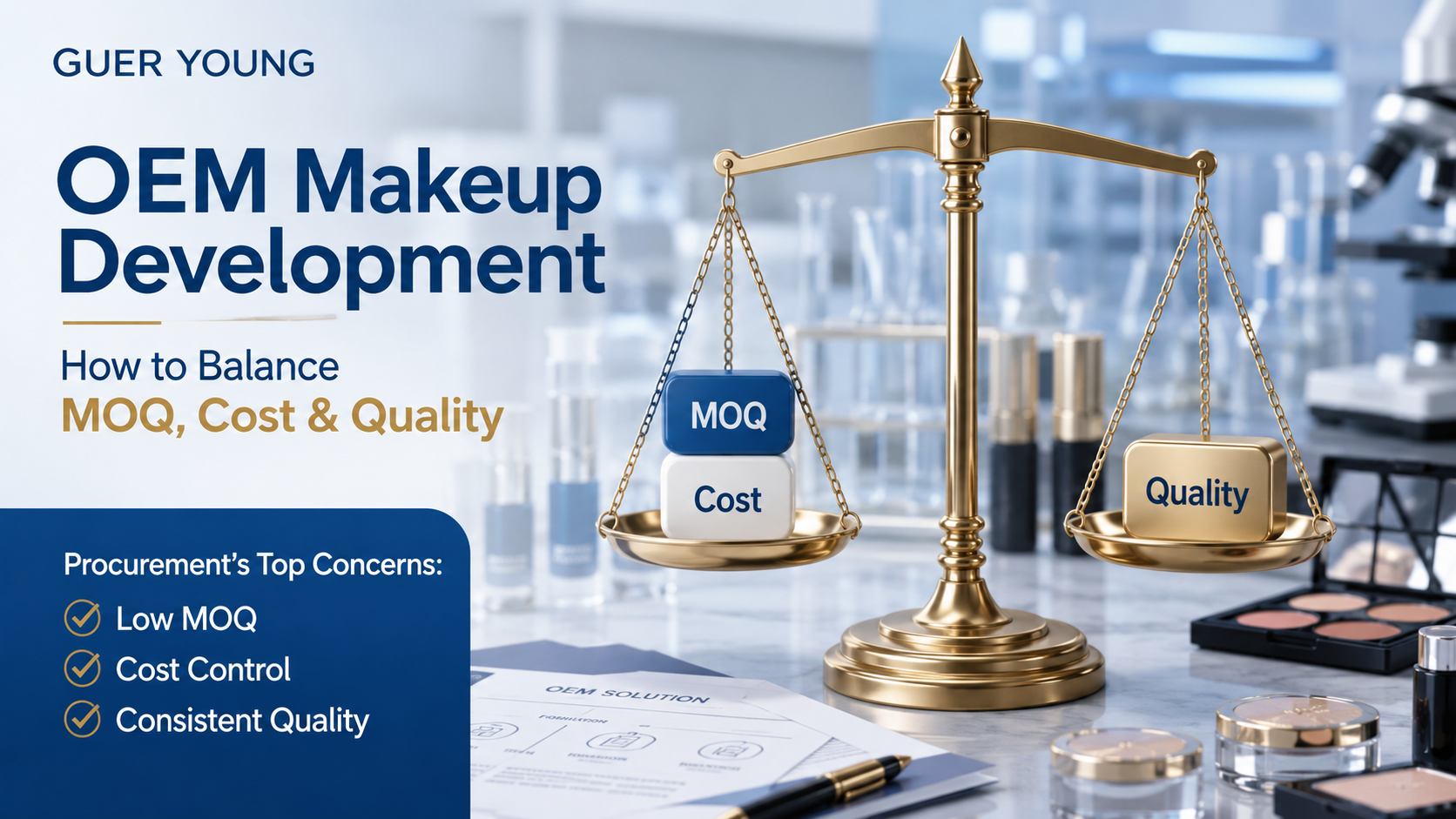
For purchasing managers, private label beauty brands, and startup founders, the biggest challenge in OEM makeup manufacturing is not finding a supplier—it's finding the right balance between MOQ (Minimum Order Quantity), cost, and product quality.
A high MOQ can tie up capital and create inventory pressure. Aggressive cost-cutting may lead to inconsistent quality and customer complaints. Prioritizing premium quality without a clear strategy can increase development costs and extend lead times.
This creates a common dilemma for beauty brands: how can you launch competitive products, minimize risk, and make smart supply chain decisions without overcommitting your budget?
The good news is that balancing MOQ, cost, and quality is achievable when approached strategically. Here are several practical solutions used by successful cosmetics brands.
1. Match MOQ Strategy to Your Brand's Growth Stage
One of the most common misconceptions in sourcing is that the lowest MOQ is always the best option.
In reality, the ideal MOQ depends on where your brand is in its development journey.
For Startup Beauty Brands
If you're entering the market for the first time, your primary goal should be validating product-market fit rather than securing the lowest unit price.
A lower MOQ allows you to:
Test market demand
Gather customer feedback
Reduce inventory risk
Preserve cash flow
Although the unit cost may be slightly higher, the reduced financial risk often makes it the smarter investment.
For Growing Brands
Once you have proven sales channels and predictable demand, increasing order volumes can help lower production costs.
At this stage, consider:
Consolidating orders around best-selling SKUs
Negotiating volume-based pricing
Planning quarterly purchasing schedules
For Established Brands
Mature brands can leverage annual purchasing agreements and larger production runs to maximize cost efficiency while maintaining supply chain stability.
The key is not to pursue the lowest MOQ possible—but to align MOQ with realistic sales projections.
2. Look Beyond Unit Price and Understand Tiered Pricing
Many buyers focus exclusively on the quoted unit price when evaluating suppliers.
However, experienced procurement teams evaluate the total cost of ownership, not just manufacturing costs.
Consider a private label lipstick project:
| Order Quantity | Unit Cost |
|---|---|
| 3,000 units | $1.80 |
| 5,000 units | $1.55 |
| 10,000 units | $1.30 |
At first glance, ordering 10,000 units appears to be the most cost-effective choice.
But if your actual sales volume only supports 3,000 units, excess inventory creates hidden costs, including:
Warehousing expenses
Cash flow constraints
Packaging obsolescence
Formula update risks
Market trend changes
Smart sourcing decisions should account for:
Manufacturing Cost + Storage Cost + Capital Cost + Inventory Risk
In many cases, a smaller initial order can generate a healthier return on investment than a larger order with a lower unit price.
3. Use Proven Formulas Instead of Starting from Scratch
Custom formulation is often viewed as the gold standard of product development.
However, fully customized formulas typically require:
Higher R&D costs
Longer development cycles
Higher MOQ requirements
Additional stability and compatibility testing
For many emerging beauty brands, starting with an entirely new formula is not the most efficient path.
A Smarter Alternative: ODM Formula Customization
Using a proven formula as a foundation allows brands to customize:
Shades and color collections
Fragrance profiles
Packaging design
Branding elements
This approach significantly reduces development costs while maintaining product performance and quality consistency.
Since the formula has already been tested and validated, brands can launch faster and with lower risk.4. Prioritize Hero Products Before Expanding Your Product Line
Many new beauty brands attempt to launch multiple categories simultaneously, such as:
Foundation
Lipstick
Mascara
Loose powder
Eyeshadow palettes
Contour products
While this may seem ambitious, it often leads to:
Higher development costs
Increased MOQ commitments
Complex inventory management
Greater supply chain risk
A more effective strategy is to focus on hero products first.
Build Around Best-Selling Categories
For example:
Lip products
Complexion products
Brow products
Concentrating resources on a small number of high-potential SKUs helps ensure superior quality and stronger market performance.
Once these products gain traction, expanding into additional categories becomes much less risky.
For procurement teams, fewer SKUs also mean easier inventory control and more efficient supplier management.
5. Develop Your Product Portfolio in Phases
Successful beauty brands rarely launch their entire product range at once.
Instead, they follow a phased development strategy.
Phase One: Core Products
Launch one to three key SKUs and evaluate:
Market demand
Customer feedback
Repeat purchase rates
Product performance
Phase Two: Category Expansion
Expand strategically based on sales data.
For example, if a lipstick line performs well, additional products may include:
Lip liners
Lip glosses
Lip care products
Phase Three: Full Product Ecosystem
Once the brand has established a loyal customer base, broader product categories can be introduced.
This phased approach minimizes procurement risk while maximizing capital efficiency.
How to Avoid the Two Biggest OEM Sourcing Mistakes
Mistake #1: High MOQ Leading to Excess Inventory
Before selecting a manufacturer, ask:
Do they support low MOQ production?
Can they offer mixed shades or mixed SKU orders?
Do they provide flexible manufacturing solutions?
Can they support repeat orders with shorter lead times?
Choosing a supplier that offers flexibility can significantly reduce inventory pressure.
Mistake #2: Sacrificing Quality for Lower Pricing
Extremely low pricing often comes with hidden compromises, including:
Lower-grade raw materials
Reduced quality control procedures
Limited product testing
Inferior packaging components
When evaluating OEM suppliers, pay close attention to:
GMP-certified manufacturing standards
Raw material sourcing systems
Stability testing procedures
Microbiological testing protocols
International regulatory compliance
The right manufacturing partner should help you reduce risk—not simply offer the lowest quote.
Why More Beauty Brands Choose GUER YOUNG for OEM & ODM Makeup Manufacturing
In today's highly competitive beauty market, brands need more than a factory. They need a reliable supply chain partner capable of supporting long-term growth.
As a professional OEM and ODM cosmetics manufacturer, GUER YOUNG helps brands balance MOQ, cost, and quality through:
Low MOQ Support
Ideal for startups and emerging beauty brands looking to test the market while minimizing inventory risk.
Consistent Quality Control
Comprehensive quality management systems ensure product consistency from raw material selection to final inspection.
Fast Sampling and Development
Accelerated product development timelines help brands bring products to market faster and capitalize on emerging trends.
One-Stop OEM & ODM Solutions
Including:
Formula development
Packaging customization
Brand support
Manufacturing services
Global compliance assistance
This streamlined approach reduces communication barriers and improves project efficiency.
Final Thoughts
In OEM makeup development, there is no universal formula for balancing MOQ, cost, and quality.
The most successful procurement decisions are those that carefully evaluate inventory risk, budget allocation, product quality, and long-term business goals.
Rather than chasing the lowest price, brands should focus on building a flexible, reliable, and scalable supply chain.
If you're looking for a trusted OEM/ODM makeup manufacturer that offers low MOQ solutions, consistent quality standards, and fast product development, GUER YOUNG is ready to help.
Contact us today to discuss your custom makeup development project and receive a tailored sourcing solution designed for your brand's growth.


andy.li@gueryoung.com

We have 10 years of experience, focusing on the development and sales of high quality eyelash growth serum, mascara, eyebrow gel, eyebrow color and other products. We also offer custom services, from tube
design to cosmetic fillings and packaging


Room 1, C3 Factory Building, No.8803 Zhuhai Avenue, Lianwan Industrial Zone, Pingsha Town, Gaolan Port Economic Zone, Zhuhai, Guangdong,China
QUICK LINKS
D Zone,5/F, NO.8 CuiZhu 5th Street,
Qianshan Xiangzhou District,Zhuhai,
Guangdong,China,519070

lynn.zhou@gueryoung.com
winnie.zhong@gueryoung.com
niki.xu@gueryoung.com