
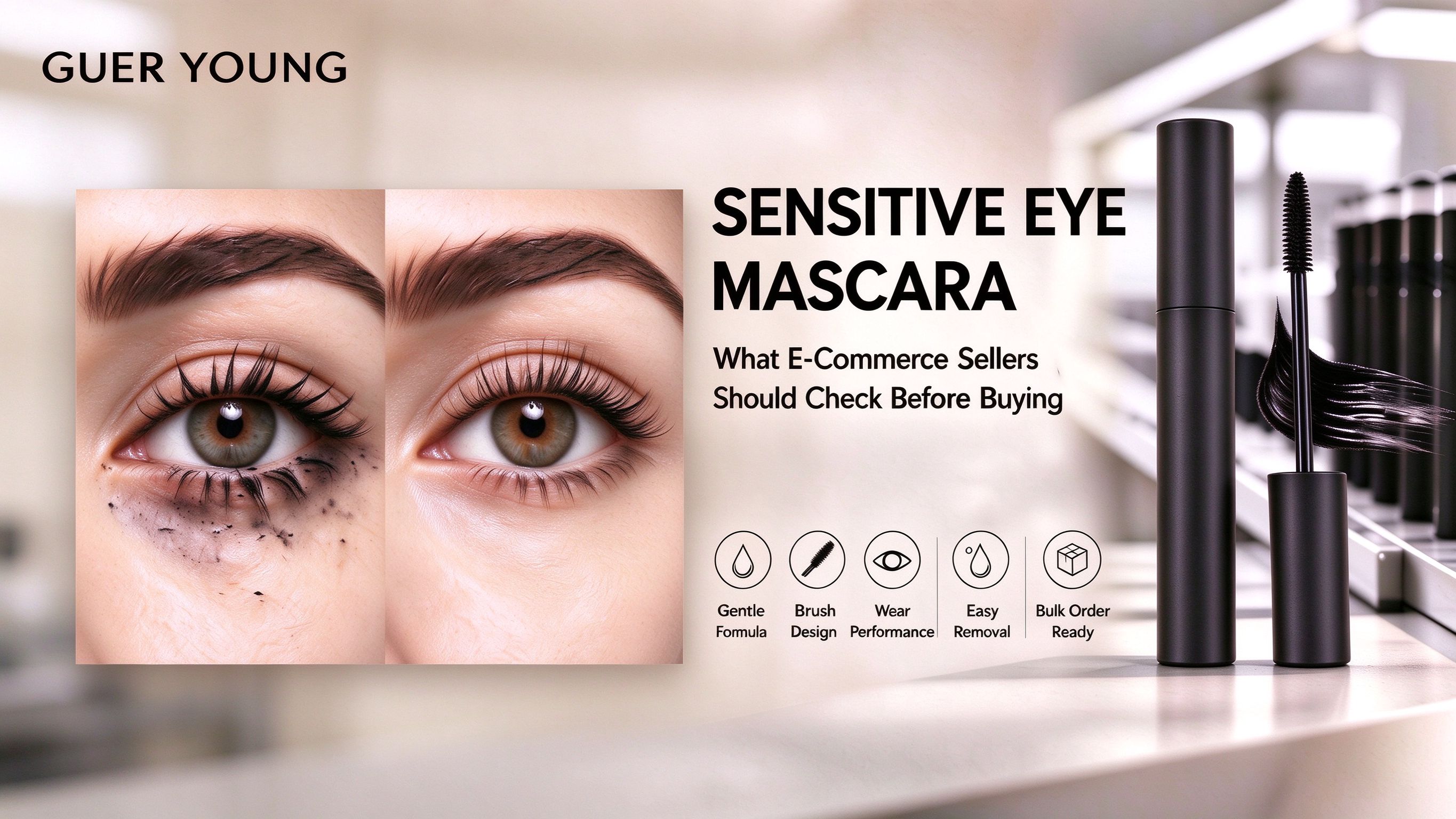
Sensitive Eye Mascara: What E-Commerce Sellers Should Check Before Buying
Read in English | Lire en Français | Lesen auf Deutsch | Leer en Español
Choosing a sensitive eye mascara for an e-commerce store takes more than finding a formula labeled “gentle” or “hypoallergenic.”
For beauty brands and online sellers, the right product should balance formula, brush design, wear performance, removal, and commercial fit.
Sensitive-eye consumers and contact lens wearers often pay close attention to comfort, flaking, smudging, and how easily mascara can be removed. These details can also influence product reviews and repeat purchases.
This guide shows what B2B buyers should check when selecting sensitive eye mascara before moving from samples to bulk orders.
1. Evaluate the Formula for Sensitive-Eye Customers
Start with the formula. For sensitive-eye customers, ingredient selection and formula design can strongly influence the overall user experience.
A product may look attractive and deliver good lash results, but the formula still needs to match the needs of your target market.
1.1 Look for a Gentle Formula Profile
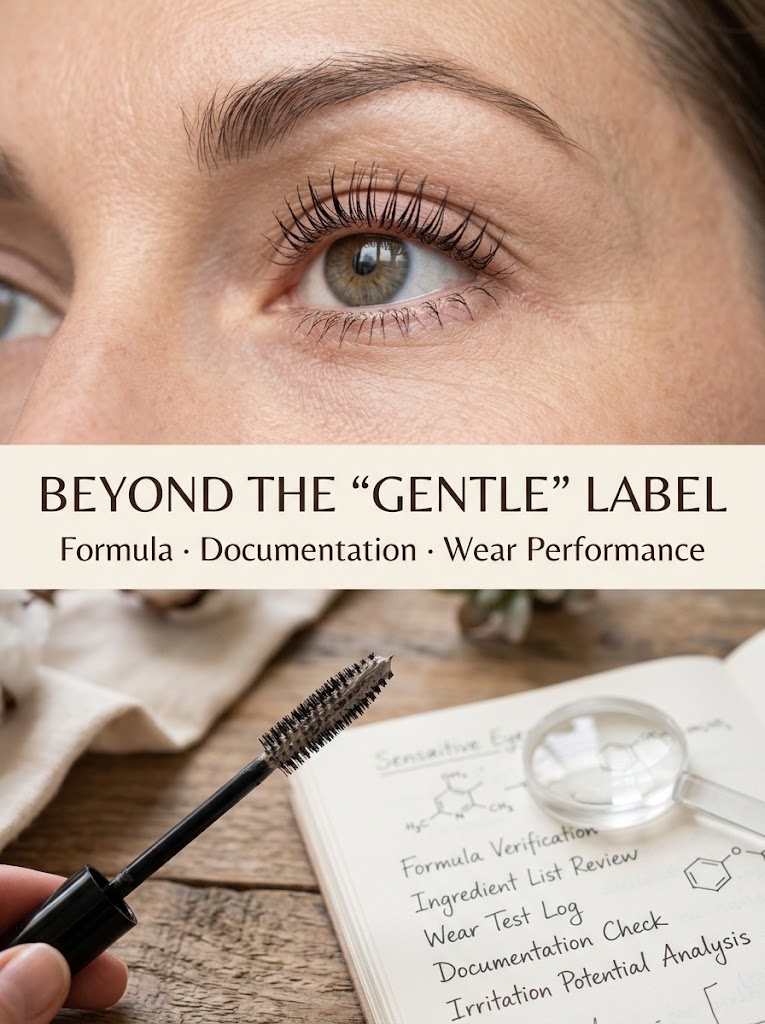
When comparing mascara samples, look beyond the front-label claims.
A gentle formula may use a simpler ingredient profile and avoid unnecessary fragrance. Some products also use conditioning ingredients to support a lash-care positioning.
Features worth reviewing include:
Fragrance-free: Suitable for shoppers who prefer to avoid added fragrance around the eye area.
Hypoallergenic positioning: Check whether supporting test information is available.
Ophthalmologist-tested: Review the actual documentation behind the claim.
Paraben-free or sulfate-free: May appeal to consumers looking for simpler formulas.
Conditioning ingredients: Vitamin E, jojoba oil, or selected botanical extracts may support a lash-care concept.
For B2B buyers, the claim itself is only the starting point. Ask the supplier what testing or documentation supports it.
1.2 Review Ingredients and Potential Irritation Concerns
Ingredient review is especially useful when sensitive-eye consumers are part of your target market.
Rather than judging one ingredient in isolation, review the complete ingredient list and consider the formula as a whole.
Pay attention to:
Added fragrance or fragrance blends.
Colorants used in the formula.
Preservative systems.
Alcohol-containing formulas.
Ingredients that may not suit your target market.
Changes between the approved sample and mass-production formula.
For Private Label and OEM projects, formula consistency is also important.
The formula approved during sampling should match the specification agreed for mass production.
1.3 Check Formula Texture and Application Performance
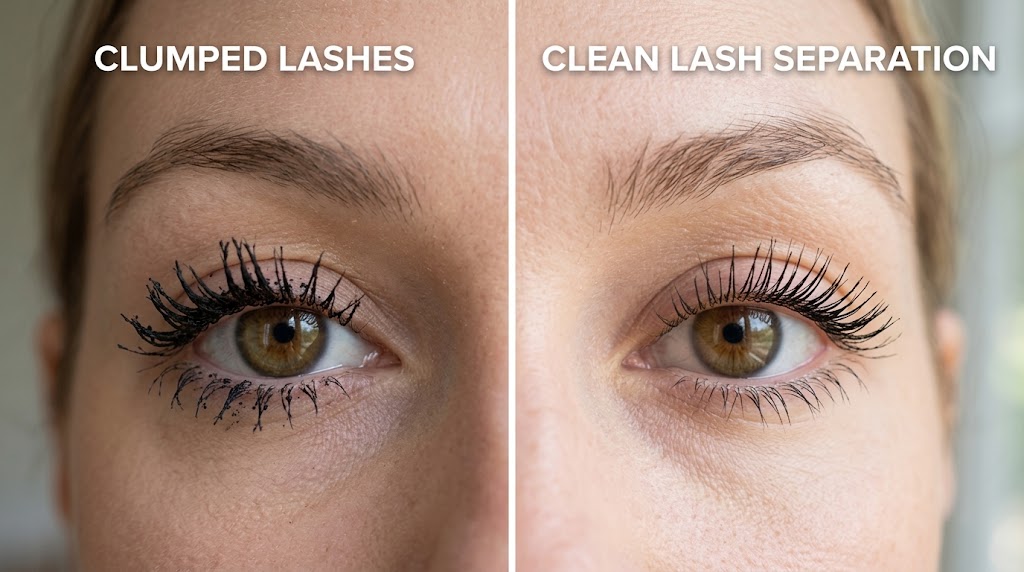
Texture affects both comfort and lash results.
A formula that is too thick may create clumps or feel heavy. One that remains too wet may be more difficult to control during application.
When testing samples, check:
Smooth application.
Product pickup from the brush.
Drying time.
Lash separation.
Clumping after multiple coats.
Lightweight feel after application.
These details matter commercially because they can influence customer reviews and product demonstrations.
Once the formula meets your requirements, move to the brush. The brush needs to work with the formula rather than simply look distinctive.
2. Choose a Brush Design That Balances Comfort and Performance
The brush determines how easily consumers can control the product and how evenly the formula reaches the lashes.
For sensitive-eye users, precision is particularly useful. A brush that is difficult to control may make application uncomfortable or messy.
2.1 Check Brush Softness and Flexibility
Brush material and flexibility can affect application comfort.
When comparing samples, pay attention to how easily the brush moves through the lashes and how much control it provides.
Common options include:
Synthetic nylon bristles: Flexible, lightweight, and suitable for various lash effects.
Silicone bristles: Useful for separation and controlled product distribution.
Natural bristles: Can provide a soft feel but require additional attention to cleaning and consistency.
Do not evaluate brush material alone.
The combination of bristle material, density, shape, and formula often determines the actual application experience.
2.2 Match Brush Shape to the Lash Effect
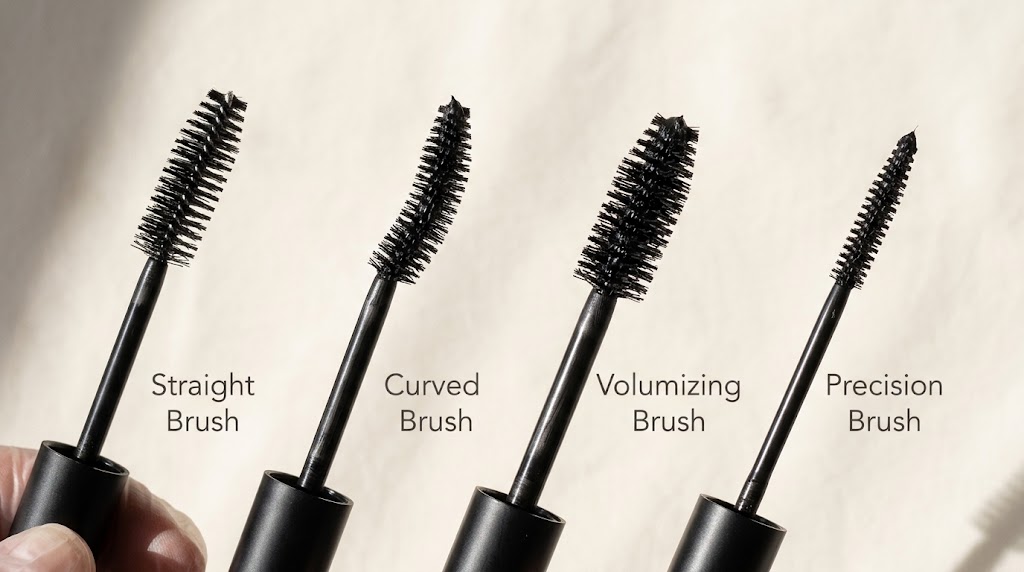
Different brush shapes support different product positions.
For an e-commerce product line, this can help create clear differences between mascara SKUs.
| Brush Type | Typical Lash Effect |
Straight brush | Lengthening and natural definition |
Curved brush | Lifting and curling |
Thick or hourglass brush | Volume and fuller-looking lashes |
Small precision brush | Bottom lashes and corners |
Silicone separation brush | Defined and separated lashes |
When testing a sample, compare the actual result with the effect you plan to communicate on the product page.
A “lengthening” mascara should visibly support that positioning, while a volumizing product should create a noticeably fuller result.
2.3 Evaluate Brush Size and Application Control
Brush size can make a noticeable difference in ease of use.
Large brushes may provide strong coverage, but they can be harder to maneuver around short lashes and inner corners.
Compact brushes generally provide more precision.
For your product line, consider:
At least one precision brush option.
A standard brush for everyday application.
Comfortable grip and handle design.
Easy access to short or lower lashes.
Consistent brush shape across production batches.
A successful mascara brush should look good in product photography and make the product easy to use.
Once the formula and brush work well together, the next question is whether the result lasts throughout the day.
3. Compare Wear Performance Before Choosing a Mascara
A gentle formula still needs reliable performance.
For online sellers, problems such as smudging, flaking, and transfer can quickly become visible in customer reviews.
3.1 Check Key Wear Performance Metrics
Do not rely only on supplier descriptions. Test samples under realistic conditions.
Focus on:
Smudge resistance: Does the formula stay in place during normal wear?
Flaking resistance: Does it remain intact instead of producing visible flakes?
Transfer resistance: Does it leave marks on the eyelid or under-eye area?
Wear time: How long does the product maintain an acceptable appearance?
Lightweight feel: Does it remain comfortable after several hours?
For a sensitive-eye product line, comfort and wear should be evaluated together.
A formula that lasts well but feels heavy may not provide the overall experience your customers expect.
3.2 Consider Contact Lens Wearers
Contact lens wearers are another customer group worth considering when selecting sensitive eye mascara.
Excessive flaking or an uncomfortable application experience can reduce product satisfaction for this audience.
When evaluating samples, check:
Low-flaking performance.
Comfortable application.
Lightweight texture.
Easy removal.
Supporting documentation for relevant product claims.
If contact lens users are part of your target market, make sure any related marketing claims are supported by appropriate evidence.
3.3 Compare Waterproof, Water-Resistant, and Non-Waterproof Options
Not every customer needs the same level of moisture resistance.
| Mascara Type | Best Fit | Main Trade-Off |
Non-waterproof | Everyday makeup | Lower moisture resistance |
Water-resistant | Balanced daily wear | Moderate moisture protection |
Waterproof | Humid climates, workouts, special occasions | May require more effort to remove |
Offering more than one type can help an e-commerce store cover different customer needs.
However, stronger wear resistance can also affect removal.
That is why wear and removal should be evaluated together, especially when comparing waterproof and non-waterproof samples.
4. Evaluate Removal Ease Before Bulk Ordering
Removal is part of the product experience, not an afterthought.
A mascara may offer excellent wear performance but still be a poor fit if customers need excessive rubbing to remove it.
4.1 Test How Easily the Formula Can Be Removed
During sample testing, compare removal performance alongside wear.
Check:
Amount of remover required.
Time needed to dissolve the formula.
Amount of rubbing needed.
Residue left after removal.
Ease of cleaning the lashes.
This comparison is particularly useful for waterproof formulas.
The goal is not to make every mascara extremely easy to remove. Instead, look for a balance between lasting performance and practical removal.
4.2 Match Removal Performance to Your Target Market
Your target customer should influence the type of formula you choose.
For shoppers who prefer quick everyday routines, an easy-to-remove mascara may be more attractive.
For customers in humid climates or those with active lifestyles, stronger wear resistance may be a higher priority.
Consider:
Customer lifestyle.
Local climate.
Expected wear time.
Makeup removal habits.
Product positioning.
Competitor offerings.
This helps you choose a formula based on actual market needs rather than simply selecting the strongest-performing option.
4.3 Communicate Removal Features Clearly
Clear product information can help shoppers choose the right mascara and reduce mismatched expectations.
Your product page can clearly identify:
Waterproof or non-waterproof.
Water-resistant.
Easy-removal formula.
Recommended removal method.
Expected wear characteristics.
For Private Label products, relevant information can also be reflected in packaging or product inserts.
Clear communication is especially useful when your product range includes several mascara formulas with different wear profiles.
Once individual factors such as formula, wear, and removal have been evaluated, it is time to assess the complete sample before moving toward a bulk order.
5. Test Samples Before Adding Mascara to Your Product Line
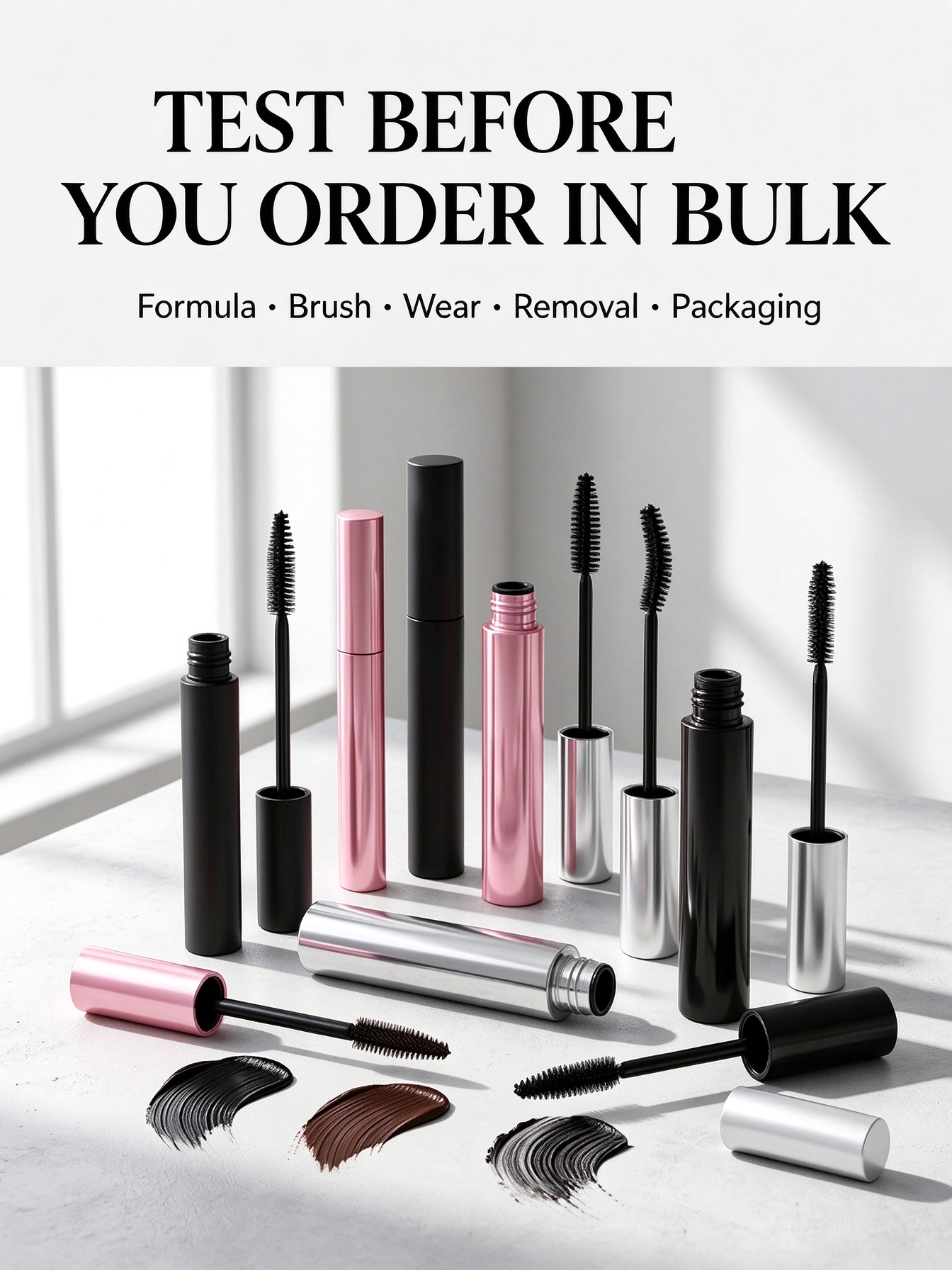
Sample testing connects product performance with the actual B2B purchasing decision.
Instead of judging a mascara from its packaging or supplier description, buyers can use samples to compare formula, brush, performance, documentation, and commercial fit.
5.1 Request Relevant Product Documentation
Before moving from sampling to mass production, ask your supplier what product information and testing documents are available.
Depending on the target market and product claims, this may include:
Ingredient list.
Product specifications.
Safety-related documentation.
Stability or compatibility testing where applicable.
Microbiological testing where applicable.
Packaging specifications.
Quality-control information.
Market-specific compliance documents.
The exact requirements depend on the market and product claims.
For this reason, buyers should confirm applicable requirements for their intended sales region rather than relying on a generic checklist.
5.2 Use a Practical Mascara Sample Checklist
A consistent checklist makes supplier and sample comparisons much easier.
Evaluate each sample for:
Formula
Texture and consistency.
Drying time.
Clumping.
Brush
Softness and flexibility.
Product pickup.
Application control.
Performance
Lash separation.
Smudging.
Flaking.
Transfer.
Wear time.
Removal
Removal time.
Residue.
Rubbing required.
Packaging
Closure.
Leakage.
Component quality.
Visual appearance.
Commercial Fit
MOQ.
Target price.
Customization.
Lead time.
For Private Label buyers, compare the approved sample with the final packaging concept before approving mass production.
5.3 Evaluate Commercial Potential Before Bulk Ordering
A mascara can perform well but still be the wrong product for your store.
Before placing a bulk order, consider:
Target price: Does it fit your intended retail position?
MOQ: Is the initial order manageable?
Packaging: Does it match your brand identity?
Customization: Can the logo, color, label, or packaging be customized?
Market demand: Is there a clear customer need?
Margin: Is there enough room for marketing and operating costs?
Supplier capability: Can quality remain consistent during mass production?
For B2B buyers, the strongest product is not necessarily the one with the longest list of claims.
It is the one that balances formula, performance, packaging, MOQ, customization, and production consistency.
For buyers moving from sample evaluation to a finished product launch, supplier capabilities can also make the process more efficient.
GUER YOUNG provides finished eye makeup solutions for beauty brands and e-commerce sellers, with OEM/ODM, Private Label, and flexible MOQ options for mascara and other eye makeup products.
Conclusion
Selecting sensitive eye mascara for an e-commerce store requires more than checking whether a product is labeled “gentle” or “hypoallergenic.”
A practical B2B evaluation should cover:
Formula profile.
Brush design.
Lash effect.
Wear performance.
Removal ease.
Product documentation.
Packaging quality.
MOQ and customization.
Supplier production capability.
Testing samples before bulk ordering gives buyers a clearer view of both product performance and commercial potential.
For beauty brands, Private Label sellers, and online retailers, the right mascara can become more than another SKU. It can be a useful addition to a differentiated eye makeup product line.


andy.li@gueryoung.com

We have 10 years of experience, focusing on the development and sales of high quality eyelash growth serum, mascara, eyebrow gel, eyebrow color and other products. We also offer custom services, from tube
design to cosmetic fillings and packaging


Room 1, C3 Factory Building, No.8803 Zhuhai Avenue, Lianwan Industrial Zone, Pingsha Town, Gaolan Port Economic Zone, Zhuhai, Guangdong,China
QUICK LINKS
D Zone,5/F, NO.8 CuiZhu 5th Street,
Qianshan Xiangzhou District,Zhuhai,
Guangdong,China,519070

lynn.zhou@gueryoung.com
winnie.zhong@gueryoung.com
niki.xu@gueryoung.com