
What Hidden Lead Time Risks Should Cosmetic Brands Confirm Before OEM Makeup Production
Read in English | Lire en Français | Leer en Español | Lesen auf Deutsch
For beauty brands in Europe and North America, launching products on time is often more important than simply getting the lowest manufacturing cost.
In today’s fast-moving beauty market, delays can mean missing seasonal campaigns, influencer launches, TikTok trends, or holiday sales opportunities. A late shipment doesn’t just affect inventory — it can disrupt an entire product launch strategy.
When searching for an OEM makeup supplier, many brands focus on one question:
“How long is the production lead time?”
However, the real causes of delays are often the hidden risks that suppliers fail to mention in advance.
As a professional private label cosmetics supplier serving global beauty brands, GUER YOUNG has seen many projects delayed not because production stopped, but because of overlooked factors such as packaging procurement, filling schedules, holiday shutdowns, compliance testing, and shipping arrangements.
This is especially true for eye makeup products like mascara, eyelash growth serum, eyeliner, and brow products, where packaging compatibility and filling precision require more detailed production management.
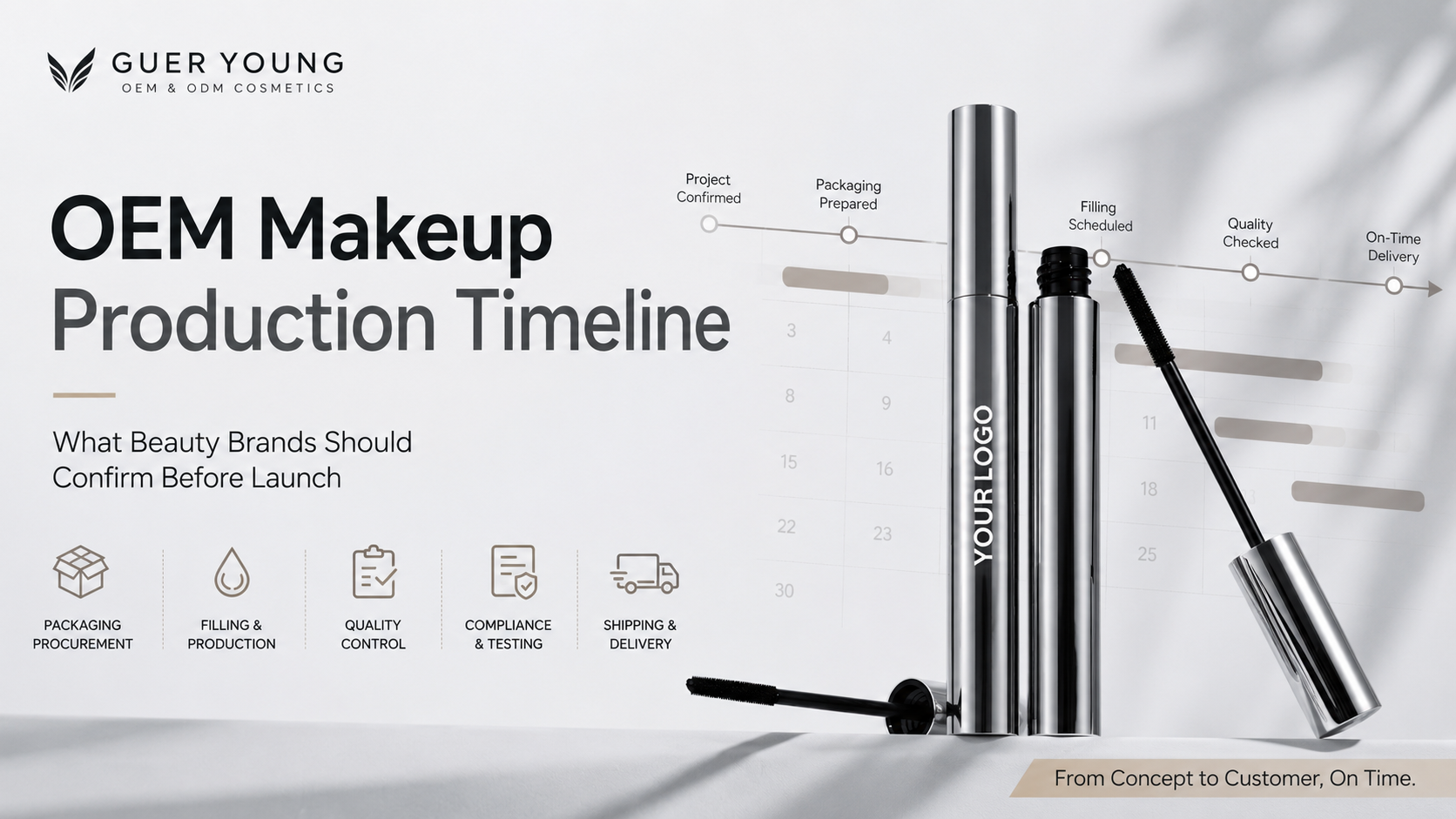
If you are planning your next cosmetic launch, here are five hidden lead time risks you should confirm before starting OEM cooperation.
1. Why Can Packaging Take Longer Than Formula Production?
Many beauty brands focus heavily on formula production timelines while underestimating the impact of packaging procurement.
For premium cosmetic products in the European and American markets, brands often request:
Custom mascara tubes
Specialized brushes
Electroplated packaging
UV gradient finishes
Metallic components
Magnetic closures
These are rarely standard stock items.
Customized packaging usually requires multiple steps, including:
Mold development
Sampling
Logo confirmation
Color matching
Surface treatment testing
Even a small revision can extend the timeline significantly.
Some suppliers only mention:
“Formula production takes 15 days.”
But they fail to explain:
“Packaging production may require 30–45 days.”
As a result, brands end up facing unexpected delays.
Before placing an OEM order, brands should confirm:
Whether packaging is in stock
Whether custom molds are required
Packaging supplier stability
Backup packaging options
Whether special decoration affects lead time
Professional OEM suppliers should provide a complete production schedule, not just a formula lead time.
2. Why Doesn’t Production Start Immediately After Ordering?
This is one of the most common misunderstandings among new beauty brands.
Most cosmetic factories operate different filling lines for different product categories, such as:
Mascara filling lines
Liquid eyeliner filling lines
Lip gloss filling lines
Powder pressing lines
Eye makeup products usually require stricter hygiene standards and equipment compatibility checks, making production scheduling more complicated.
During peak seasons such as:
Black Friday
Christmas
Summer product launches
Viral social media periods
Factory filling lines are often fully booked in advance.
Some suppliers may promise:
“Delivery within 25 days.”
But in reality:
Packaging has not arrived
Previous orders are still in queue
Filling schedules are not secured
This often leads to repeated shipment delays.
Instead of only asking about production lead time, brands should confirm:
Has the actual filling schedule already been reserved?
A realistic delivery schedule should include:
Raw material preparation
Packaging arrival
Filling time
Assembly time
Quality inspection
Shipment arrangement
These details determine whether products can truly launch on time.
3. Why Are Holiday Delays Often Underestimated?
Many overseas beauty brands are unfamiliar with how Asian supply chains operate during major holidays.
In China, holidays such as:
Chinese New Year
National Day
Labor Day
can significantly affect cosmetic production timelines.
The issue is not simply “a few days off.”
Actual delays may include:
Workers returning home early
Slow post-holiday recovery
Packaging factory shutdowns
Raw material shortages
Port congestion
As a result, a one-week holiday may create delays lasting more than a month.
Brands often encounter situations where:
Samples are approved but mass production cannot begin
Formula production is completed but packaging is unavailable
Finished products miss shipping schedules
For brands with fixed launch calendars, these disruptions can directly impact revenue plans.
To reduce risks, brands should:
Place peak-season orders 60–90 days earlier
Secure packaging in advance
Confirm shipping space early
Avoid scheduling launches immediately after major holidays
Proper planning is far more effective than last-minute order chasing.
4. Why Can Compliance Testing Delay Product Launches?
For the European and American markets, cosmetics must meet strict safety and compliance standards before entering the market.
This is particularly important for eye makeup products such as:
Eyelash growth serums
Waterproof mascaras
Long-wear eyeliners
Sensitive skin brow products
These products often require:
Stability testing
Microbiological testing
Packaging compatibility testing
Preservative challenge testing
Some brands may also require:
EU compliance documents
FDA-related files
Vegan certifications
Cruelty-free declarations
If these materials are not prepared early, brands may face situations where:
Products are completed but cannot legally launch.
Low-cost suppliers often emphasize:
“Cheap pricing”
“Fast production”
while lacking experience with Western regulatory requirements.
Before cooperation, brands should confirm:
Export experience in Europe and North America
Ability to provide testing documentation
Familiarity with international cosmetic regulations
Mature formulation support
These capabilities are often more valuable than low pricing.
5. Why Is Shipping Time More Complicated Than Expected?
Many brands assume:
Factory shipment means products are already on the way to market.
In reality, international logistics involves many uncertainties.
Cosmetic products containing liquids or creams often face stricter transportation inspections.
Common shipping delays include:
Ocean freight congestion
Port delays
Customs inspections
Amazon warehouse appointments
Third-party warehouse queues
Without proper logistics planning, brands may encounter situations where:
Products are fully completed
But unable to enter sales channels on time
Experienced OEM suppliers usually help clients plan:
Air freight vs. sea freight
DDP vs. FOB shipping terms
Carton specifications
Labeling requirements
Warehouse compliance standards
Reliable delivery means more than production completion — it means products arriving in the market successfully.
Why Is Stable Lead Time Management Critical for OEM Cosmetic Partnerships?
For beauty brands in Europe and North America, a reliable OEM supplier should offer more than manufacturing capability.
A strong supplier should also help brands:
Identify hidden risks early
Coordinate the supply chain effectively
Control overall timelines
Reduce launch uncertainty
This is especially important for eye makeup manufacturing, where packaging, filling precision, stability, and compliance all require careful coordination.
GUER YOUNG specializes in OEM and ODM solutions for mascara, eyelash growth serum, eyeliner, brow products, as well as lip makeup, face makeup, and cosmetic care products. For brands looking for a more stable and market-ready cosmetic supply chain, effective lead time management is often the key to a smoother and more successful product launch.


andy.li@gueryoung.com

We have 10 years of experience, focusing on the development and sales of high quality eyelash growth serum, mascara, eyebrow gel, eyebrow color and other products. We also offer custom services, from tube
design to cosmetic fillings and packaging


Room 1, C3 Factory Building, No.8803 Zhuhai Avenue, Lianwan Industrial Zone, Pingsha Town, Gaolan Port Economic Zone, Zhuhai, Guangdong,China
QUICK LINKS
D Zone,5/F, NO.8 CuiZhu 5th Street,
Qianshan Xiangzhou District,Zhuhai,
Guangdong,China,519070

lynn.zhou@gueryoung.com
winnie.zhong@gueryoung.com
niki.xu@gueryoung.com