
Why Do So Many Affordable Mascaras Cause Lashes to Fall Flat? The Formula Problems Suppliers Never Tell You About
Read in English | Lire en Français | Leer en Español | Lesen auf Deutsch
Many consumers have experienced the same frustrating issue with affordable mascaras: lashes look beautifully lifted right after application, but within a couple of hours, the curl disappears and the lashes start drooping again. Most people assume the problem comes from the mascara brush, so they keep changing applicators, trying new curling techniques, or even blaming their natural lashes.
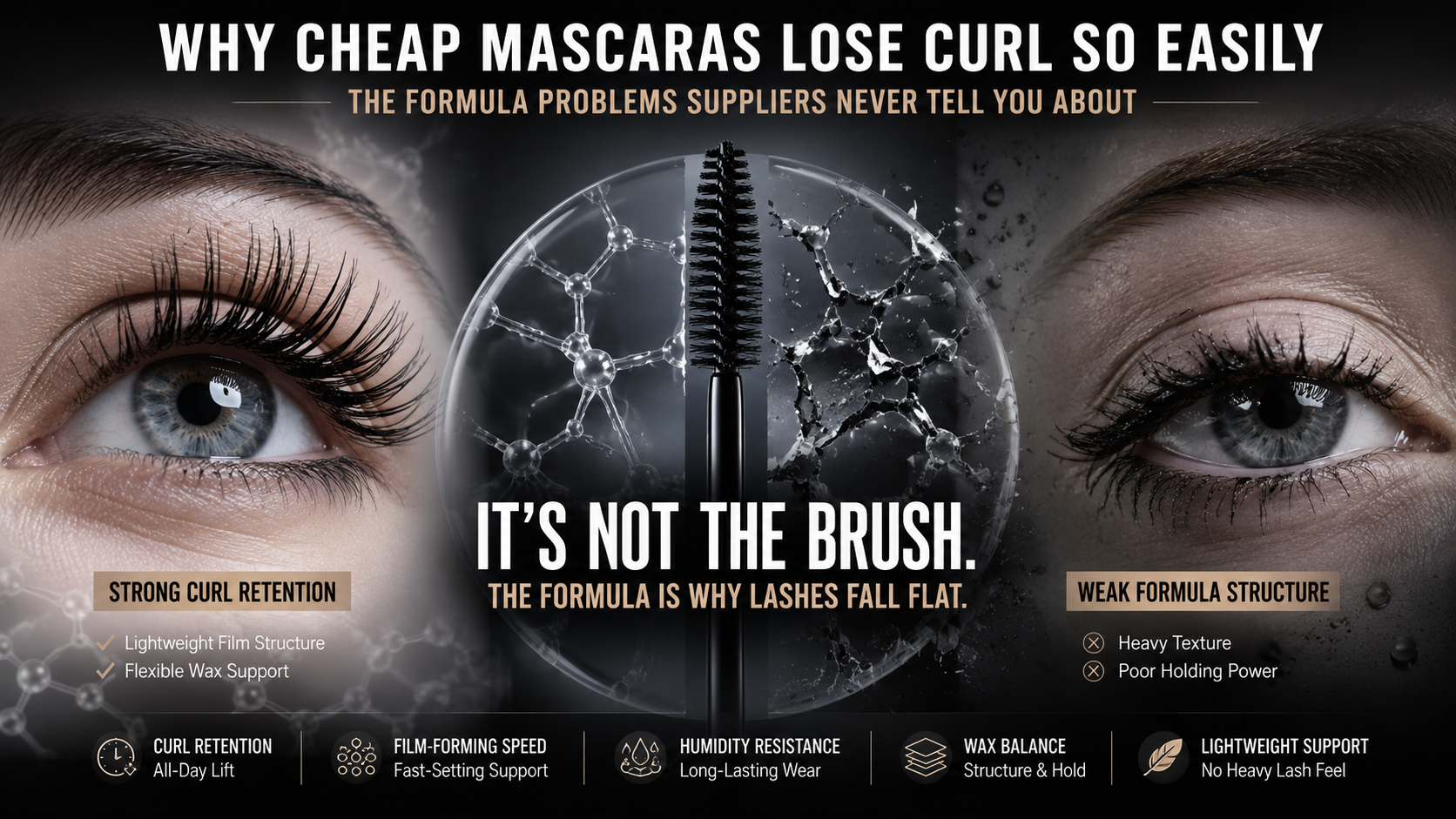
But in reality, the true reason behind collapsing lashes is usually not the brush at all — it’s the formula.
For beauty brands targeting the European and North American markets, frequent customer complaints such as “curl doesn’t last,” “lashes fall flat,” or “lashes soften after a few hours” are often signs of formulation compromises made during low-cost production.
As an independent cosmetics supplier specializing in eye makeup products, GUER YOUNG has seen many brands focus heavily on packaging, brush design, and marketing while overlooking the most important factor affecting repeat purchases: structural holding power within the mascara formula itself.
Why Cheap Mascaras Lose Curl So Easily
Long-lasting lash curl is fundamentally a “film-forming support” issue.
When mascara is applied, it creates a thin coating around each lash. That coating does more than provide color — it is responsible for holding the lash in its curled shape.
Many low-cost mascaras reduce or simplify key ingredients such as:
Film formers
Lightweight wax systems
Volatile solvents
Structural polymers
Moisture-resistant agents
As a result, lashes may appear lifted immediately after application because the wet formula temporarily shapes them upward. But once the product begins to dry and settle, the formula lacks the strength needed to maintain the curl.
Consumers see “lashes falling flat,” but the real issue is:
The formula cannot build a stable curl-support structure.
Is the Brush Really the Problem?
The mascara brush does matter, but its main role is shaping the lashes during application — not maintaining curl throughout the day.
Many brands overemphasize silicone brushes, curved brushes, or ultra-thin applicators while ignoring a critical reality:
If the formula lacks holding power, even the best brush cannot keep lashes lifted for long.
This explains why some mascaras:
Look amazing right after application
Perform well in photos or short videos
Appear dramatic in social media promotions
Yet fail in real-life wear after only a few hours.
Today’s European and American consumers are increasingly focused on authentic product performance, especially on platforms like TikTok, Instagram, and YouTube, where long-wear tests are everywhere.
If a mascara cannot maintain curl, consumers often associate it with:
Cheap formulation
Poor product quality
Weak oil resistance
Unsuitable performance for straight lashes
Low repurchase value
For beauty brands, this can seriously damage long-term reputation and customer loyalty.
Why Do Some Asian Supply Chains Struggle with Lash Retention?
Many factories producing low-cost mascaras prioritize:
Easy filling processes
Lower raw material costs
Faster production speed
Higher output efficiency
Unfortunately, this often means sacrificing essential curl-support ingredients.
Several common low-cost formulation approaches are especially likely to cause lash collapse.
1. Excessively Water-Based Systems
High-water-content formulas may feel smooth and lightweight during application, but they also make lashes heavier.
For naturally straight or downward-pointing lashes, additional weight quickly causes the curl to drop.
2. Unbalanced Wax Ratios
Quality waxes are expensive, so cheaper mascaras often reduce their concentration.
However, wax systems are essential for:
Lash structure support
Curl fixation
Long-lasting shape retention
Without a stable wax balance, lashes gradually lose support throughout the day.
3. Slow Film Formation
Some affordable mascaras dry too slowly because brands want a “creamy” or “easy-to-apply” texture.
The problem is that lashes begin falling before the film fully sets.
As a result, the curl never properly locks into place.
4. Weak Humidity Resistance
Consumers in Europe and North America expect mascaras to survive:
Long workdays
Humid environments
Sweat
Oily skin conditions
Without proper moisture resistance, lashes can quickly lose structure in humid weather.
This is one reason why many budget mascaras receive significantly worse reviews during summer seasons.
Consumers Are Becoming Harder to Impress with “Cheap but Pretty”
A few years ago, attractive packaging and low prices were enough to drive sales.
Today, social media reviews have educated consumers about product performance and formulation quality.
Long-wear curl retention tests are now standard content among beauty influencers.
Consumers compare products based on:
Curl retention after 4–8 hours
Smudge resistance
Clumping
Fiber fallout
Real-life wear performance
As a result, beautiful packaging alone is no longer enough to build long-term customer loyalty.
What truly creates repeat purchases is:
Consistent formula performance.
What Beauty Brands Should Focus on During Mascara Development
Brands that want competitive mascara products should pay close attention to several critical areas during development.
Curl Retention Testing
Testing should go beyond the “fresh application” effect.
More importantly, brands should evaluate:
Performance after 2 hours
Performance after 6 hours
High-humidity conditions
Outdoor environments
The key question is simple:
Do the lashes still stay lifted?
Formula and Brush Compatibility
Different brushes require different viscosity levels and drying speeds.
Poor formula compatibility can lead to:
Uneven application
Heavy lashes
Clumping
Weak support
Different Lash Characteristics Across Markets
Not all consumers have the same lash type.
Fine, straight, or downward-facing lashes often require significantly stronger support systems.
Brands entering international markets must account for these differences during product development.
Repurchase Potential
Many beauty brands focus heavily on first-time conversions.
But long-term profitability comes from repeat customers.
And in mascara products, repeat purchase decisions often depend on one thing:
Does the curl actually last all day?
How GUER YOUNG Helps Brands Avoid Lash Collapse Problems
As a professional eye makeup supplier, GUER YOUNG works closely with independent beauty brands, private label startups, and OEM/ODM clients across Europe and North America.
Our mascara development process focuses on real-world wear performance — not just immediate sample appearance.
We pay particular attention to:
Curl-support systems
Film-forming speed
Humidity resistance
Lightweight texture optimization
Long-lasting wear performance
Formula compatibility with different brush designs
In addition to mascara products, GUER YOUNG also provides:
Eyelash growth serums
Eyeliners
Brow products
Lip makeup products
Face makeup products
Skincare and personal care items
Helping beauty brands build a stronger and more complete product portfolio.
If your brand is looking for eye makeup products with genuine market competitiveness — not simply low-cost manufacturing — GUER YOUNG can provide more reliable formulation solutions tailored to the expectations of European and North American consumers.
Whether you are developing a new product line, launching a private label brand, or seeking OEM/ODM cooperation, you are welcome to explore our product solutions and sample development services further.


andy.li@gueryoung.com

We have 10 years of experience, focusing on the development and sales of high quality eyelash growth serum, mascara, eyebrow gel, eyebrow color and other products. We also offer custom services, from tube
design to cosmetic fillings and packaging


Room 1, C3 Factory Building, No.8803 Zhuhai Avenue, Lianwan Industrial Zone, Pingsha Town, Gaolan Port Economic Zone, Zhuhai, Guangdong,China
QUICK LINKS
D Zone,5/F, NO.8 CuiZhu 5th Street,
Qianshan Xiangzhou District,Zhuhai,
Guangdong,China,519070

lynn.zhou@gueryoung.com
winnie.zhong@gueryoung.com
niki.xu@gueryoung.com