
Why Cosmetic Bulk Orders Fail After Sample Approval: OEM QC Process to Ensure Consistency
Read in English | Lire en Français | Leer en Español | Lesen auf Deutsch
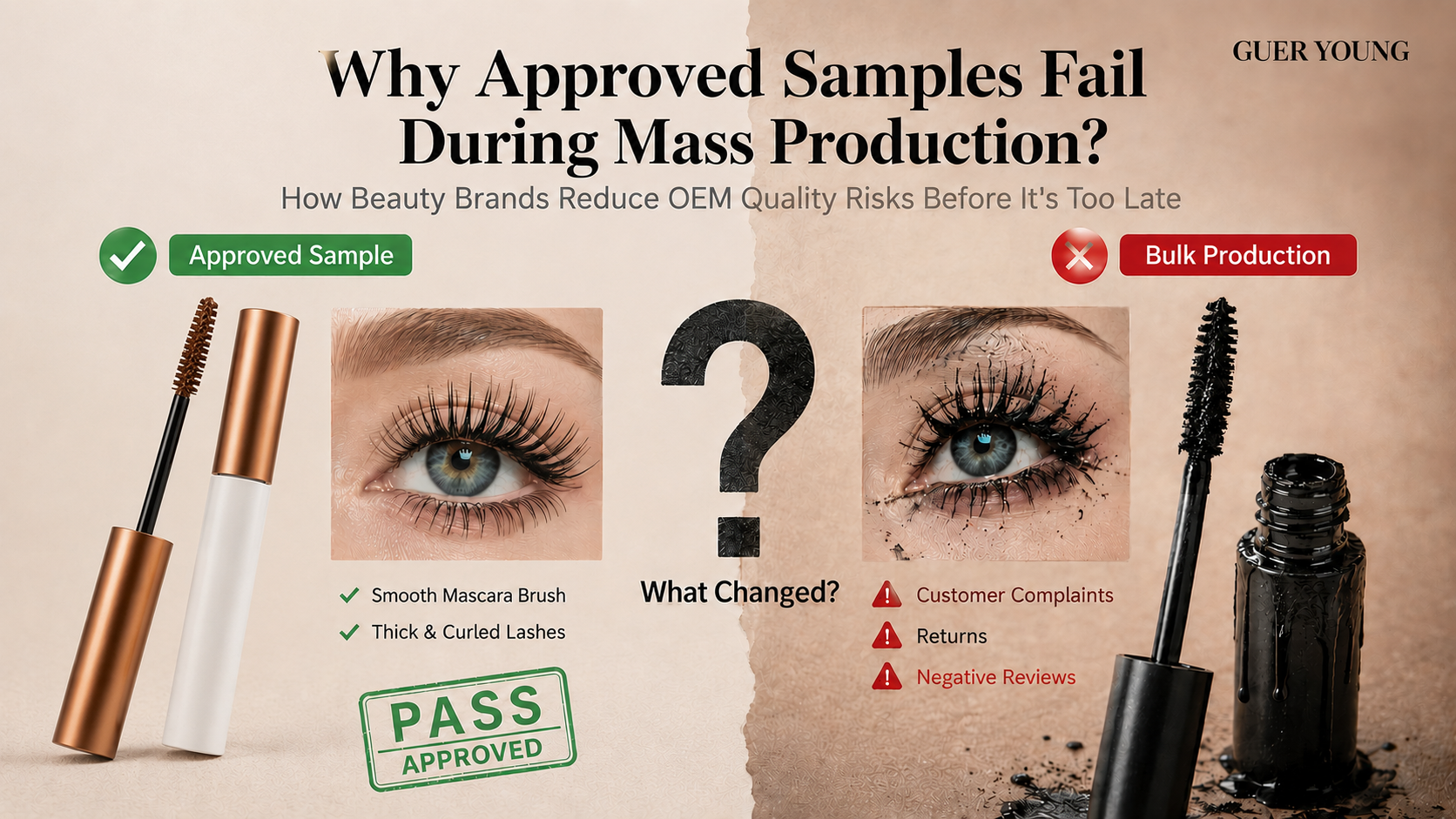
Why Do Approved Samples Fail During Mass Production?
For beauty brand procurement managers, finding a supplier is often not the biggest challenge. The real problem begins when a product performs perfectly during sampling but fails once production scales.
You may have experienced situations like these:
A mascara sample delivers smooth application and volume, but bulk orders arrive with clumping issues.
An eyelash growth serum performs consistently in early batches, then shows noticeable variations in later production runs.
A brow gel passes testing but generates customer complaints after launch.
Packaging leaks, cracks, or suffers printing defects during transportation.
Customer complaint rates increase, damaging brand reputation and repeat purchases.
These issues not only increase return and compensation costs but can also hurt your brand's performance on platforms such as Amazon, Sephora, Ulta, and other retail channels.
For procurement professionals, reducing customer complaints and minimizing OEM production risks has become a critical part of supply chain management.
Why Does Bulk Production Differ from Approved Samples?
Inconsistent Raw Materials
Many cosmetic OEM manufacturers source ingredients from multiple suppliers or different production batches to reduce costs.
For products such as eyelash growth serums, mascaras, and brow gels, even small ingredient variations can affect:
Texture
Adhesion
Color performance
Wear time
Overall user experience
The result is inconsistent product performance from batch to batch.
Skipping Pilot Production Validation
Some factories move directly from laboratory samples to mass production without conducting pilot runs.
This often overlooks critical factors such as:
Formula scale-up stability
Filling compatibility
Packaging compatibility
Transportation simulation testing
As a result, products that perform well in the lab may behave very differently in large-scale production.
This is one of the most common causes of cosmetic OEM production failures.
Weak Quality Management Systems
Many suppliers have manufacturing equipment but lack a comprehensive quality management process.
Common problems include:
Insufficient incoming material inspections
Limited in-process quality monitoring
Inadequate finished product testing
Poor batch traceability
As order volumes increase, these risks become significantly more difficult to control.
How Can OEM Manufacturers Systematically Reduce Quality Risks?
A professional cosmetic OEM partner should offer more than manufacturing capacity. They should provide a complete quality assurance system designed to protect your brand throughout the production lifecycle.
Step 1: Project Risk Assessment
Potential risks should be identified before product development begins, including:
Formula stability risks
Packaging compatibility risks
Regulatory compliance risks
Transportation and storage risks
Addressing issues early is far more cost-effective than fixing them after launch.
Step 2: Pilot Production Verification
A pilot production run should always be conducted before mass manufacturing.
Key validation areas include:
Formula stability at production scale
Filling accuracy
Packaging compatibility
High- and low-temperature transportation performance
This stage is one of the most effective ways to reduce cosmetic OEM production risks.
Step 3: Full-Process Quality Control
Professional manufacturers typically implement a three-stage quality control system.
Raw Material Inspection
All ingredients and packaging components are inspected before entering production.
In-Process Quality Control
Critical production parameters are monitored throughout manufacturing.
Finished Product Testing
Products are evaluated for:
Microbiological safety
Stability
Performance
Appearance
Packaging integrity
This helps ensure compliance with the quality expectations of North American and European markets.
Step 4: Batch Traceability Management
Every production batch should have complete documentation.
If a market issue occurs, manufacturers can quickly identify:
Ingredient sources
Production dates
Manufacturing records
Inspection results
This significantly reduces potential brand exposure and financial losses.
Why More Brands Choose OEM Partners with Proven Quality Systems
For procurement managers, factory capability is ultimately a form of risk management.
GUER YOUNG has specialized in the development and manufacturing of eyelash growth serums, mascaras, brow gels, and other eye beauty products for more than 10 years, serving over 100 beauty brands worldwide.
We provide a complete one-stop OEM solution, including:
Product planning
Formula development
Packaging design
Sample development
Filling and production
Quality assurance
International logistics support
Rather than focusing solely on manufacturing, we prioritize product consistency from sample approval through mass production.
For brands seeking a reliable cosmetic OEM manufacturer, an eyelash growth serum supplier, or a private label mascara partner, a strong quality management system is often far more valuable than the lowest production cost.
Industry Example: Reducing Customer Complaints by 42%
A growing European beauty brand experienced ongoing quality consistency issues with its mascara product line.
The challenges included:
Significant differences between production batches
Increased customer complaints regarding clumping
Rising return rates from retail channels
After implementing a more comprehensive OEM quality management framework, the brand:
Added pilot production validation
Introduced packaging compatibility testing
Strengthened raw material supplier controls
Established a complete batch traceability system
Within six months, the results were significant:
Customer complaints decreased by 42%
Product consistency improved by more than 35%
Repeat orders from distribution partners increased by 30%
Product ratings continued to improve
This reflects a growing industry trend: brands increasingly prioritize quality management capability when selecting manufacturing partners.
6 Questions Every Procurement Manager Should Ask Before Placing an Order
Before choosing a cosmetic OEM supplier, verify the following:
1. Do you conduct pilot production before mass manufacturing?
This helps ensure consistency between approved samples and bulk orders.
2. How do you manage raw material batch consistency?
Reliable ingredient sourcing is essential for product stability.
3. What quality control procedures are in place?
A complete system should cover raw materials, production, and finished goods.
4. Do you provide batch traceability?
Traceability helps reduce business risk and accelerate problem resolution.
5. Do you perform packaging compatibility testing?
This minimizes transportation damage and market complaints.
6. Do you have proven experience in my product category?
Experience with eyelash growth serums, mascaras, and brow gels can significantly reduce development and production risks.
Ready to Reduce Your Cosmetic OEM Risks?
Avoid costly production failures, inconsistent batches, and customer complaints before they impact your brand.
When evaluating a cosmetic OEM supplier, the most important question is not price.
Can they consistently deliver the same quality from sample approval to mass production?
Request Your Customized OEM Consultation
Based on your product requirements—including mascara, eyelash growth serum, brow gel, and other eye beauty products—GUER YOUNG can provide:
Formula development recommendations
Packaging and production feasibility analysis
Manufacturing scale-up planning
Quality control strategy consultation
Our goal is simple: help you identify potential risks before production begins and create a reliable path to successful commercialization.
Contact GUER YOUNG today for a one-on-one product development and manufacturing consultation, and discover how a robust quality management system can help reduce customer complaints, improve product consistency, and support long-term brand growth.


andy.li@gueryoung.com

We have 10 years of experience, focusing on the development and sales of high quality eyelash growth serum, mascara, eyebrow gel, eyebrow color and other products. We also offer custom services, from tube
design to cosmetic fillings and packaging


Room 1, C3 Factory Building, No.8803 Zhuhai Avenue, Lianwan Industrial Zone, Pingsha Town, Gaolan Port Economic Zone, Zhuhai, Guangdong,China
QUICK LINKS
D Zone,5/F, NO.8 CuiZhu 5th Street,
Qianshan Xiangzhou District,Zhuhai,
Guangdong,China,519070

lynn.zhou@gueryoung.com
winnie.zhong@gueryoung.com
niki.xu@gueryoung.com