Industry Insight: A fast-growing market trapped in a repeat-order dilemma
The global false eyelash market is growing rapidly. Across the UK, Europe, and international beauty markets, false lashes have evolved from a professional makeup accessory into a mainstream, everyday beauty category. Demand continues to expand across retail, e-commerce, and wholesale channels.
Yet behind this growth lies a structural contradiction: repeat orders at the wholesale level remain consistently low.
Many beauty wholesalers, distributors, and brand owners share the same experience. The first order happens smoothly. The second order is delayed. The third order often never comes. The familiar “one order and gone” pattern has become the norm rather than the exception.
This is not a demand problem. It is not purely a pricing problem either.
At its core, this is a product and channel design problem.
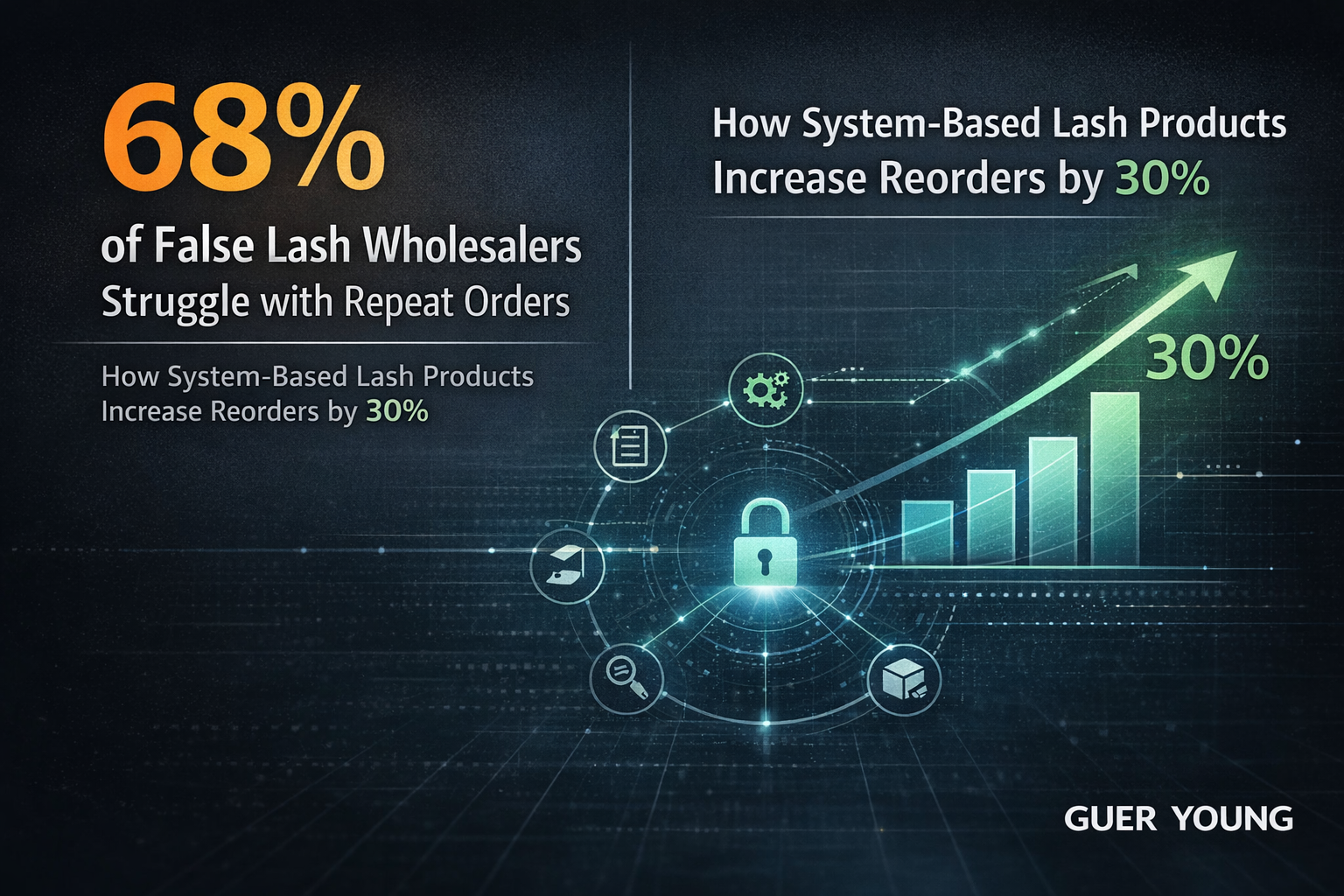
In fact, up to 68% of false eyelash wholesalers struggle with repeat orders not because their products fail—but because they lack a system-based product solution. Most false lashes are still sold as isolated SKUs, rather than as part of a structured, repeatable purchasing logic.
Why do 68% of false eyelash wholesalers fail to secure stable reorders?
Reason 1: False lashes are treated as one-off items, not replenishment products
In many wholesale portfolios, false lashes are positioned as occasional or seasonal items. Without a clear usage cycle, buyers have no reason to reorder on a predictable schedule.
Reason 2: Overloaded SKUs with no clear buying pathway
Too many styles, unclear naming, and weak usage differentiation force buyers to re-evaluate their choices every time they restock. Decision fatigue becomes a silent barrier to reordering.
Reason 3: Wholesale relationships remain transactional, not operational
When suppliers focus only on shipment volume rather than helping downstream partners sell through faster and more consistently, loyalty disappears quickly.
Market-backed observations:
A UK distributor reorganized false lashes into daily, occasion, and professional-use systems, resulting in nearly 30% higher reorder frequency.
A European e-commerce seller reduced return rates by 22% after switching from single styles to curated lash collections.
In Middle Eastern markets, repositioning lashes from “event-only” products to “daily beauty solutions” significantly increased order cycles.
Industry trade publications consistently highlight that future B2B beauty growth depends more on repeat-order velocity than on expanding assortments.
15 practical ways to build differentiated, repeat-driven wholesale performance
To break out of the repeat-order trap, suppliers must shift from product selling to system building. This can be done across three strategic dimensions:
1. Product Combination Strategy
Upgrade false lashes from single items to structured collections
Categorize by usage scenarios, not just styles
Create fixed replenishment sets
Reduce low-efficiency SKUs
Offer channel-exclusive system collections
2. Market & Brand Operations
Position lashes as a “system solution,” not a commodity
Standardize naming and visual logic
Provide downstream sellers with clear selling narratives
Build long-term usage value, not impulse demand
Support brand-building rather than pure volume distribution
3. Transaction & Service Optimization
Simplify ordering processes
Define annual purchasing rhythms
Guide customers on reorder timing
Use data to support replenishment decisions
Evolve from supplier to long-term business partner
How system-based false eyelash products increase repeat orders by 30%
What truly drives differentiation is not how many single units are shipped—but whether suppliers provide wholesalers with:
A repeatable success model
Products that naturally generate consumer reorders
A clear, structured annual purchasing cadence
System-based false eyelash products integrate product combinations, usage scenarios, and replenishment rhythm into one coherent framework. Buyers no longer start from zero every time they restock. Instead, they follow an established system that simplifies decisions and reduces risk.
When reordering becomes logical rather than optional, repeat orders happen naturally. Across multiple markets, this approach has consistently delivered around 30% improvement in reorder rates.
Final thoughts: Repeat orders are the real moat in wholesale beauty
The future of the false eyelash wholesale business does not lie in more styles—it lies in better systems.
System-based product solutions transform lashes from short-term transactions into long-term revenue drivers.
As a GUER YOUNG finished cosmetics independent supplier and B2B seller, I continue to see the same pattern globally: the most resilient wholesale channels are built on structured products, clear replenishment logic, and long-term repeat ordering.
If you are rethinking how to improve repeat orders and stabilize channel revenue in the false eyelash category, I’d be interested to exchange insights.
#falseeyelashes#lashes#finishedcosmetics#beautywholesale#cosmeticswholesale#systembasedproducts#repeatorders#reorderrate#B2Bbeauty#beautydistribution#ukbeautymarket#europeanbeauty#globalbeauty#wholesalers
#distributors#brandowners#largeretailers#ecommercesellers#OEMlashes#privatelabellashes#SKUmanagement#inventoryturnover#channelgrowth#profitstrategy#differentiation#supplychainpartners#beautytrends#productstrateg
y#channelstrategy#orderingcycle#longtermpartnership#customermanagement#wholesalepainpoints#repeatbusiness#highmargincategory#B2Bseller#beautybusiness#systemsolutions






