Read in English | Lire en Français | Leer en Español | Lesen auf Deutsch
For beauty brands selling in the European and American markets, shade consistency is no longer just a quality issue — it directly impacts customer trust, reviews, and repeat purchases.
Many cosmetic brands have faced situations like these:
The same lipstick shade looks darker in the next production batch
Customers complain that the product received doesn’t match previous purchases
Influencer swatches look different from the actual delivered products
Different warehouse batches create inconsistent customer experiences
On e-commerce platforms, these problems become even more serious.
Unlike offline retail, customers shopping on Shopify stores, Amazon, TikTok Shop, or Sephora online cannot physically test the product. Their purchasing decisions rely entirely on product photos, videos, influencer reviews, and shade descriptions.
Once the delivered color differs from expectations, refund requests, low ratings, and customer complaints increase rapidly.
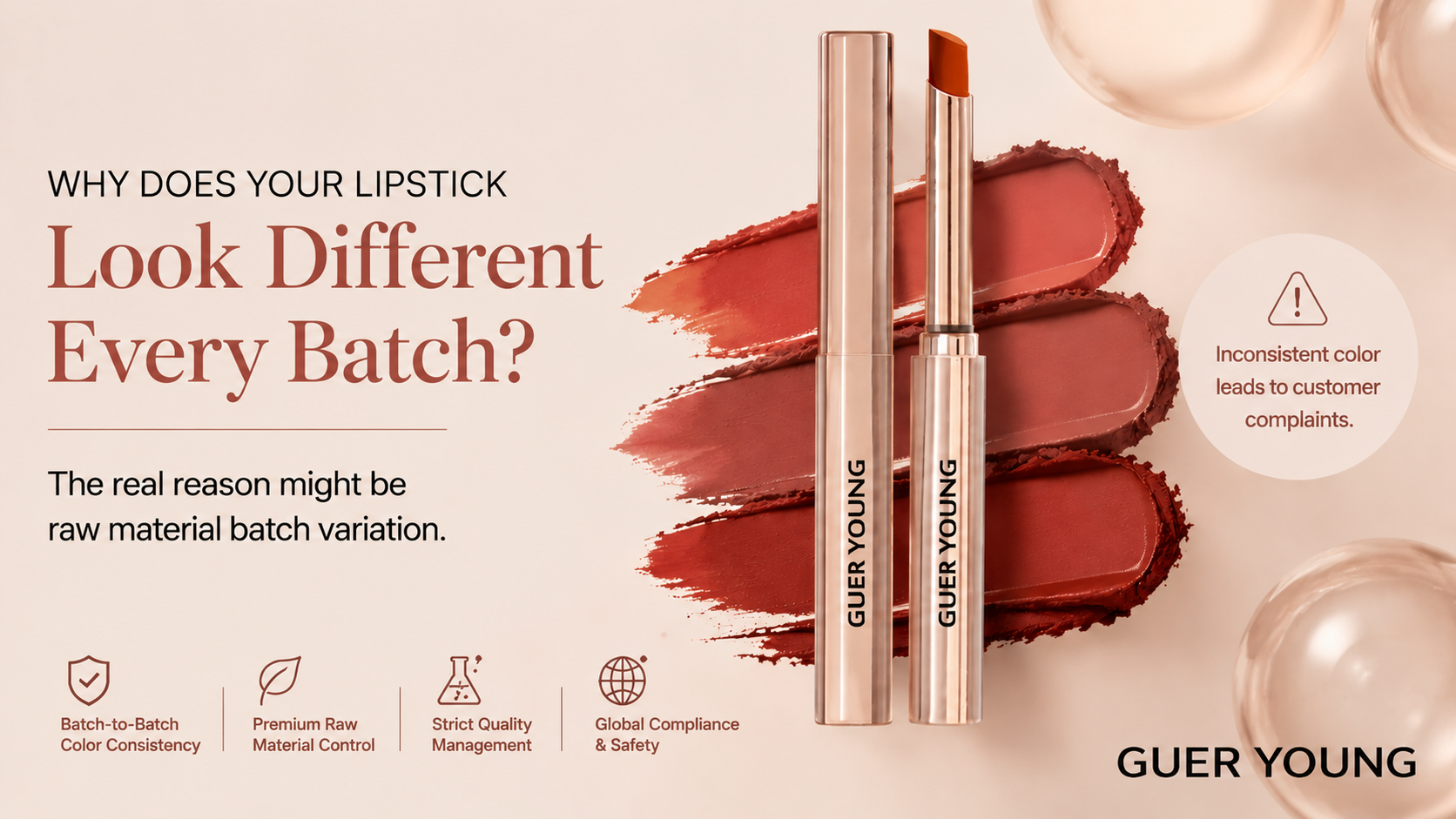
And in many cases, the root cause is not the formula itself — but the raw material batch.
Why Can the Same Formula Produce Different Colors?
A common misunderstanding in cosmetics manufacturing is:
“If the formula stays the same, the color should stay the same.”
In reality, lipstick and lip products are extremely sensitive to raw material variations.
Even when the formula percentage remains identical, slight differences in pigments, oils, waxes, or pearl powders can significantly affect the final shade.
This is especially common when:
Pigment particle sizes vary
Different raw material suppliers are used
Dispersion performance changes
Raw minerals come from different sources
Manufacturing processes are adjusted upstream
These differences may seem minor in the lab, but consumers can easily notice them on the lips.
For Western beauty consumers who expect strong shade consistency, even a subtle color shift can damage brand credibility.
Why E-Commerce Brands Are More Vulnerable to Shade Complaints
Online beauty brands face a unique challenge:
Customers expect the product they receive to perfectly match the online swatches.
When batch inconsistency happens, brands often experience:
Worse, consumers may assume the brand secretly changed the formula or lowered quality standards.
For growing indie beauty brands, this can seriously affect long-term brand reputation.
The Real Issue: Inconsistent Supply Chain Color Control
Many suppliers can “create a beautiful shade.”
Far fewer can reproduce the exact same shade consistently across multiple production batches.
That’s why experienced cosmetic manufacturers focus heavily on:
Raw material batch tracking
Pigment stability testing
LAB color measurement systems
Standardized sample development
Bulk production color control
For bestselling lipstick shades, consistency is often more important than trendiness.
Because once a shade becomes popular, brands must maintain identical performance across:
Without stable shade management, operational costs rise quickly.
How Professional Cosmetic OEMs Reduce Shade Mismatch Risks
When choosing a cosmetic manufacturing partner, brands should ask not only:
“Can you make this shade?”
But more importantly:
“Can you reproduce this shade consistently over time?”
Professional cosmetic suppliers typically control shade consistency through several key systems.
Stable Raw Material Sourcing
Reliable upstream suppliers are the foundation of shade stability.
Experienced factories usually:
Work with fixed pigment suppliers
Maintain raw material batch records
Test incoming pigment quality
Avoid frequent supplier switching
Standardized Sampling Procedures
Many future color issues begin during the sample development stage.
Professional manufacturers use:
to ensure better shade accuracy before production begins.
Pre-Production Batch Comparison
Before mass production, stable factories compare new batches against approved historical samples.
This often includes:
Batch sample retention
Archived shade references
Multi-light environment testing
Secondary color confirmation procedures
These steps significantly reduce customer complaints caused by visible shade differences.
Shade Stability Matters Beyond Lip Products
Many brands focus only on lipstick consistency, but eye makeup products are equally sensitive to color variation.
For example:
Black mascaras appearing grayish
Brown eyebrow pencils shifting undertones
Eyeliners losing pigment intensity
can all affect the final makeup result and customer satisfaction.
Consumers in European and American markets are highly detail-oriented when it comes to makeup performance, making consistency a critical part of brand loyalty.
Long-Term Brand Growth Starts with Supply Chain Stability
Today, customer acquisition costs for beauty brands continue to rise.
What truly determines long-term growth is whether customers receive the same trusted product every time they reorder.
GUER YOUNG provides stable cosmetic OEM/ODM solutions for beauty brands worldwide, specializing in eye makeup products including mascaras, eyelash serums, eyeliners, and brow products, while also offering lip makeup, face makeup, and skincare product development services.
By focusing on raw material control, shade consistency management, and stable batch production, GUER YOUNG helps brands reduce color mismatch complaints, improve customer satisfaction, and strengthen long-term repeat purchase performance.
If you are looking for a more reliable cosmetic manufacturing partner or want to improve shade consistency across your product line, GUER YOUNG is ready to support your brand’s growth with professional cosmetic development and production solutions.






