
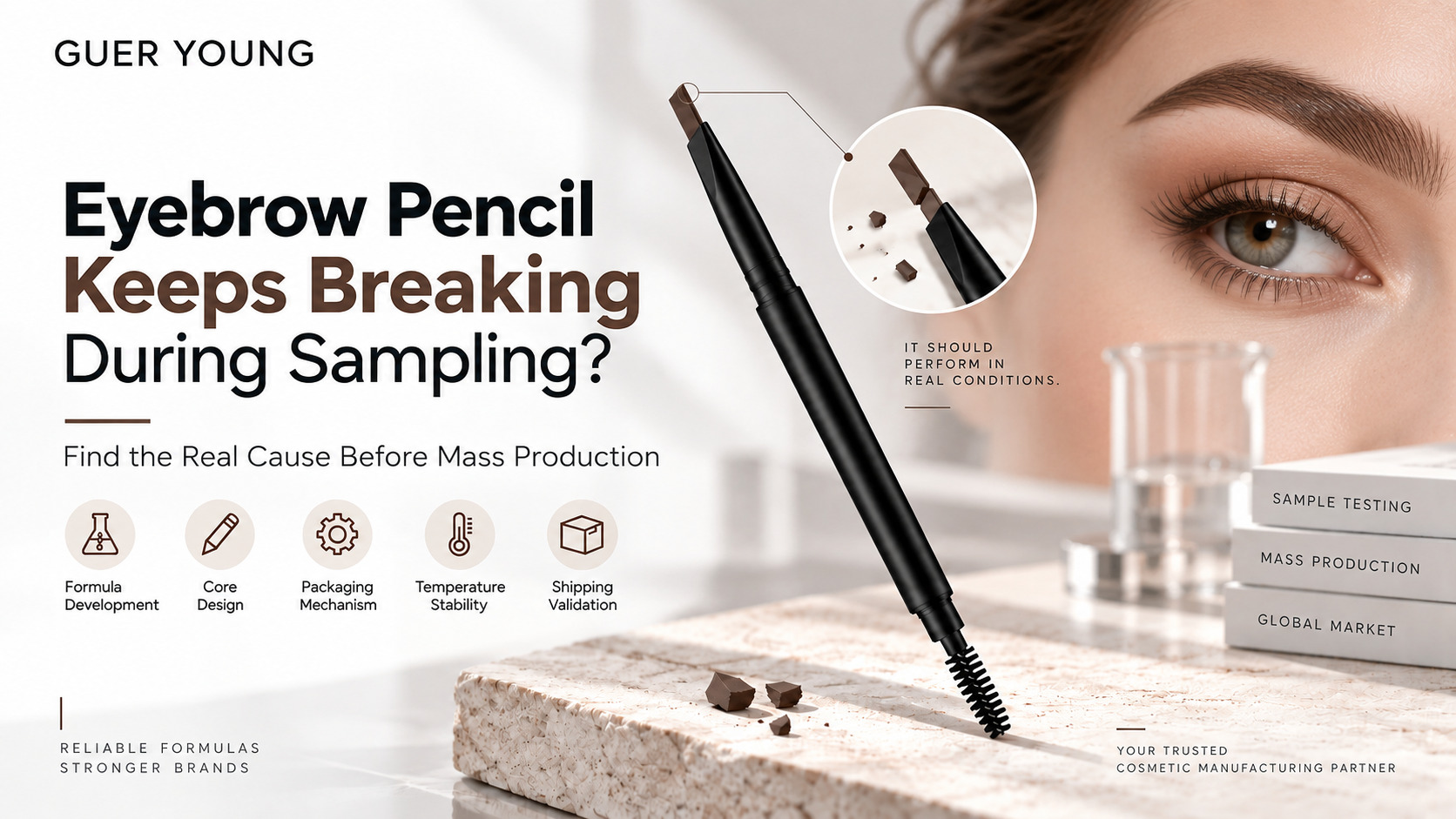
Eyebrow Pencil Keeps Breaking During Sampling? What Brands Should Test Before Mass Production
Read in English | Lesen auf Deutsch| Leer en Español | Lire en Français
Your private label eyebrow pencil sample looks great. The color is natural, the application feels smooth, and the fine tip creates precise strokes.
Then you extend the pencil a little further—and the tip breaks.
The first reaction is often:
“Is the eyebrow pencil formula too soft? Should we make it harder?”
Not necessarily.
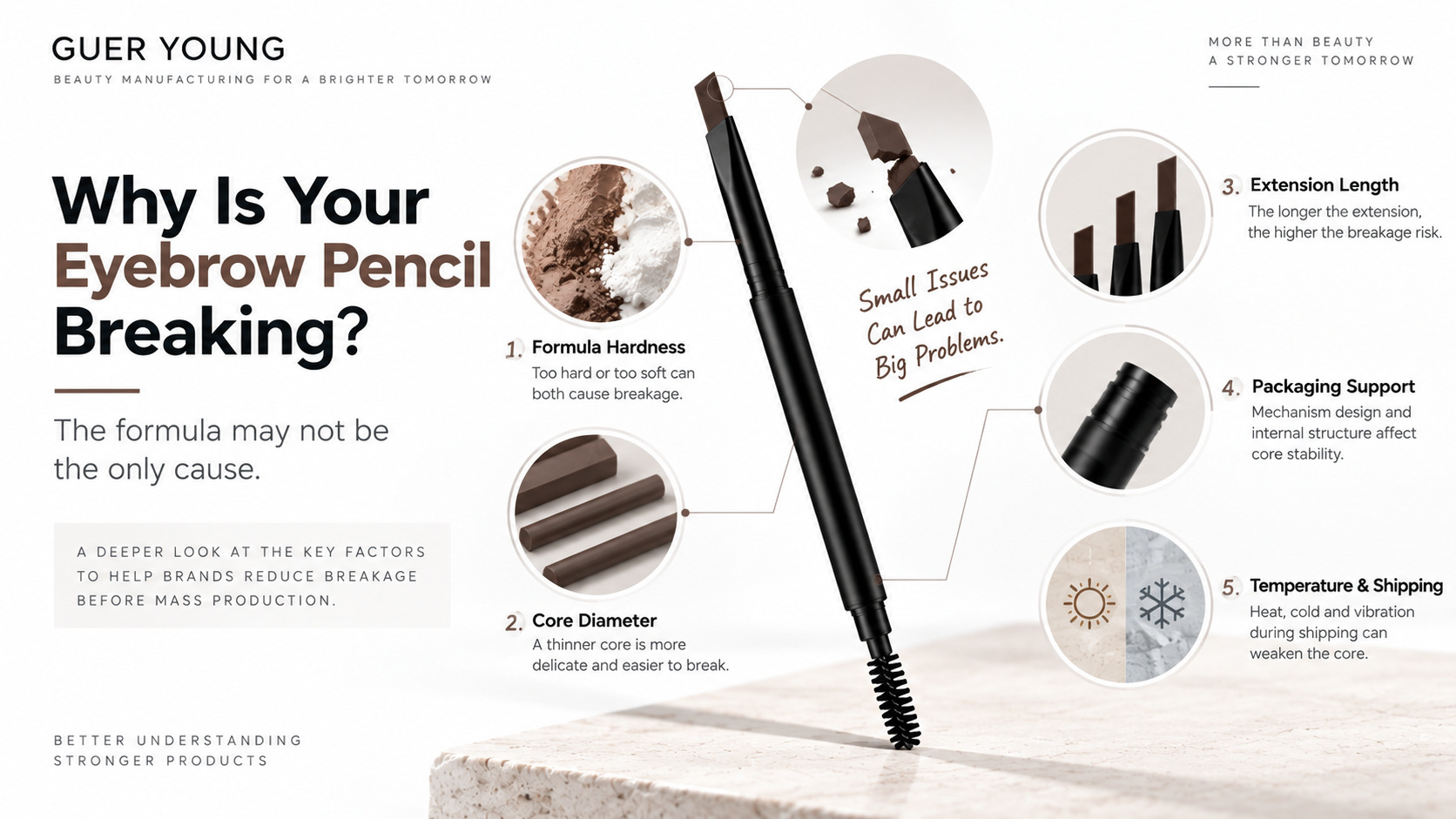
Eyebrow pencil breaking can be influenced by the wax-and-oil system, eyebrow pencil hardness, core diameter, tip design, packaging mechanism, extension length, temperature, and shipping conditions.
Simply making the formula harder may improve break resistance, but it can also reduce smoothness and natural color payoff.
For brands developing a private label eyebrow pencil or starting an eyebrow pencil OEM project, the real challenge is balancing smooth application, pigmentation, a fine tip, and structural strength.
Why Pencil Breakage Matters to Beauty Brands
Consumers do not see the formula structure or internal packaging mechanism. They see one thing:
“My eyebrow pencil keeps breaking.”
Repeated breakage can lead to negative reviews, returns, customer service issues, and lower repurchase rates.
That is why working with an eyebrow pencil manufacturer should involve more than approving the shade and testing a few strokes.
A sample that applies beautifully is not automatically ready for mass production.
It also needs to remain stable through repeated use, temperature changes, storage, and transportation.
Quick Diagnosis: How Is the Eyebrow Pencil Breaking?
Different types of breakage can point to different causes.
What You See
| What to Check | |
Tip breaks during application | Formula hardness, core diameter, pressure |
Core snaps when extended further | Core diameter, lateral force, mechanism support |
Core is already broken on arrival | Shipping vibration, impact, core fixation |
Breakage increases in hot conditions | Wax/oil system, temperature stability |
Harder formula becomes difficult to draw with | Formula balance, payoff, glide |
Core feels loose inside the component | Core holder and mechanism compatibility |
Before changing the formula, ask:
Where does it break? When does it break? Under what conditions?
Those answers can help identify whether the problem comes from the formula, core, packaging—or a combination of them.
Case Study: A Fine, Smooth Brow Pencil That Kept Breaking
In one private label eyebrow pencil project, the client had four clear requirements:
Natural color payoff
Smooth application
A fine, precise core
Good break resistance
The first two sample rounds delivered the desired makeup effect.
But during practical testing, one issue appeared:
When the pencil was extended slightly further, the tip became more likely to snap.
The client's first suggestion was to make the formula harder.
Instead of immediately increasing eyebrow pencil hardness, GUER YOUNG reviewed the product as a complete system.
We checked the wax-to-oil balance, core diameter and shape, how securely the eyebrow pencil core sat in the holder, lateral force at different extension lengths, and the temperature and transportation conditions the product might encounter.
The result?
The problem was not caused by one factor. It came from the interaction between smoothness, a fine core, and the packaging structure.
Making the formula harder could reduce breakage, but it could also compromise the smooth glide and natural payoff the client already liked.
Instead, we adjusted the structural balance of the eyebrow pencil formula and tested it together with the core dimensions and packaging.
Several sample versions were evaluated under different hardness levels, extension lengths, pigmentation requirements, and temperature conditions.
The final direction preserved the desired makeup effect while improving stability for real-world use.
The key takeaway:
A brow pencil that feels great during sampling is not necessarily ready for mass production.
Does a Harder Eyebrow Pencil Formula Prevent Breaking?
Not always.
A typical brow pencil formula combines waxes, oils, pigments, powders, and other structural ingredients.
Waxes help build structure, while oils influence glide, spreadability, and color release.
If the formula is too soft, it may feel exceptionally smooth but become less stable with a very fine core, longer extension, or higher temperatures.
Making it too hard can create other problems:
More drag during application
Lower color payoff
Less comfortable skin feel
More strokes needed to build color
For a custom eyebrow pencil formula, the goal is not maximum hardness. It is the right balance for the intended core, packaging, makeup result, and market.
Do Pigmentation and Core Diameter Affect Strength?
Yes. Both can change how a brow pencil performs.
Increasing pigmentation may require changes to pigments, powders, waxes, and oils. Those adjustments can affect friction, glide, hardness, and core structure.
For a long lasting eyebrow pencil, adhesion and wear also need to be considered alongside pigmentation and application feel.
Core diameter matters too.
Fine-tip pencils are ideal for creating hair-like strokes, but a thinner core can be more sensitive to lateral pressure—especially when consumers extend it further than expected.
Round, triangular, and flat cores also respond differently to pressure.
This is why the same eyebrow pencil formula should not automatically be used across every core size or tip design.
Formula, core geometry, and packaging support need to be evaluated together.
Can Packaging Cause Eyebrow Pencil Breaking?
Yes.
Some apparent “formula problems” actually originate from the packaging.
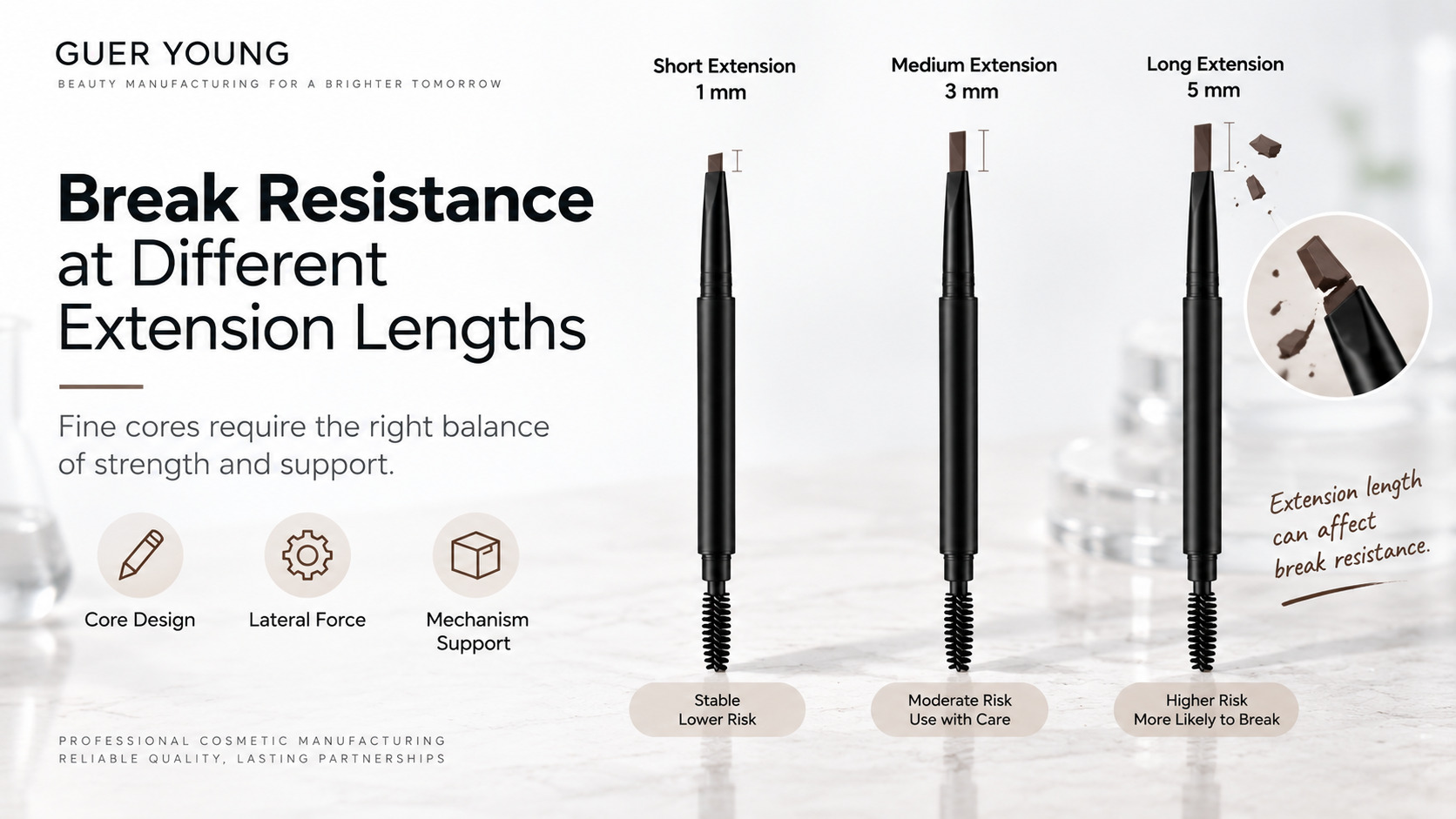
A retractable pencil combines the eyebrow pencil core, holder, twisting mechanism, and outer component. If the core is not held securely or the mechanism allows excessive movement, lateral force during application can increase.
Extension length is another important variable.
A pencil may perform perfectly when only a small amount of core is exposed, but behave differently when a consumer twists out several additional millimeters.
Instead of testing only:
“Does the pencil break?”
Ask:
“Under what conditions does the risk of breakage increase?”
That question is much more useful before approving mass production.
What About Temperature and Shipping?
A pencil that performs well in a controlled environment may behave differently after warehousing and international shipping.
Higher temperatures can soften certain wax-and-oil systems. Transportation can also expose fine cores to vibration, drops, and repeated impacts.
For this reason, GUER YOUNG recommends considering the target market and expected logistics conditions during sample development.
A product intended for a hot climate or long-distance international shipping should not be evaluated only through a room-temperature application test.
What Should Brands Test Before Mass Production?
During an eyebrow pencil OEM project, sample approval should go beyond:
“Is the shade right?”
and
“Does it feel smooth?”
Brands should consider testing:
Color payoff and consistency
Glide and application friction
Eyebrow pencil hardness
Break resistance at different extension lengths
Performance at different application angles and pressures
Core-to-holder fit
Twisting mechanism stability
Performance after temperature exposure
Core integrity after drop or transportation simulation
Adhesion, wear, and final makeup appearance
When developing a custom eyebrow pencil formula, comparing multiple sample versions can help identify the best balance between hardness, glide, pigmentation, and structural stability.
The goal is not to maximize one performance parameter.
The goal is to build a product that works as a complete system.
Smooth Application vs. Structural Strength
Eyebrow pencil development often involves trade-offs.
Brand Requirement
| Development Consideration | |
Smoother application | An overly soft system may reduce stability |
Finer core | More sensitivity to lateral force |
Stronger pigmentation | Formula structure may need rebalancing |
Better break resistance | Should not sacrifice application quality |
Longer wear | Adhesion, glide, and payoff must work together |
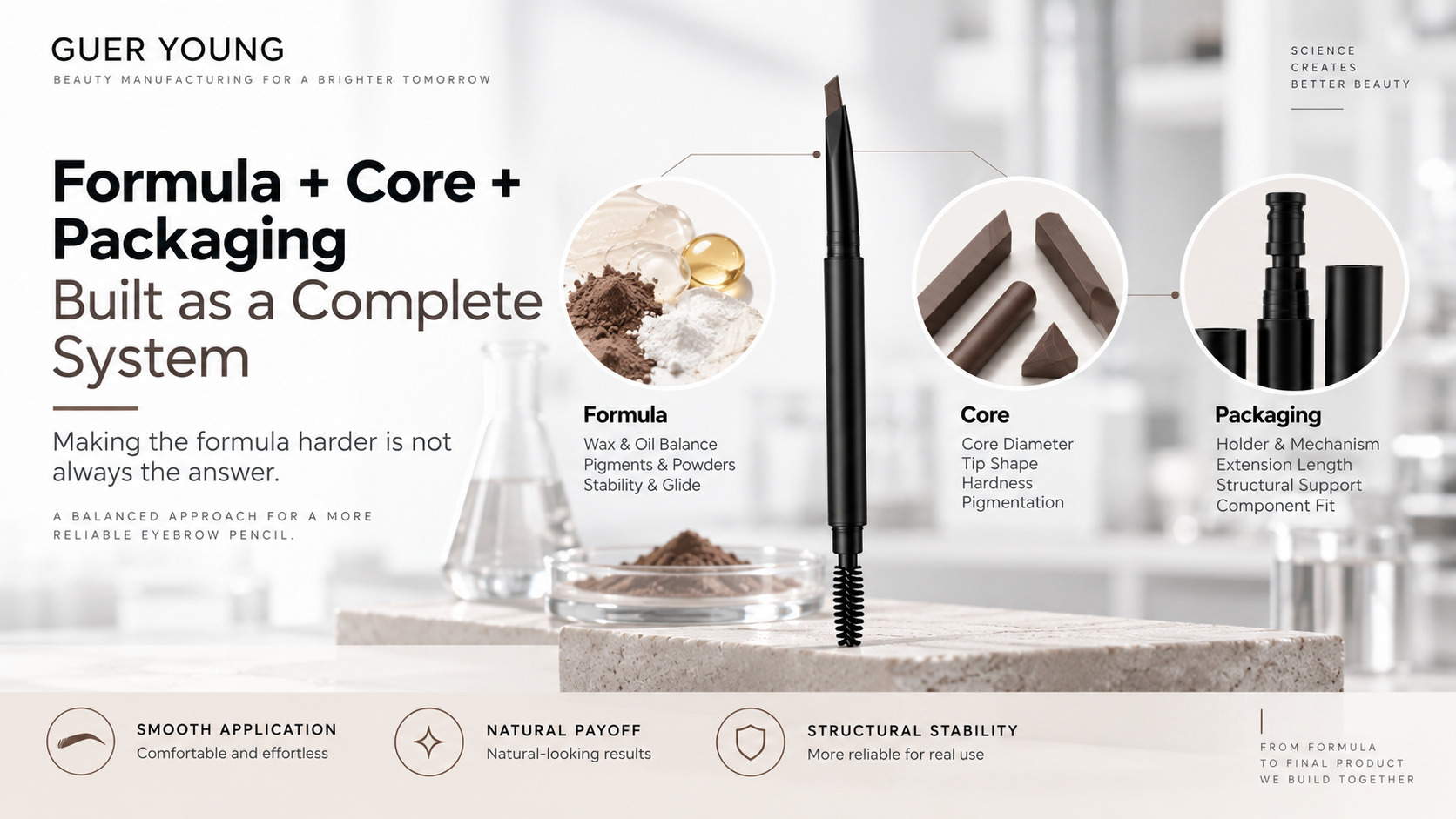
A successful eyebrow pencil is not simply “hard” or “soft.”
Formula, core, and packaging must work together.
For beauty brands, the real test is not whether a pencil feels good during a few strokes on a sample table. It is whether the finished product can maintain its intended performance through real consumer use.
That is why formula customization + sample testing should happen before mass production.
Is Your Eyebrow Pencil Sample Breaking?
If your current sample has a breakage problem, you may not need to start the entire project again.
Before the next sampling round, prepare:
Target core diameter and tip shape
Desired pigmentation and glide
Where and when the current sample breaks
Packaging specifications
Target sales markets
Performance characteristics you want to improve
For private label eyebrow pencil and eyebrow pencil OEM projects, GUER YOUNG provides formula customization + sample testing to evaluate the formula together with core dimensions, packaging compatibility, and intended use conditions.
Already have an eyebrow pencil sample that keeps breaking? Send us your product requirements and evaluate potential risks before mass production.
Don't wait for consumers to tell you why the pencil keeps breaking.
Find the potential failure points before production.


andy.li@gueryoung.com

We have 10 years of experience, focusing on the development and sales of high quality eyelash growth serum, mascara, eyebrow gel, eyebrow color and other products. We also offer custom services, from tube
design to cosmetic fillings and packaging


Room 1, C3 Factory Building, No.8803 Zhuhai Avenue, Lianwan Industrial Zone, Pingsha Town, Gaolan Port Economic Zone, Zhuhai, Guangdong,China
QUICK LINKS
D Zone,5/F, NO.8 CuiZhu 5th Street,
Qianshan Xiangzhou District,Zhuhai,
Guangdong,China,519070

lynn.zhou@gueryoung.com
winnie.zhong@gueryoung.com
niki.xu@gueryoung.com