
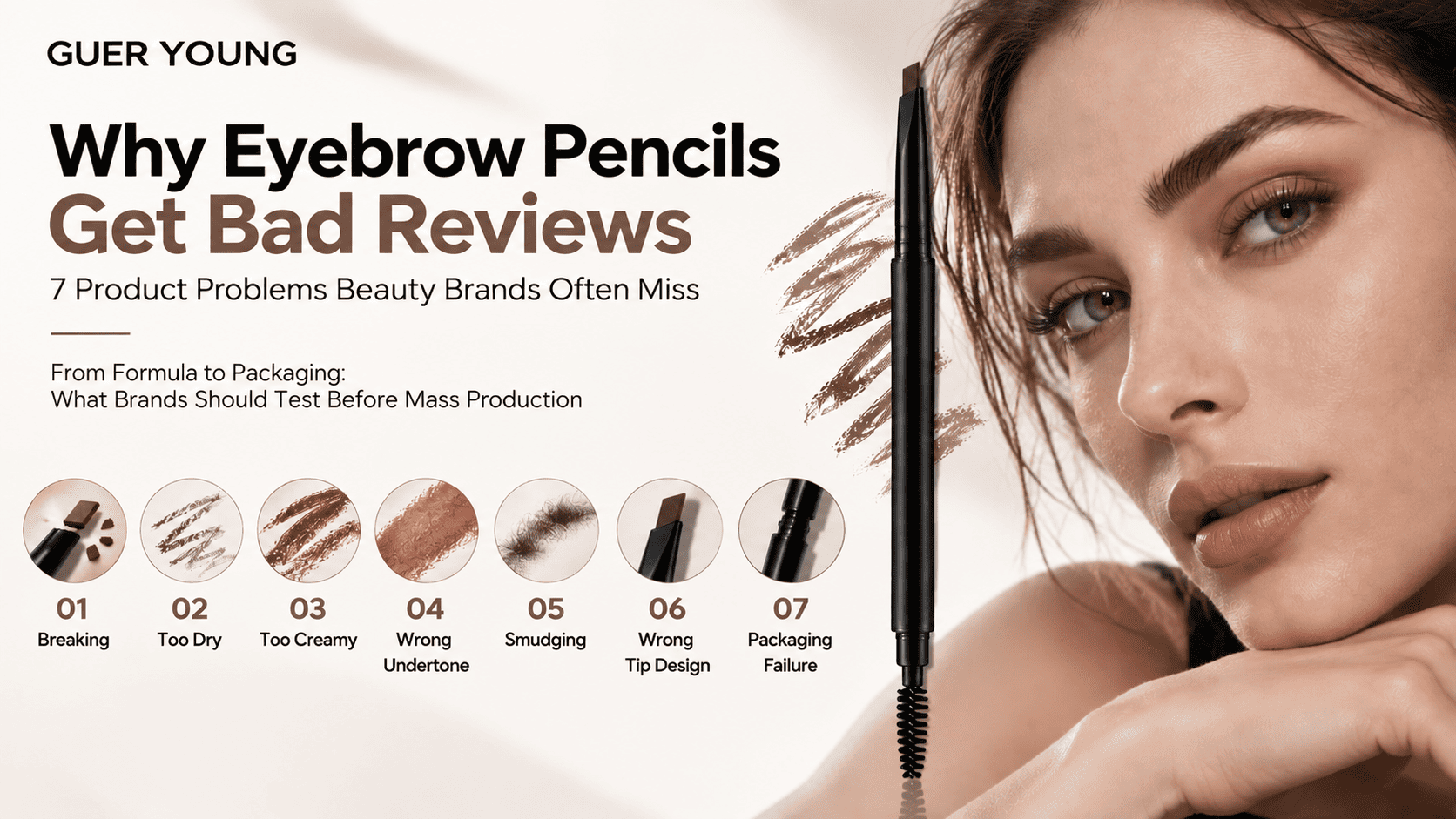
Why Eyebrow Pencils Get Bad Reviews: 7 Product Problems Beauty Brands Often Miss
Read in English | Lesen auf Deutsch| Leer en Español
An eyebrow pencil can look great during sample approval and still receive poor reviews after launch.
For beauty brands, the biggest risks often appear only after consumers have used the product several times:
The core keeps breaking.
The formula feels too dry.
The color looks too warm or red.
The pencil smudges after a few hours.
The core feels loose inside the component.
These eyebrow pencil problems may seem minor during product development. After launch, however, they can lead to negative reviews, returns, lower repurchase rates, and damage to brand reputation.
So before approving a custom eyebrow pencil or private label eyebrow pencil for mass production, there is one important question to ask:
What could consumers complain about after launch?
Here are seven product issues beauty brands should identify before a new brow pencil reaches the market.
1. Eyebrow Pencil Breaking: Is the Ultra-Fine Core Strong Enough?
Ultra-fine eyebrow pencils are designed to create precise, hair-like strokes.
But a thinner core also introduces a common product risk: eyebrow pencil breaking.
A pencil may perform perfectly when only a small amount of the core is exposed. Once a consumer twists it out farther, however, the risk of breakage can increase.
This is especially important for micro and ultra-fine brow pencils.
Before approving the product, brands should evaluate:
Core strength at different extension lengths
Breakage during repeated application
Stability under different application pressures
Performance at different temperatures
Compatibility between the core and packaging component
A good ultra-fine pencil needs to deliver precision without making the product feel fragile.
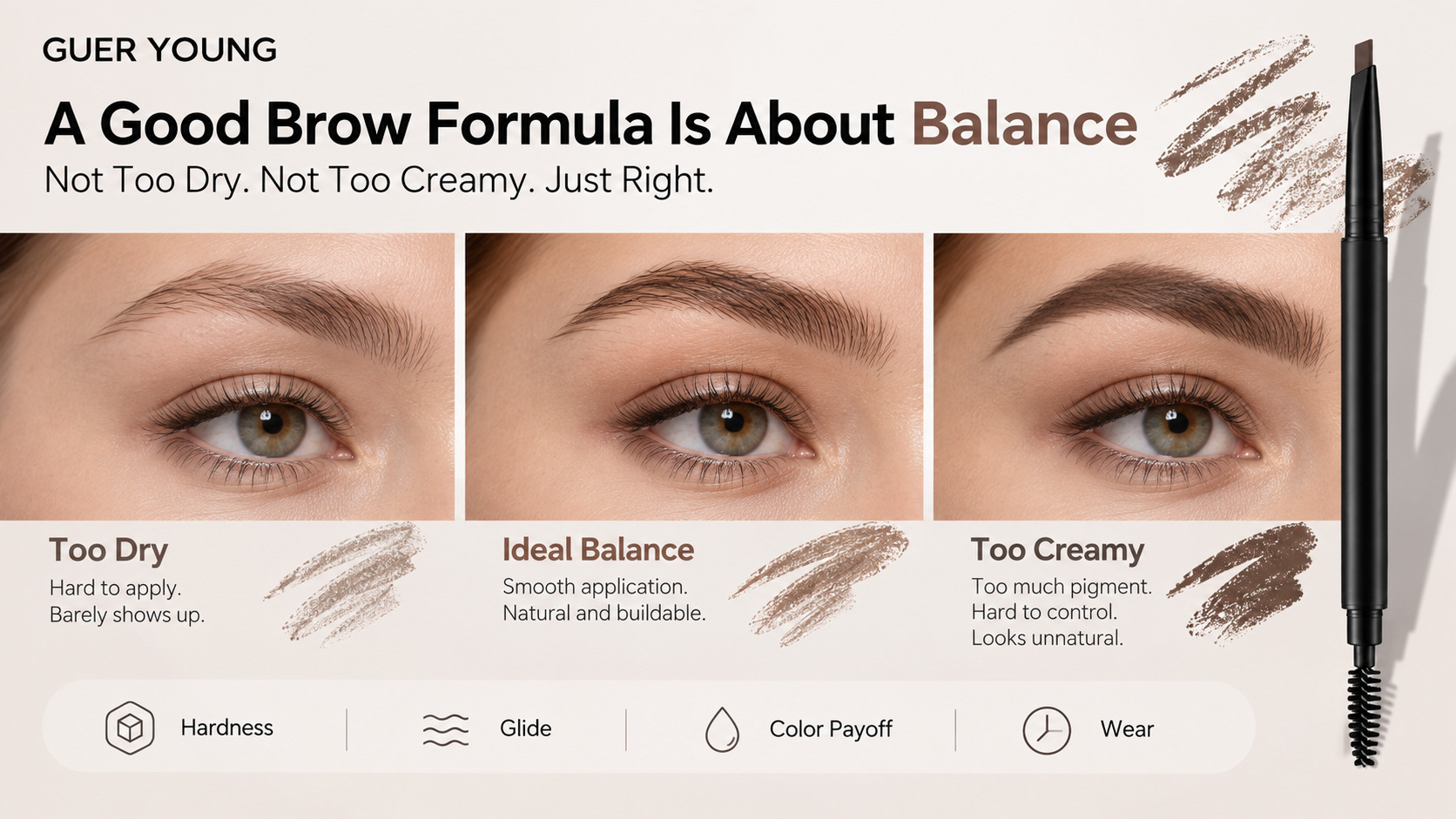
2. Too Dry: Does Better Wear Make Application More Difficult?
Long wear is an important selling point for brow products.
But making an eyebrow pencil formula harder does not automatically make the product better.
If the formula becomes too dry, consumers may need to go over the same area repeatedly just to build visible color.
That often turns into reviews such as:
“Too dry.”
“Hard to apply.”
“Barely shows up.”
The solution is not simply to make the core softer.
A softer formula may improve glide, but it can also increase pigmentation, smudging, or breakage.
The real development challenge is finding the right balance between hardness, glide, color payoff, adhesion, and wear.
3. Too Creamy: Can Consumers Control the Color Payoff?
The opposite problem can be just as damaging.
A very creamy brow pencil may feel impressive during the first swatch. But on the eyebrows, excessive color payoff can make it difficult to create a natural result.
This matters particularly for products positioned around:
Natural-looking brows
Hair-like strokes
Buildable color
Precise application
Consumers should be able to control the intensity rather than getting a heavy block of pigment in one stroke.
During eyebrow pencil product development, brands should test the product on actual brows—not only on the hand or arm.
A good swatch does not always equal a good consumer experience.
4. Why Does a Brown Eyebrow Pencil Look Too Red?
Shade complaints are another frequent source of poor reviews.
Brown, Dark Brown, Taupe, and Ash Brown may sound straightforward, but their undertones can look very different depending on skin tone, hair color, and lighting.
A brown shade that looks balanced in the pencil may appear too red or warm once applied to the brows.
An overly gray shade can create the opposite problem and look harsh on some consumers.
When working with an eyebrow pencil supplier, brands should evaluate shades through actual application instead of relying only on a color reference or arm swatch.
A better development process looks like this:
Target Market → Skin Tone → Hair Color → Brow Application → Shade Adjustment
The final shade should be judged by how it looks on the consumer, not just inside the laboratory.
5. Waterproof but Still Smudging: What Went Wrong?
A waterproof eyebrow pencil can still receive complaints about poor wear.
Why?
Because consumers do not encounter water alone.
Their brow makeup is exposed to:
Sweat
Sebum
Heat
Humidity
Friction
Hours of wear
A simple water test therefore tells only part of the story.
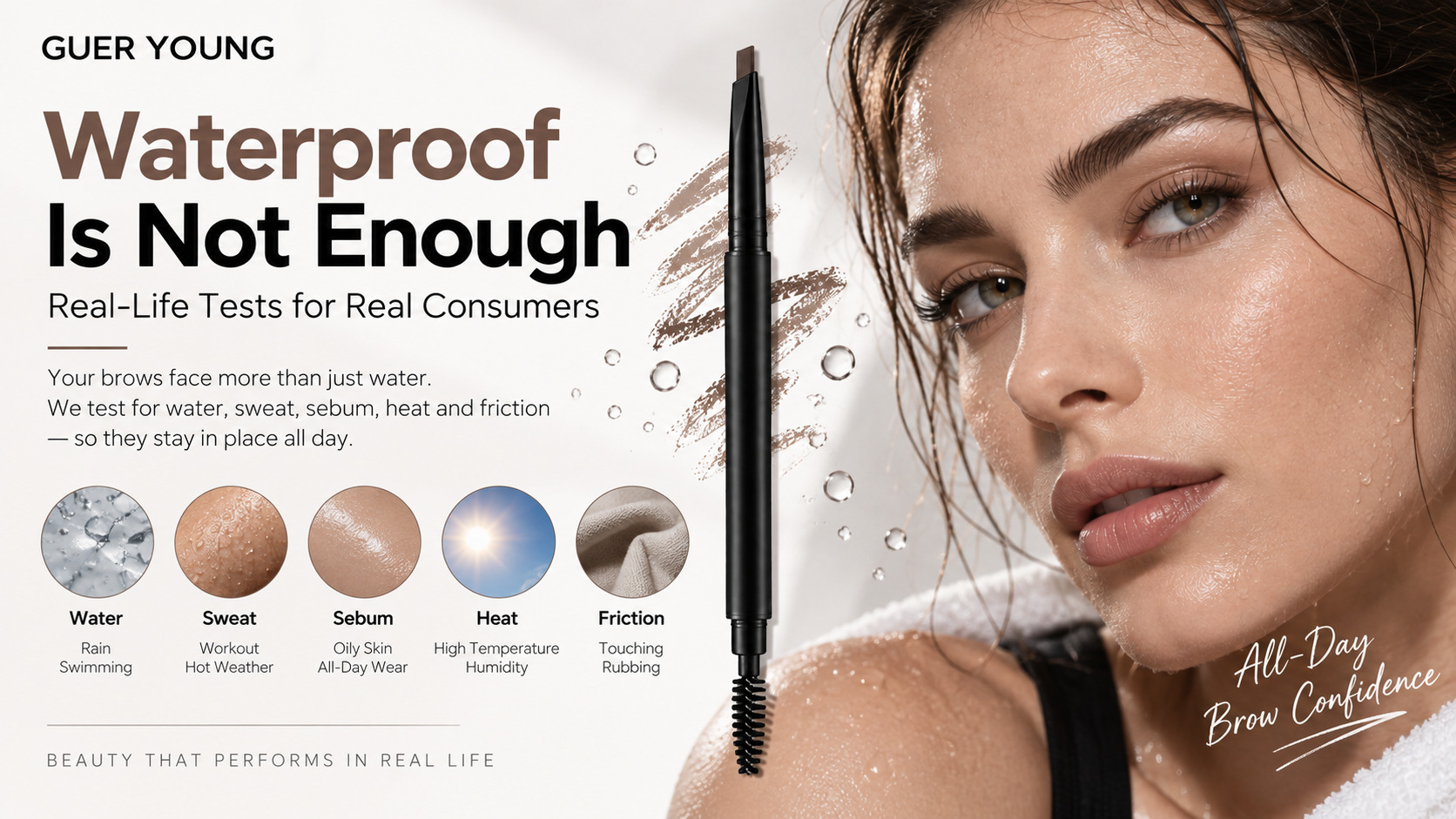
For a waterproof or long-wear positioning, brands should consider evaluating water resistance, sweat resistance, sebum resistance, rub resistance, smudge resistance, and long-wear performance.
Products intended for hot or humid markets may require additional stability testing.
“Waterproof” and “stays in place all day” are not necessarily the same product requirement.
6. Does the Tip Design Match the Consumer's Brow Routine?
Tip design directly affects how consumers use an eyebrow pencil.
An ultra-fine tip works well for creating individual hair-like strokes.
A triangle tip can combine outlining with filling.
A flat or angled tip may make it faster to fill sparse areas.
A common development mistake is choosing a popular component first and building the product concept around it afterward.
A stronger process starts with the consumer:
Target Consumer → Brow Routine → Desired Result → Tip Design → Formula → Packaging
If the marketing promise is “natural hair-like strokes,” the tip and formula must actually make those strokes easy to create.
7. Is the Formula Good but the Packaging Failing?
Consumers do not review the bulk formula separately from the package.
They review the finished eyebrow pencil.
That means an otherwise good formula can still receive a one-star review because:
The spoolie feels too stiff.
The cap becomes loose.
The pencil core wobbles.
The retractable mechanism jams.
The core does not retract properly.
The pencil becomes loose after repeated use.
This is why eyebrow pencil quality should be evaluated at the finished-product level.
When selecting an eyebrow pencil manufacturer, brands should ask:
Are we testing only the formula—or the complete product consumers will actually use?
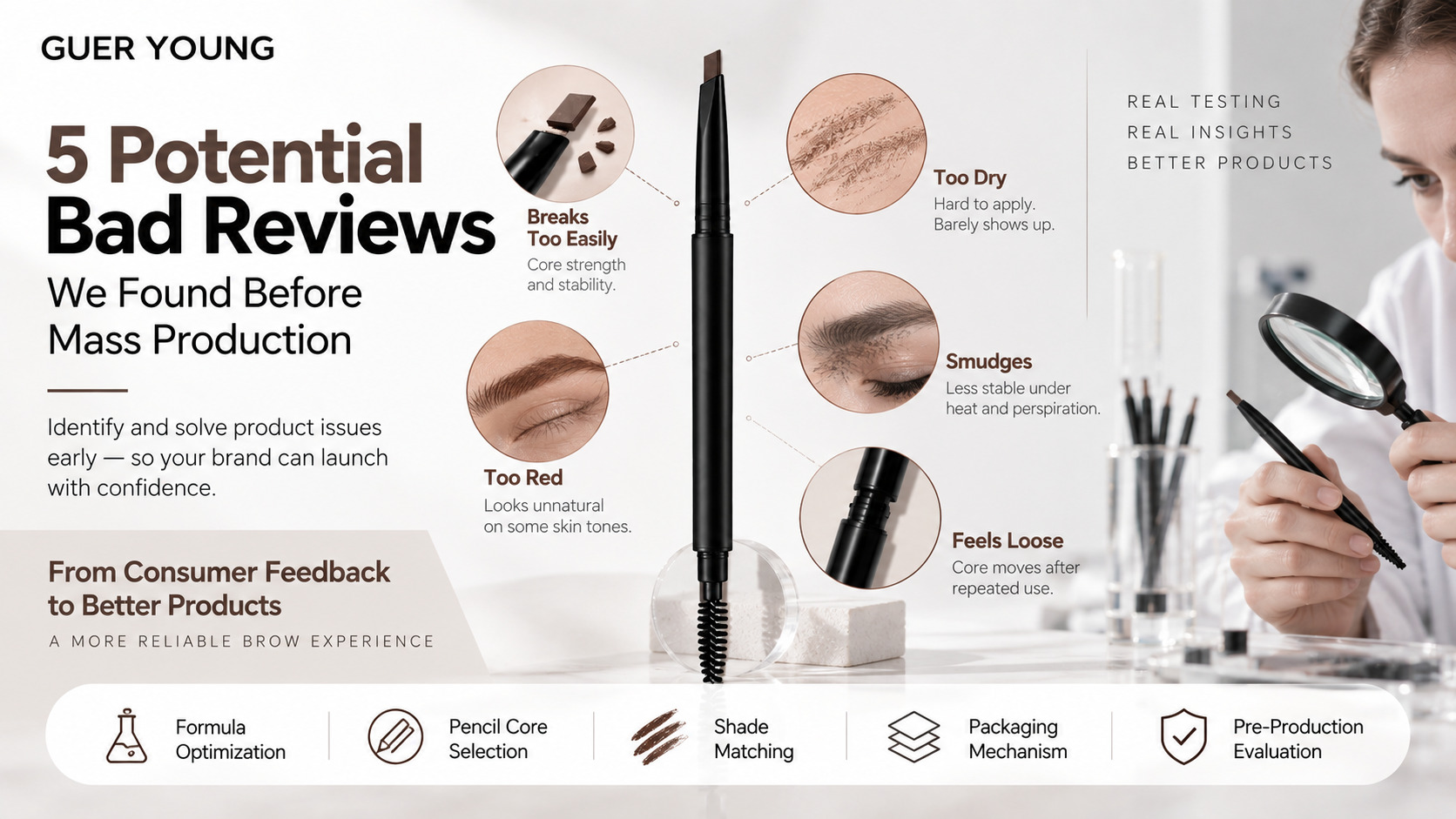
Case Study: We Found 5 Potential Bad Reviews Before This Ultra Fine Eyebrow Pencil Went Into Production
A beauty brand approached us to develop an Ultra Fine Eyebrow Pencil.
The positioning was clear:
Natural Hair-Like Strokes + Precise Application + Waterproof Wear
The initial samples looked promising.
But the client was less concerned about whether the product could be made and more concerned about what might happen after launch.
Their question was simple:
“Could small product issues turn into a large number of negative reviews?”
Instead of moving directly into mass production, we evaluated the product again based on real consumer use scenarios.
What Did We Find?
Five potential issues appeared during testing:
1. The ultra-fine core could break when extended too far.
2. The original formula was slightly too hard and required repeated strokes to build color.
3. One brown shade appeared too red on certain skin tones and hair colors.
4. Smudge resistance was less stable under heat and perspiration.
5. The core occasionally felt slightly loose after repeated use of the retractable mechanism.
None of these issues looked catastrophic on its own.
Together, however, they could easily become five consumer reviews:
“Breaks too easily.”
“Too dry.”
“The color looks too red.”
“Smudges after a few hours.”
“The pencil feels loose.”
We Didn't Just Change the Formula
Making the formula softer might solve the dry application problem.
But it could also affect break resistance, color payoff, and smudge performance.
So GUER YOUNG approached the project across four connected areas:
Formula + Pencil Core + Shade + Packaging Mechanism
The hardness and glide of the core were rebalanced to create buildable color without making application too heavy.
The brown shade was adjusted and reviewed across different skin tones and hair colors.
Water, sweat, friction, and heat-related performance were evaluated based on the product's waterproof positioning.
The core and retractable component were also rematched and tested at different extension lengths and through repeated use.
After several rounds of adjustment, the client approved the final version for production.
What mattered was not simply that we had developed another eyebrow pencil.
The real value was this:
We identified potential bad reviews before consumers had the chance to write them.
Eyebrow Pencil Pre-Launch Checklist for Beauty Brands
Before approving a private label eyebrow pencil or fully customized brow pencil for mass production, Product Managers can use the following questions as a practical review checklist.
Area
Question to Ask Before Approval
Pencil Core | Does it break at different extension lengths? |
Formula | Is it too dry, too soft, or too pigmented? |
Application | Can consumers build color naturally? |
Shade | Does it look natural across target skin tones and hair colors? |
Wear | How does it perform against water, sweat, sebum, and rubbing? |
Tip Design | Does it support the intended brow look? |
Mechanism | Does the core remain stable after repeated twisting? |
Packaging | Are the cap, spoolie, and internal components reliable? |
Stability | Does heat, cold, or transportation affect performance? |
Finished Product | Does mass-production performance match the approved sample? |
If these questions do not have clear answers, “the sample looks good” may not be enough reason to approve mass production.
Turn Consumer Complaints Into Product Specifications
One of the most useful ways to improve eyebrow pencil product development is to stop treating consumer complaints as vague opinions.
Instead, translate them into product requirements that R&D, quality teams, and suppliers can evaluate.
For example:
“Breaks too easily.”
Turn it into tests for core strength, extension length, application pressure, and component stability.
“Too dry.”
Evaluate hardness, glide, color payoff, and buildability.
“The shade looks too red.”
Review the shade on different skin tones, undertones, hair colors, and actual brows.
“Smudges after a few hours.”
Evaluate water, sweat, sebum, friction, and long-wear performance.
“The pencil feels loose.”
Check core dimensions, component tolerances, and retractable mechanism compatibility.
This changes the development conversation.
Instead of waiting for consumers to identify a problem after launch, the brand and eyebrow pencil supplier can define the risk before production and build it into the approval process.
What Should Beauty Brands Look for in an Eyebrow Pencil Manufacturer?
MOQ, pricing, lead time, shade options, and packaging choices all matter when selecting a manufacturing partner.
But for brands trying to build products with strong repeat-purchase potential, there is another question worth asking:
Can the manufacturer help identify what consumers may dislike before the product launches?
A capable eyebrow pencil manufacturer should not only ask:
“What shade do you want?”
The development conversation should also include:
“What could your consumers complain about?”
For custom eyebrow pencil and private label eyebrow pencil projects, GUER YOUNG supports brands across formula development, shade matching, pencil-core selection, packaging compatibility, and pre-production evaluation.
The goal is to identify potential product issues while there is still time to fix them.
Because changing a formula or component during development is one thing.
Discovering the same problem after inventory has been produced, marketing budgets have been spent, and negative reviews have started accumulating is much more expensive.
If you are developing an Ultra Fine Eyebrow Pencil, Waterproof Eyebrow Pencil, Micro Brow Pencil, or another customized brow product, GUER YOUNG can support development based on your brand positioning, target consumers, and product requirements.
Fixing a product issue before mass production costs far less than managing bad reviews after launch.


andy.li@gueryoung.com

We have 10 years of experience, focusing on the development and sales of high quality eyelash growth serum, mascara, eyebrow gel, eyebrow color and other products. We also offer custom services, from tube
design to cosmetic fillings and packaging


Room 1, C3 Factory Building, No.8803 Zhuhai Avenue, Lianwan Industrial Zone, Pingsha Town, Gaolan Port Economic Zone, Zhuhai, Guangdong,China
QUICK LINKS
D Zone,5/F, NO.8 CuiZhu 5th Street,
Qianshan Xiangzhou District,Zhuhai,
Guangdong,China,519070

lynn.zhou@gueryoung.com
winnie.zhong@gueryoung.com
niki.xu@gueryoung.com