
The Hidden Cost Draining Beauty Brands: How Repeated Sampling Delays Your Cosmetic Launch Timeline
Read in English | Lire en Français | Leer en Español | Lesen auf Deutsch
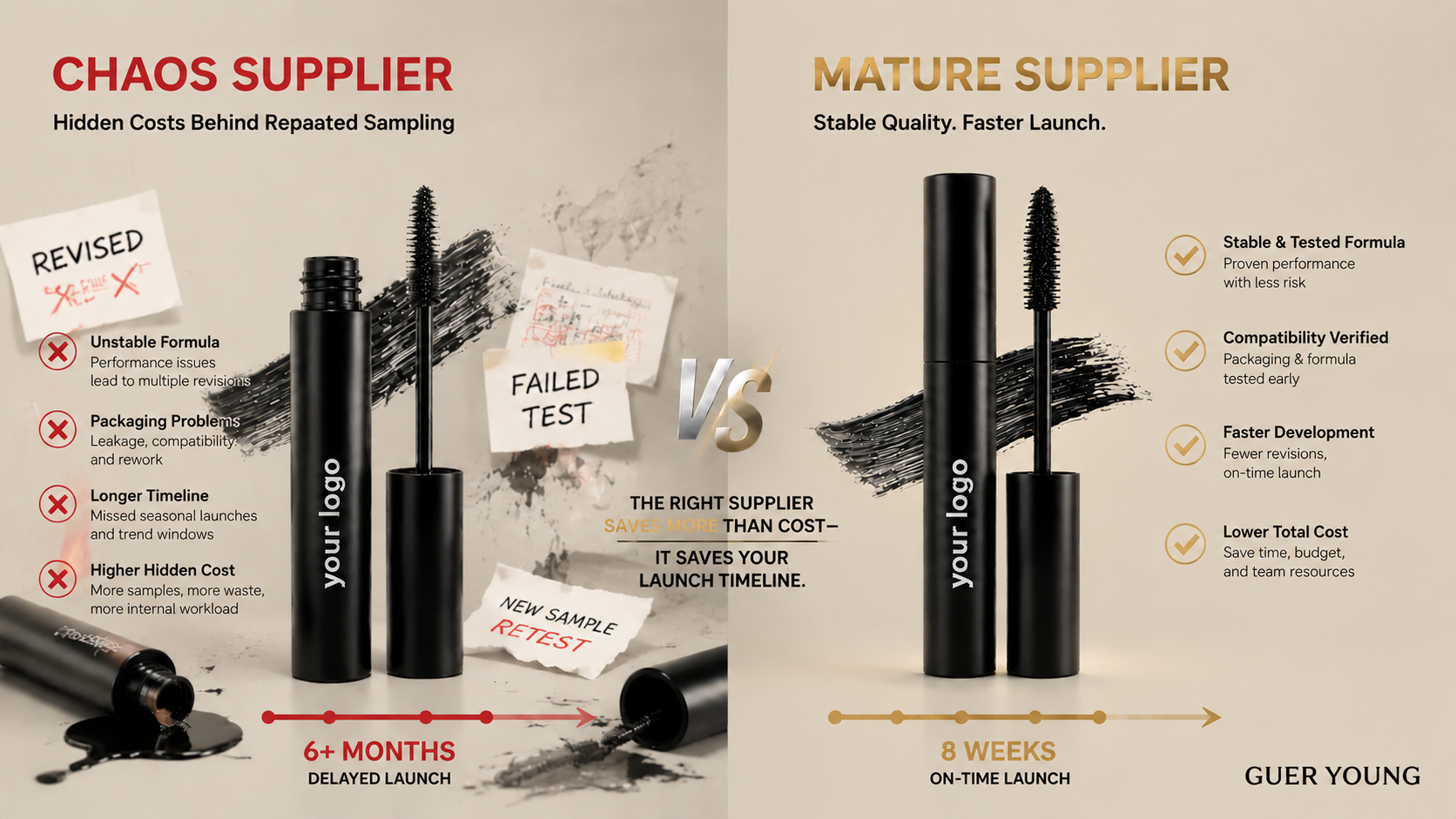
For many beauty brands in Europe and the United States, the most expensive part of product development is not manufacturing itself — it’s the hidden cost behind endless revisions.
Color adjustments, formula modifications, packaging rework, brush compatibility issues, leaking components, unstable textures… what seems like a small correction often turns into weeks or even months of delays.
And in the cosmetics industry, time is profit.
Missing key selling seasons like Black Friday, Holiday launches, Summer collections, or Back-to-School campaigns can significantly impact annual revenue. Even if the final product is eventually completed, the market opportunity may already be gone.
Today, the real challenge for many beauty brands is not the lack of products.
It’s the inability to launch products on time.
Why Do Cosmetic Brands Keep Repeating Sampling?
When searching for suppliers, many brands focus heavily on price while overlooking one critical factor:
Supply chain maturity.
Repeated revisions usually come from several common problems.
1. Formula Stability Issues
Eye makeup products require far higher stability standards than many other cosmetic categories.
Take mascara as an example:
Slight viscosity changes can affect application performance
Poor temperature stability may cause clumping during shipping
Different brush heads perform differently with the same formula
Without an experienced formulation team, brands often fall into endless cycles:
“This version dries too fast”
“The lengthening effect is not strong enough”
“The waterproof effect is difficult to remove”
“The texture feels too heavy”
Each modification may require another 2–3 weeks for testing and approval.
And one single product can easily go through 5–10 rounds of revisions.
2. Packaging and Formula Compatibility Problems
This is one of the most underestimated issues among beauty brands.
Especially for products like:
Eyeliners
Lash serums
Brow products
Liquid eye makeup
Common problems include:
Uneven product dispensing
Poor sealing performance
Formula reacting with packaging materials
Metal oxidation
Leakage during shipping
Many of these issues only appear after stability tests, transportation simulations, or long-term usage.
As a result, brands are forced to:
Replace packaging suppliers
Modify structures
Redo compatibility testing
Refill and retest products
At that point, both budget and timeline start spiraling out of control.
3. Suppliers That Don’t Truly Understand the Western Market
Some factories know how to manufacture products.
But not every supplier understands what European and American consumers actually care about.
The Western beauty market places strong emphasis on:
User experience
Formula safety
Packaging consistency
Long-lasting performance
Visual effect on social media
Comfortable wear
If a supplier only executes instructions mechanically without proactively identifying potential risks, development timelines become much longer.
A mature cosmetics supplier should already know:
Which brush heads perform better for Western consumers
Which textures work best for TikTok beauty trends
Which packaging designs have higher defect rates
Which shades are more commercially successful in Western markets
This kind of experience is often far more valuable than simply offering lower prices.
The Real Loss Behind Repeated Sampling Is Not Just Money
Most brands only calculate direct costs such as:
Sampling fees
Mold costs
Packaging expenses
But the true hidden cost is much bigger.
1. Missing Key Sales Opportunities
The beauty industry depends heavily on timing.
For example:
Summer waterproof mascara launches
Holiday limited editions
Black Friday campaigns
Seasonal makeup collections
If a launch is delayed by even two months, the entire marketing plan may collapse.
Influencer campaigns, paid advertising schedules, retailer planning, and product photography all need to be postponed.
Those losses are far greater than the sampling cost itself.
2. Internal Team Resources Get Continuously Consumed
Product delays also create internal operational pressure:
Designers repeatedly revise packaging
Purchasing teams constantly coordinate changes
Brand managers review endless samples
Marketing departments postpone launch campaigns
For many beauty brands, one of the biggest hidden costs each year is simply:
Wasted team time caused by supply chain inefficiency.
3. Missing Social Media Trend Windows
Today’s beauty market moves extremely fast.
Platforms like:
TikTok
Instagram Reels
YouTube Shorts
can create and kill trends within months.
A makeup trend may only stay relevant for one season.
If product development takes too long, the market hype may disappear before the product is even launched.
How Mature Suppliers Reduce Repeated Sampling
The goal is not simply finding a supplier that “can produce.”
The real value lies in finding a supplier that can get close to the right solution from the beginning.
Based on GUER YOUNG’s experience serving beauty brands in Europe and North America, reducing repeated sampling depends on three critical factors.
1. Early Formula & Packaging Compatibility Testing
A mature supplier verifies early-stage compatibility between:
Formula stability
Brush performance
Filling behavior
Shipping durability
Temperature resistance
instead of discovering problems right before mass production.
This is especially important for:
Mascara
Eyeliner
Lash growth serum
Brow products
because even small issues can lead to large-scale rework later.
2. Using Proven Best-Selling Base Formulas
Many brands waste time because they develop everything from scratch.
A faster approach is optimizing based on proven formulations.
For example:
Waterproof mascaras
Clean beauty eyeliners
Lash-enhancing serums
Long-lasting brow products
Using mature base formulas can significantly shorten testing cycles.
3. Designing Around Real Western Consumer Usage
A strong supplier does more than manufacturing.
They also consider:
Western makeup habits
Influencer filming performance
Long-wear user experience
E-commerce shipping risks
Amazon return factors
Retail shelf stability
These details often determine whether products require repeated modifications later.
Cosmetic Sourcing Is No Longer About Finding the Lowest Price
In the past, brands mainly asked:
“Who offers the cheapest quote?”
Today, more beauty brands are asking:
Who can launch products faster?
Who can reduce revision rounds?
Who can lower rework risks?
Who can deliver consistently?
Because a mature supply chain does more than save costs.
It helps brands win valuable market timing.
GUER YOUNG specializes in providing eye makeup solutions for beauty brands worldwide, including mascara, lash growth serum, eyeliner, and brow products, while also supporting lip makeup, face makeup, and skincare product development.
If you are looking for a more stable and efficient cosmetic manufacturing partner to reduce repeated sampling and accelerate your product launch timeline, you can explore GUER YOUNG’s OEM/ODM solutions and discover customized cosmetic development services designed for the Western beauty market.


andy.li@gueryoung.com

We have 10 years of experience, focusing on the development and sales of high quality eyelash growth serum, mascara, eyebrow gel, eyebrow color and other products. We also offer custom services, from tube
design to cosmetic fillings and packaging


Room 1, C3 Factory Building, No.8803 Zhuhai Avenue, Lianwan Industrial Zone, Pingsha Town, Gaolan Port Economic Zone, Zhuhai, Guangdong,China
QUICK LINKS
D Zone,5/F, NO.8 CuiZhu 5th Street,
Qianshan Xiangzhou District,Zhuhai,
Guangdong,China,519070

lynn.zhou@gueryoung.com
winnie.zhong@gueryoung.com
niki.xu@gueryoung.com