
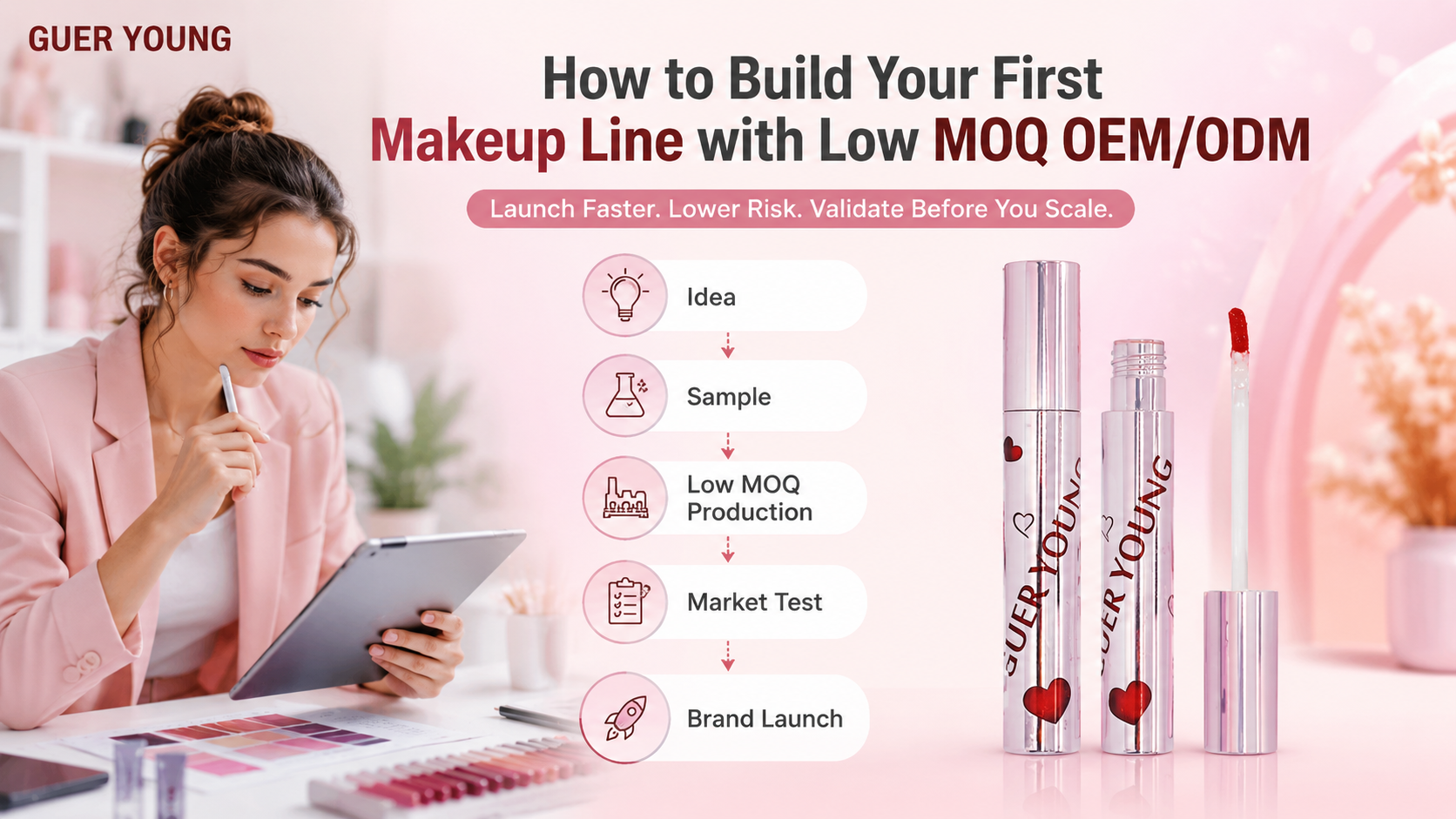
How to Build Your First Makeup Line with Low MOQ OEM/ODM
Read in English | Lire en Français | Leer en Español | Lesen auf Deutsch
For most new beauty brand founders, eCommerce sellers, and sourcing managers, launching a first makeup product line comes with several common challenges:
Limited budget for product development
Uncertainty about which products to launch first
Long development timelines that delay market entry
Fear of unsold inventory and cash flow pressure
Lack of experience managing cosmetic supply chains
In reality, many new beauty brands don't fail because of poor products—they fail because of poor development strategies.
Launching too many SKUs at once, investing heavily in custom formulations, or spending excessively on premium packaging can quickly drain resources before the brand has even validated market demand.
For emerging brands, the goal should not be perfection from day one. The smarter approach is to validate the market with minimal investment, reduce development risks, and scale based on real sales data.
So how can a new beauty brand build its first makeup line through OEM/ODM manufacturing while keeping costs under control?
Strategy #1: Start with Low MOQ Production to Reduce Risk
One of the biggest financial risks for startups isn't product development—it's inventory.
Many entrepreneurs assume OEM manufacturing requires large order quantities. However, many experienced cosmetic manufacturers now offer low MOQ solutions, making it easier for brands to test the market before committing to larger production runs.
Benefits of low MOQ production include:
Lower upfront investment
Reduced inventory risk
More budget available for marketing and customer acquisition
Greater flexibility for replenishment based on actual sales performance
For example, launching a lip gloss or liquid lipstick with a small initial order allows brands to test demand through Shopify, Amazon, TikTok Shop, or other sales channels before scaling production.
For new brands, managing inventory risk is often more important than achieving the lowest possible unit cost.
Strategy #2: Improve Existing Best-Sellers Instead of Developing from Scratch
Many founders believe their first product must have a completely unique formula.
In practice, developing a custom formula from scratch is expensive, time-consuming, and often unnecessary.
A more cost-effective approach is to build on proven products already validated by the market.
Common ODM customization options include:
Using established formulations
Adjusting trending shades and color collections
Upgrading packaging design
Adding targeted product benefits
Creating brand-specific visual positioning
For example:
Adding moisturizing benefits to a bestselling lip product
Adapting eyeshadow palettes to current US and European color trends
Designing social-media-friendly packaging for younger consumers
This approach significantly reduces R&D costs while increasing the likelihood of market acceptance.
Strategy #3: Accelerate Sampling and Product Validation
In today's beauty market, speed often matters more than perfection.
Many product launches fail not because the product is weak, but because brands spend too much time revising samples and miss market opportunities.
An efficient development process typically includes three stages:
Step 1: Validate Market Demand
Before development begins, identify what consumers are already buying.
Key research sources include:
TikTok beauty trends
Amazon best-seller rankings
Social media engagement data
Consumer reviews and feedback
Successful product selection should be driven by market demand—not personal preference.
Step 2: Fast Sample Approval
Focus on validating core elements:
Color payoff
Product performance
User experience
Packaging appearance
Formula stability
Avoid excessive revisions and prioritize confirming the product's key selling points.
Step 3: Small-Batch Market Testing
Launch with a limited quantity and collect real-world feedback.
Actual customer behavior provides more valuable insights than internal discussions.
Fast validation allows brands to optimize products based on data instead of assumptions.
Strategy #4: Build a Small Product Collection Instead of Relying on One Hero Product
Many startups invest their entire budget into a single product, hoping it will become a bestseller.
However, a single-product strategy carries significant risk.
A more sustainable approach is to launch a small but complete product collection.
Examples include:
Starter Makeup Collection
2 Lip Products
1 Mascara
1 Brow Pencil
Popular Western Market Collection
Lip Gloss
Liquid Blush
Mascara
Brow Gel
Social Commerce Collection
Lip Products
Blush Products
Highlighter Products
Benefits of launching multiple complementary SKUs include:
Stronger brand identity
Higher average order value
Increased cross-selling opportunities
Reduced dependence on a single product's performance
For most startups, launching with 3–5 SKUs is often the most practical and cost-effective strategy.
Strategy #5: Validate the Market Before Investing in Full Customization
Many founders invest heavily in:
Custom molds
Exclusive packaging
Proprietary formulations
High-end branding assets
Before making these investments, one critical question must be answered:
Will consumers actually buy the product?
A smarter growth path is:
Launch quickly using proven products
Gather real sales data
Identify top-performing SKUs
Invest in customization and brand upgrades later
This approach minimizes financial risk while increasing the probability of long-term success.
For Amazon sellers, TikTok Shop brands, and Shopify store owners, rapid testing and iteration often outperform large upfront investments.
How to Avoid Product Development Failure and Inventory Problems
Based on industry experience, most makeup product launches fail because of:
Too many SKUs
Excessive MOQ requirements
Unclear product positioning
Lack of market validation
Long development cycles
To improve launch success rates, new brands should follow five key principles:
✔ Start with small production runs
✔ Use proven products whenever possible
✔ Validate products through fast sampling
✔ Focus on core categories first
✔ Expand based on actual sales performance
The goal of your first product line is not perfection—it is market validation.
Once demand is proven, scaling becomes significantly less risky.
Why Choosing the Right OEM/ODM Partner Matters
For brands with limited supply chain experience, an experienced OEM/ODM manufacturer can provide far more than production services.
The right partner can help:
Reduce development costs
Recommend proven products and trending shades
Shorten sampling timelines
Suggest product line combinations
Support regulatory compliance for US and EU markets
GUER YOUNG has extensive experience serving beauty brands in North America and Europe, offering OEM/ODM solutions across lip, eye, and face makeup categories.
With low MOQ support, fast sampling capabilities, and a wide range of ready-to-launch product options, GUER YOUNG helps emerging brands bring products to market faster while minimizing development risks.
Request Your Custom Makeup Product Development Plan
If you're planning to launch a beauty brand or expand your makeup product portfolio, success starts with the right development strategy—not simply a larger budget.
By selecting the right products, controlling inventory risk, and focusing on proven market opportunities, you can significantly reduce trial-and-error costs while accelerating your path to market.
Contact GUER YOUNG today to discuss your OEM/ODM project and receive a customized product development proposal tailored to your target market, budget, and sales channels.
Our team is ready to help you launch faster, lower risk, and build a beauty brand positioned for long-term growth.


andy.li@gueryoung.com

We have 10 years of experience, focusing on the development and sales of high quality eyelash growth serum, mascara, eyebrow gel, eyebrow color and other products. We also offer custom services, from tube
design to cosmetic fillings and packaging


Room 1, C3 Factory Building, No.8803 Zhuhai Avenue, Lianwan Industrial Zone, Pingsha Town, Gaolan Port Economic Zone, Zhuhai, Guangdong,China
QUICK LINKS
D Zone,5/F, NO.8 CuiZhu 5th Street,
Qianshan Xiangzhou District,Zhuhai,
Guangdong,China,519070

lynn.zhou@gueryoung.com
winnie.zhong@gueryoung.com
niki.xu@gueryoung.com