
When Should Beauty Brands Replace an Underperforming Mascara?
Read in English | Lire en Français | Lesen auf Deutsch | Leer en Español | Leggi in inglese
For beauty brand owners, product managers, and private label businesses, deciding when to discontinue a mascara SKU is an important part of product portfolio management. Keeping an underperforming product can tie up inventory and reduce profitability, while removing it too early may result in lost customers and sales opportunities.
This guide explains how to evaluate mascara SKU performance, identify warning signs, make informed discontinuation decisions, and manage a smooth product phase-out.
1. Understanding the Mascara Product Lifecycle
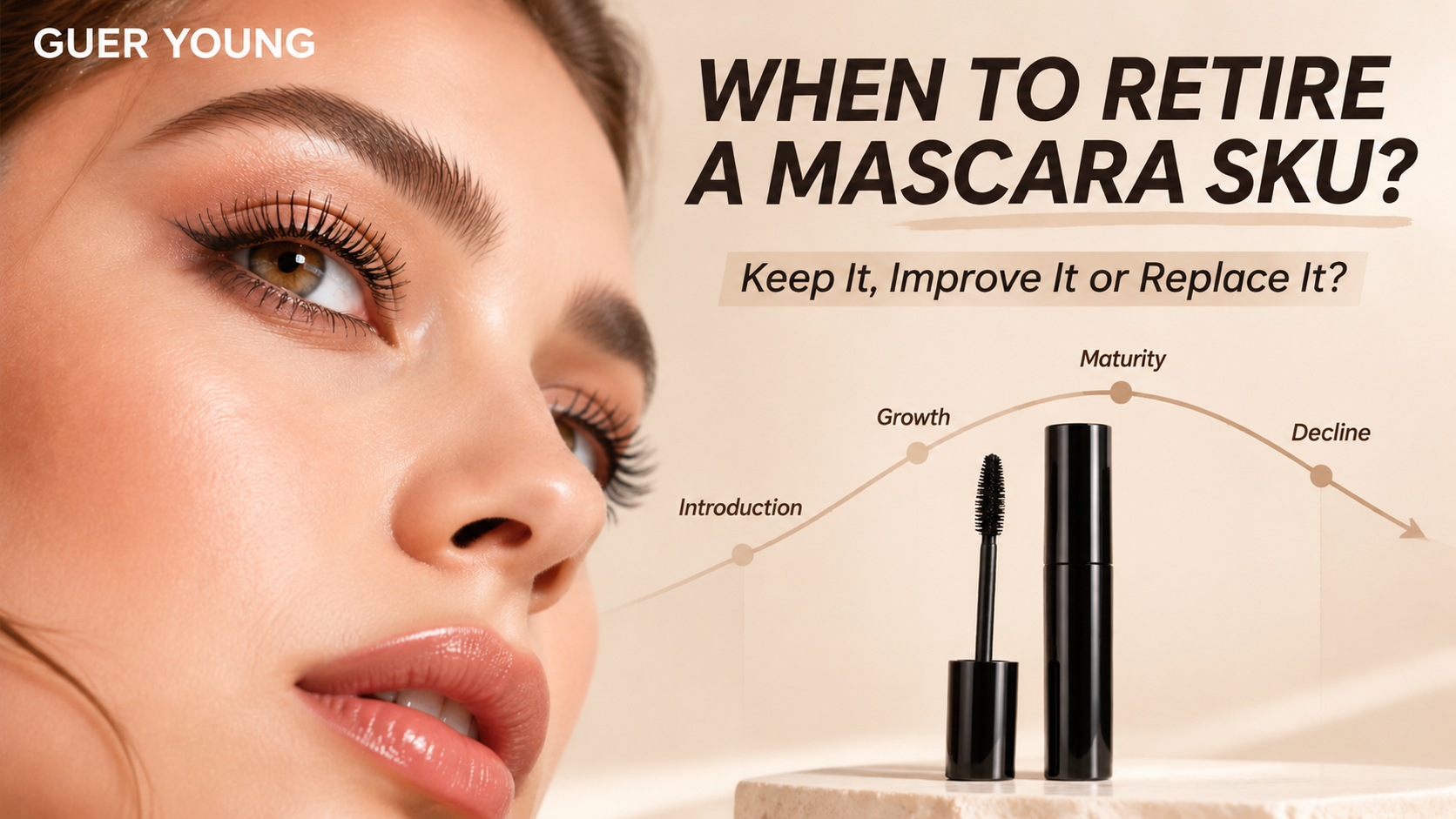
Mascara products generally have a lifecycle of 18–24 months in the 2026 eye makeup market. Understanding each stage helps brands decide whether a product needs more time, improvement, or discontinuation.
1.1 The Four Stages of a Mascara Product Lifecycle
Lifecycle Stage | Typical Characteristics |
Introduction | Low initial sales, higher marketing costs, sampling and influencer promotion |
Growth | Rising sales, wider distribution, and increasing sell-through rates |
Maturity | Stable sales, stronger profit contribution, and growing competition |
Decline | Falling demand, excess inventory, and slower stock turnover |
According to the 2026 industry data used in this guide, 62% of curling mascara SKUs enter decline within 20 months of launch, compared with 48% of lengthening mascara formulas.
1.2 How Lifecycle Stage Influences Product Decisions
Brands should avoid discontinuing products simply because their initial sales are slow.
Introduction (0–6 months): Allow time for product awareness and customer acquisition. Social media algorithms may take 3–4 months to generate consistent discovery traffic.
Growth and maturity: Review sales and profitability quarterly to identify changes in demand.
Decline: Start a formal evaluation within 30 days after two consecutive months of declining sales.
2. How to Evaluate the Performance of an Existing Mascara SKU
A mascara SKU should be evaluated using both financial results and market feedback. Looking at multiple indicators provides a clearer picture than relying on sales volume alone.
2.1 Financial Performance Metrics to Track
The following benchmarks can help identify underperforming products:
Metric | Warning Threshold | What It Indicates |
90-day sell-through rate | Below 35% | Slow inventory movement |
Gross profit margin | Below 25% | Declining SKU profitability |
Annual inventory turnover | Below 2x | Capital tied up in stock |
For comparison, fast-fashion beauty brands may achieve sell-through rates of 55% or higher for top-performing mascara lines.
Private label brands should also consider supplier minimum order quantities (MOQs). Low-volume SKUs may carry higher unit costs, making an otherwise popular product less profitable.
2.2 Operational and Market Performance Indicators
Financial results do not tell the whole story. Brands should also review:
Customer ratings: Sustained ratings below 3.8 stars may indicate product or customer experience problems, especially when reviews repeatedly mention clumping or flaking.
Competitive positioning: Having 12 or more similar waterproof mascara products in the same Amazon price range may make differentiation difficult.
Brand alignment: A formula that no longer matches the brand's positioning may need reformulation or replacement.
Combining these indicators helps brands distinguish between temporary sales fluctuations and long-term product problems.
3. When Is It Time to Discontinue a Mascara Product?
One weak performance metric does not automatically mean a product should be removed. However, several warning signs appearing together may indicate that a SKU is no longer commercially viable.
3.1 Early Warning Signs That Require Attention
Consider placing the product on a 90-day performance improvement plan when you observe:
Sales decline of 15% or more for two consecutive months, without an identifiable external cause.
Sell-through rates below 40% for two consecutive quarters.
Customer return rates above 8% for three consecutive months.
For example, an established volumizing mascara may begin losing sales after competitors introduce new tubing mascara products. Before discontinuing it, a brand could test a formula or positioning update over 90 days.
3.2 Critical Issues That May Require Discontinuation
Some situations require a more urgent review:
Gross profit margin falls below 18% and cannot be improved through cost reductions or price adjustments.
Annual inventory turnover drops below 1x.
Regulatory or formulation issues require costly changes to meet applicable EU or FDA requirements.
The SKU takes sales away from a higher-margin, higher-growth mascara in the same product range.
Important: If a product has a safety issue, the brand should prioritize the appropriate safety response, including recall or withdrawal where required, rather than treating it as an ordinary commercial phase-out.
4. How to Make the Final Mascara SKU Discontinuation Decision
Once performance data has been collected, brands need a consistent decision-making process. The goal is to compare the cost of keeping a product with the potential benefits of improving or replacing it.
4.1 A Three-Step Decision-Making Process
Use the following process before discontinuing an underperforming mascara SKU:
Data Audit: Review six months of sales, profit margins, inventory levels, and customer feedback.
Scenario Testing: Compare three options: keeping the product unchanged, refreshing its formula or packaging, or discontinuing it.
Stakeholder Approval: Align sales, marketing, and supply chain teams to identify potential risks and opportunities.
For small businesses and startups, this process may take 2–3 weeks. Larger brands may need 4–6 weeks for cross-functional review.
4.2 When Should You Keep an Underperforming SKU?
A product with weak financial performance may still deserve a place in the portfolio if it:
Acts as a hero or loss-leader product that attracts customers to other items.
Serves a loyal niche audience with no suitable replacement.
Supports product bundles that increase the average order value of higher-margin products.
Brands should also discuss MOQ flexibility with suppliers. Lower order quantities for established products may improve profitability and make continued production viable.
5. How to Manage a Smooth Mascara Product Phase-Out
After deciding to discontinue a mascara SKU, brands should plan inventory clearance and customer communication together. A structured phase-out helps reduce unnecessary losses and protect customer relationships.
5.1 Inventory Management and Replacement Product Planning
Consider these approaches to manage remaining inventory:
Offer existing customers a limited-time 20–30% last-chance discount.
Bundle the discontinued mascara with best-selling products, such as a lengthening mascara and eyeliner set.
Work with suitable beauty discount retailers or subscription boxes to move remaining stock.
Avoid excessive discounts of 70% or more, which may weaken perceived product value and encourage customers to wait for clearance sales.
At the same time, identify a replacement SKU where possible. The new product should serve a similar customer need while offering a clear improvement in positioning, performance, or profitability.
5.2 Customer Communication and Post-Discontinuation Follow-Up
Transparent communication can help maintain customer trust during a product transition.
Notify customers approximately 30 days before discontinuation through email, social media, and product page announcements.
Recommend a suitable alternative from the existing product range.
Collect feedback from loyal customers to understand what they valued about the discontinued product.
The 2026 consumer behavior data referenced in this guide indicates that 68% of beauty consumers appreciate brands explaining why a product is being phased out.
For beauty brands planning their next mascara launch, working with a reliable finished cosmetics supplier can also make product replacement easier. GUER YOUNG provides finished mascara supply, OEM/ODM, and private label services to support product development, customization, and ongoing manufacturing needs.


andy.li@gueryoung.com

We have 10 years of experience, focusing on the development and sales of high quality eyelash growth serum, mascara, eyebrow gel, eyebrow color and other products. We also offer custom services, from tube
design to cosmetic fillings and packaging


Room 1, C3 Factory Building, No.8803 Zhuhai Avenue, Lianwan Industrial Zone, Pingsha Town, Gaolan Port Economic Zone, Zhuhai, Guangdong,China
QUICK LINKS
D Zone,5/F, NO.8 CuiZhu 5th Street,
Qianshan Xiangzhou District,Zhuhai,
Guangdong,China,519070

lynn.zhou@gueryoung.com
winnie.zhong@gueryoung.com
niki.xu@gueryoung.com