
Hypoallergenic Mascara: What to Check Before Bulk Ordering
Read in English | Lire en Français | Lesen auf Deutsch | Leer en Español
For beauty brands and e-commerce sellers, sourcing mascara labeled “hypoallergenic” or “suitable for sensitive eyes” involves more than selecting a product. If a supplier cannot support its claims with relevant evidence, or if bulk production differs from the approved sample, brands may face customer complaints, returns, and product-page compliance risks.
Before placing a bulk order, buyers need to answer three important questions: What supports the supplier’s claims? Do the supporting documents match the actual product being purchased? Will bulk production meet the agreed specifications after sample approval?
This guide explains how to evaluate supplier claims, review product documentation, and verify sample-to-bulk consistency before purchasing mascara for your beauty brand or online store.
1. What Should You Verify When a Supplier Claims Its Mascara Is Hypoallergenic?
1.1 Understand What “Hypoallergenic” Actually Means
The term “hypoallergenic” is generally used to suggest that a product is intended to reduce the likelihood of causing allergic reactions. However, it does not mean that a product can never cause an allergic reaction or that it is suitable for every person with sensitive eyes.
In the United States, the FDA states that there is no uniform federal standard or definition governing the use of “hypoallergenic” for cosmetics. It also does not require every product using this claim to pass one specific test.
For buyers, this means that a label alone is not enough to establish a product’s safety or suitability.
Before approving a supplier, ask:
What is the basis for the hypoallergenic claim?
Is there test documentation relevant to the formula or finished product?
What was tested, which methods were used, and what were the findings?
Does the evidence relate to the final mascara formula rather than only an individual ingredient?
Are the intended use and limitations of the claim clearly explained?
Suppliers may provide different types of supporting evidence depending on the formula, claim, and target market. The important point is whether they can explain the basis of the claim and provide documentation relevant to the specific product.
1.2 Distinguish Between Similar Product Claims
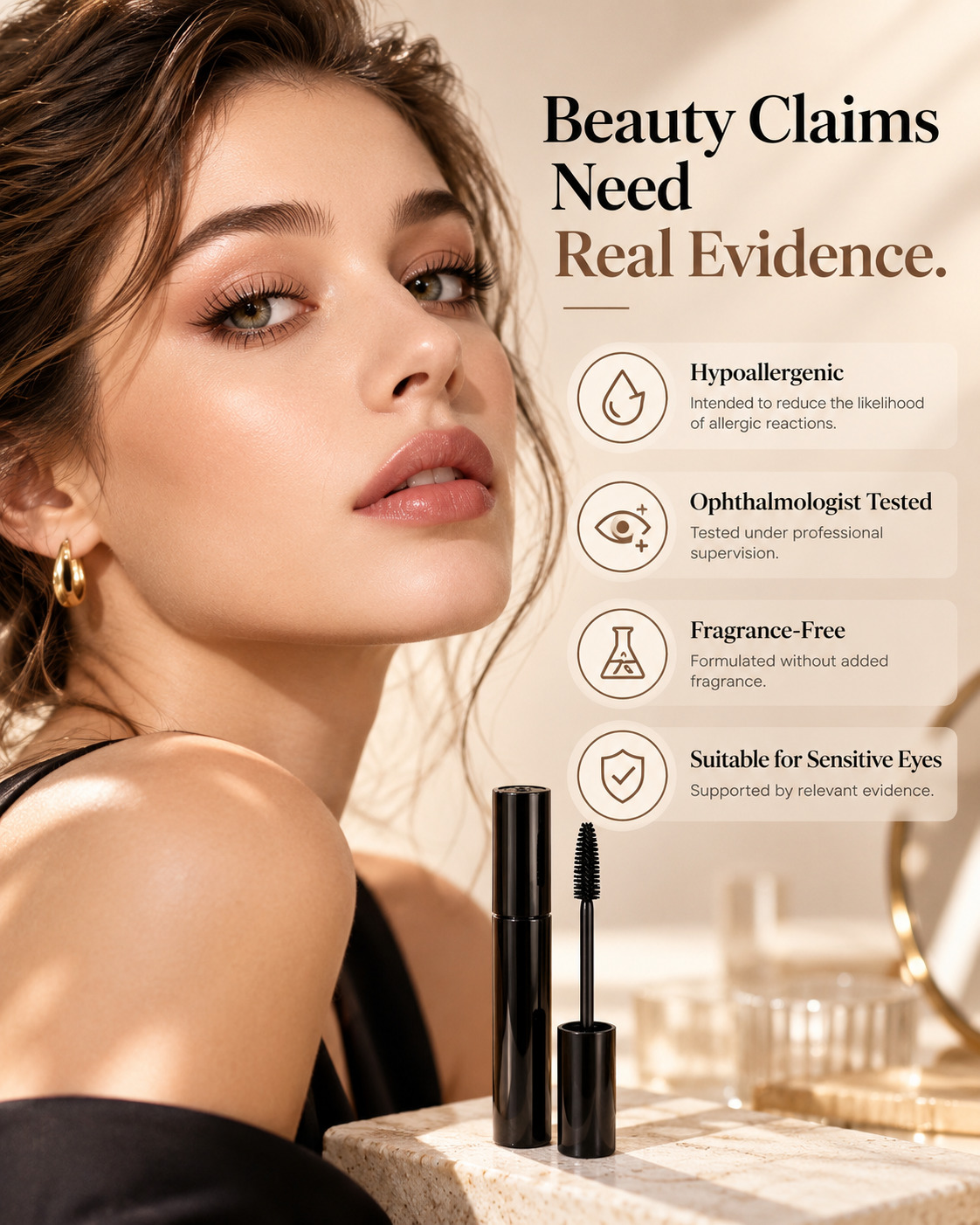
Different cosmetic claims communicate different information and should not be treated as interchangeable.
| Product claim | What buyers should verify |
Hypoallergenic | The basis of the claim, supporting evidence, and intended scope |
Ophthalmologist tested | Whether testing was conducted, which product was tested, and what the test covered |
Dermatologist tested | The test subjects, method, and actual findings |
Fragrance-free | Whether the final formula supports the claim under the applicable definition and market requirements |
Suitable for sensitive eyes | Whether relevant evidence supports the stated suitability |
For example, “ophthalmologist tested” does not automatically mean “hypoallergenic.” Similarly, a fragrance-free formula is not necessarily free from every ingredient that could cause irritation or an allergic reaction.
For beauty brands, the goal is not to collect as many marketing claims as possible. It is to ensure that each statement used on packaging, product pages, and advertisements is supported by appropriate evidence.
1.3 Check Whether Product Page Claims Are Supported
One purpose of reviewing supplier documentation is to ensure that the claims used in your own marketing do not go beyond what the available evidence supports.
If a supplier can demonstrate that a product underwent a particular test, that does not automatically justify describing the mascara as “allergy-proof” or “safe for all sensitive eyes.” Absolute claims may mislead customers and create additional challenges when reviewing product listings or handling complaints.
Before publishing a product page, review:
Hypoallergenic and sensitive-eye claims on packaging;
Product descriptions and advertising copy;
Consistency between supporting evidence and marketing language;
Relevant cosmetic labeling and claims requirements in each target market.
For additional guidance, see the FDA’s explanation of Hypoallergenic Cosmetics.
2. How Should You Review a Mascara Supplier’s Documentation?
Once you understand the claims, the next step is to determine whether the supplier’s documents are relevant to the product you intend to purchase. A large collection of documents does not automatically prove a hypoallergenic claim.
2.1 Check the Key Details in Test Reports
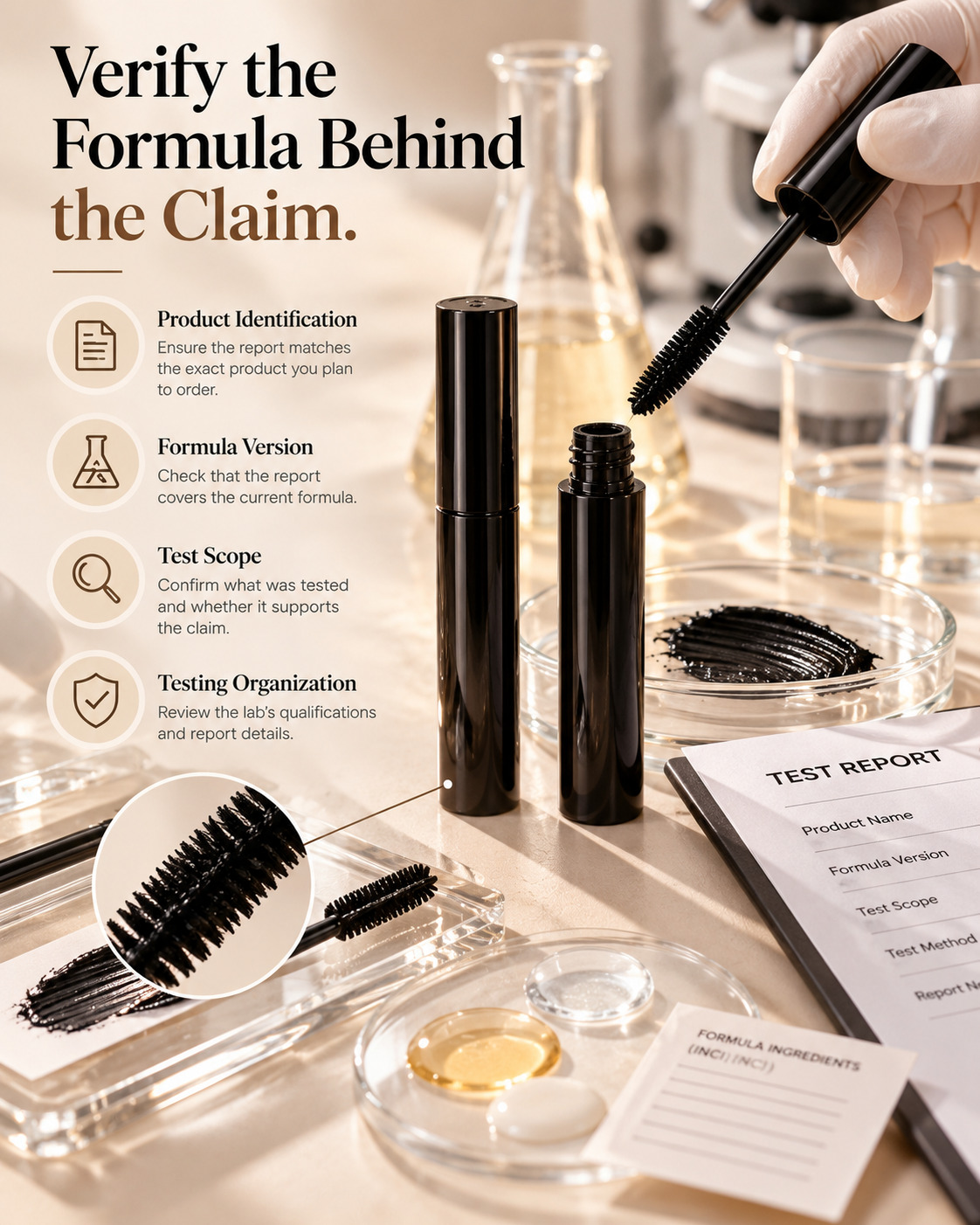
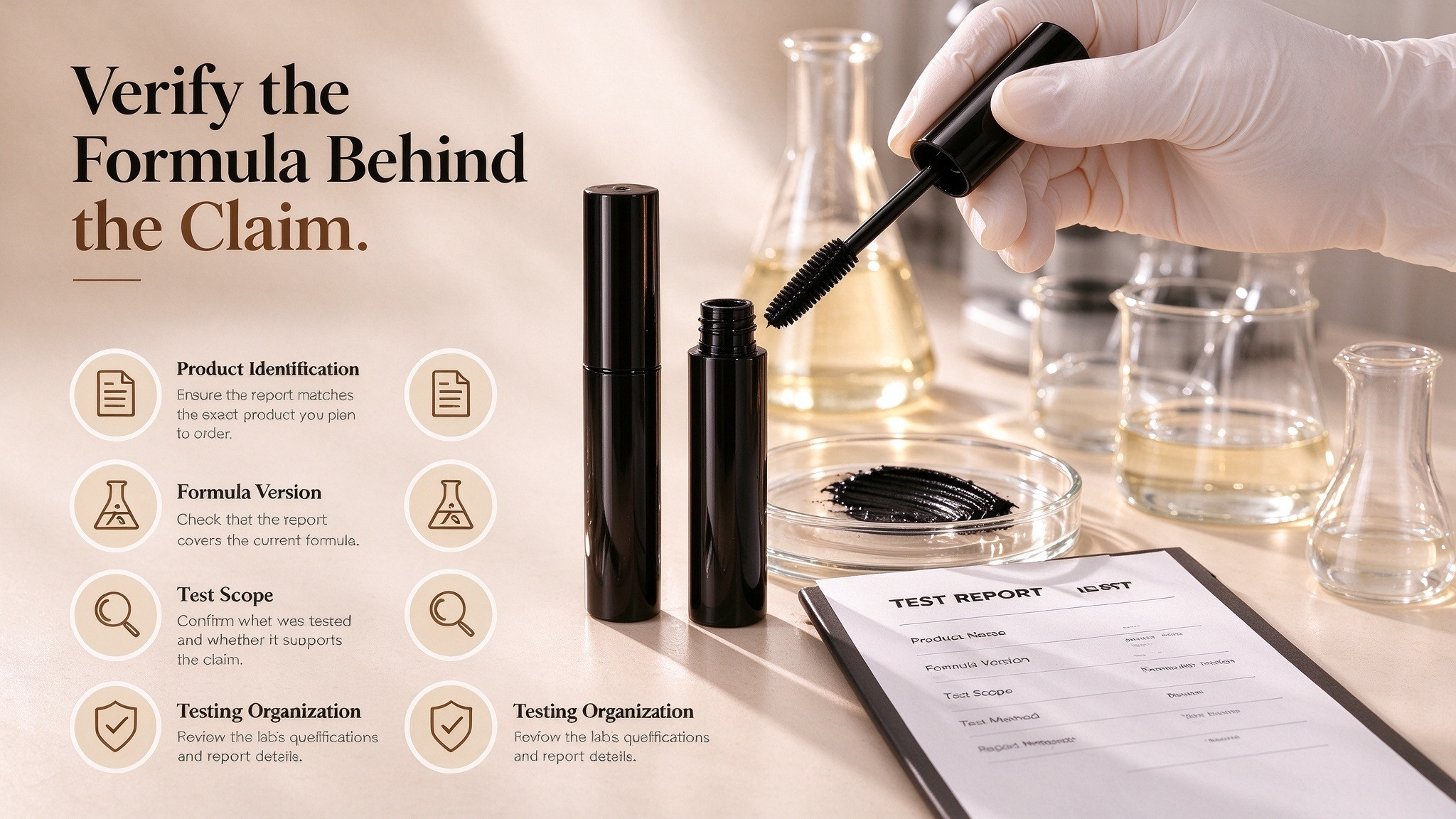
If a supplier provides test reports, review the following information:
Product identification: Does the product name, model, or formula information match the mascara you plan to order?
Formula version: Does the report cover the current formula rather than an earlier version?
Test scope: What was actually evaluated, and is it relevant to the claim being made?
Test method: Are the methods, test conditions, and relevant limitations explained?
Testing organization: Are the organization’s name, relevant qualifications, and report-verification details available?
Findings: What does the report actually support? Is the supplier interpreting the results more broadly than justified?
A report covering an individual ingredient or a different formula should not automatically be treated as proof that the finished mascara is hypoallergenic.
If the relationship between the report and the final product is unclear, ask the supplier to explain it. Where appropriate, verify the report directly with the issuing organization.
2.2 Understand the Purpose of Each Document
During sourcing, suppliers may provide ingredient lists, product safety assessment documents, test reports, quality management certificates, and safety data sheets. These documents serve different purposes.
Document type | Main purpose | What buyers should check |
INCI ingredient list | Provides declared ingredient information | Confirm that it corresponds to the final formula and meets target-market labeling requirements |
Finished-product test report | Documents the scope, methods, and findings of specific tests | Check whether the testing is relevant to the intended claim |
Product safety assessment documentation | Supports the assessment of product safety | Confirm that it applies to the specific product and target market |
GMP or ISO documentation | Provides information about manufacturing or quality management systems | Verify the scope, validity, and applicable manufacturing site |
SDS/MSDS | Provides relevant safety and handling information | Do not treat it as direct proof of hypoallergenic claims or finished-product safety |
Market notification or registration documentation | Provides evidence of a relevant regulatory procedure, where applicable | Do not assume it represents official approval of a hypoallergenic claim |
Documentation requirements depend on the product, the claims being made, and the intended market.
For example, cosmetics sold in the European Union are subject to applicable requirements concerning product safety assessment, the Product Information File (PIF), and notification. A CPNP notification is not the same as official EU certification that a product is hypoallergenic.
In the United States, cosmetic regulatory responsibilities also depend on the parties involved and the applicable requirements. Buyers should evaluate their own responsibilities based on the product, sales model, and target market rather than assuming that a supplier’s documents alone establish compliance.
For reference, consult the FDA’s Cosmetics Laws & Regulations and the EU Regulation on Common Criteria for Cosmetic Claims.
3. Why Should You Check Bulk Production After Sample Approval?
Document reviews help buyers evaluate whether a supplier’s claims have an appropriate basis, but they cannot replace an assessment of the actual product. For brands planning to sell mascara over time, another critical question is whether bulk production remains consistent with the approved sample.
3.1 Establish Sample-to-Bulk Consistency Requirements
Passing a sample evaluation does not guarantee that every subsequent bulk order will perform identically. Changes in the formula, raw materials, brush, manufacturing process, or packaging components may affect product quality and user experience.
When approving a sample, record and retain:
The approved product model and formula version;
Mascara texture, color, scent, and product pickup;
Wand shape, bristle material, and compatibility between the wand and formula;
Application, film formation, clumping, smudging, and removal performance;
Packaging structure, label information, and product identification details;
Completed tests and the scope of the supporting evidence.
These records provide a reference for later inspection. When bulk goods arrive, carry out checks based on the purchase agreement and the product’s risk profile. Similar appearance alone is not enough to establish complete consistency.
If the supplier changes the formula, key raw materials, wand, or manufacturing process, require advance notification. Then assess whether updated documentation, additional testing, or renewed sample approval is necessary.
3.2 Put Key Requirements in the Purchase Agreement
Once the sample has been approved, translate the important requirements into written purchasing specifications. This helps prevent misunderstandings about what “consistent with the sample” or “hypoallergenic mascara” means.
Depending on the order and cooperation model, the purchase agreement or quality specification can address:
Product model, formula version, and identification of the approved sample;
Key product specifications and agreed acceptance criteria;
Required documentation and update procedures;
Notification requirements for changes to the formula, raw materials, wand, or manufacturing process;
Batch identification, traceability, and quality communication;
Investigation, corrective action, and handling procedures for products that do not meet agreed requirements.
Specific terms should reflect the order size, product risks, and actual business arrangement. For hypoallergenic-related claims, it is particularly useful to identify which product and formula version the supporting evidence covers and which claims it can reasonably support.
4. Mascara Bulk Order Checklist
Before placing an order, use this checklist to review the main sourcing requirements.
4.1 Supplier and Product Verification
The meaning and scope of the hypoallergenic claim have been clarified.
The supplier has explained the basis of the claim and provided relevant supporting documentation.
Test reports have been checked for product identity, formula version, and test scope.
The purposes of ingredient lists, test reports, safety assessment documents, quality system documentation, and SDS/MSDS have been distinguished.
Relevant labeling, claims, and compliance requirements for the target market have been reviewed.
The sample has been evaluated and approval records have been retained.
Bulk inspection criteria and change notification requirements have been agreed upon.
Quality issue communication, traceability, and handling procedures have been clarified.
4.2 Choose a Finished Mascara Supplier That Supports Your Sourcing Process
After reviewing the claims and supporting documents, evaluate whether the supplier can support your broader sourcing requirements. Beyond price, minimum order quantity, and lead time, consider how the supplier handles sample requests, product documentation, customization, and quality communication.
GUER YOUNG supplies finished eye makeup products and offers OEM/ODM and private label services. If you are sourcing mascara for your beauty brand or online store, explore our finished mascara product range and discuss available samples, customization options, and product documentation for your target market.
Conclusion
Verifying a mascara supplier’s hypoallergenic claims involves more than checking a label or collecting documents. Buyers need to establish whether the claims have a reasonable basis, whether the supporting evidence applies to the actual product, and whether bulk production will meet the agreed requirements.
Completing these checks before ordering helps beauty brands and e-commerce sellers evaluate suppliers more systematically, reduce information gaps during purchasing, and establish a stronger foundation for product listing and quality management.
Practical next step: Before confirming a bulk order, obtain documentation relevant to the exact product, complete a sample evaluation, and agree on key specifications and change-control requirements in writing.


andy.li@gueryoung.com

We have 10 years of experience, focusing on the development and sales of high quality eyelash growth serum, mascara, eyebrow gel, eyebrow color and other products. We also offer custom services, from tube
design to cosmetic fillings and packaging


Room 1, C3 Factory Building, No.8803 Zhuhai Avenue, Lianwan Industrial Zone, Pingsha Town, Gaolan Port Economic Zone, Zhuhai, Guangdong,China
QUICK LINKS
D Zone,5/F, NO.8 CuiZhu 5th Street,
Qianshan Xiangzhou District,Zhuhai,
Guangdong,China,519070

lynn.zhou@gueryoung.com
winnie.zhong@gueryoung.com
niki.xu@gueryoung.com