
How to Choose a Finished Mascara Supplier for Your Spring Collection Launch
Read in English | Lire en Français | Lesen auf Deutsch | Leer en Español | Leggi in Italiano
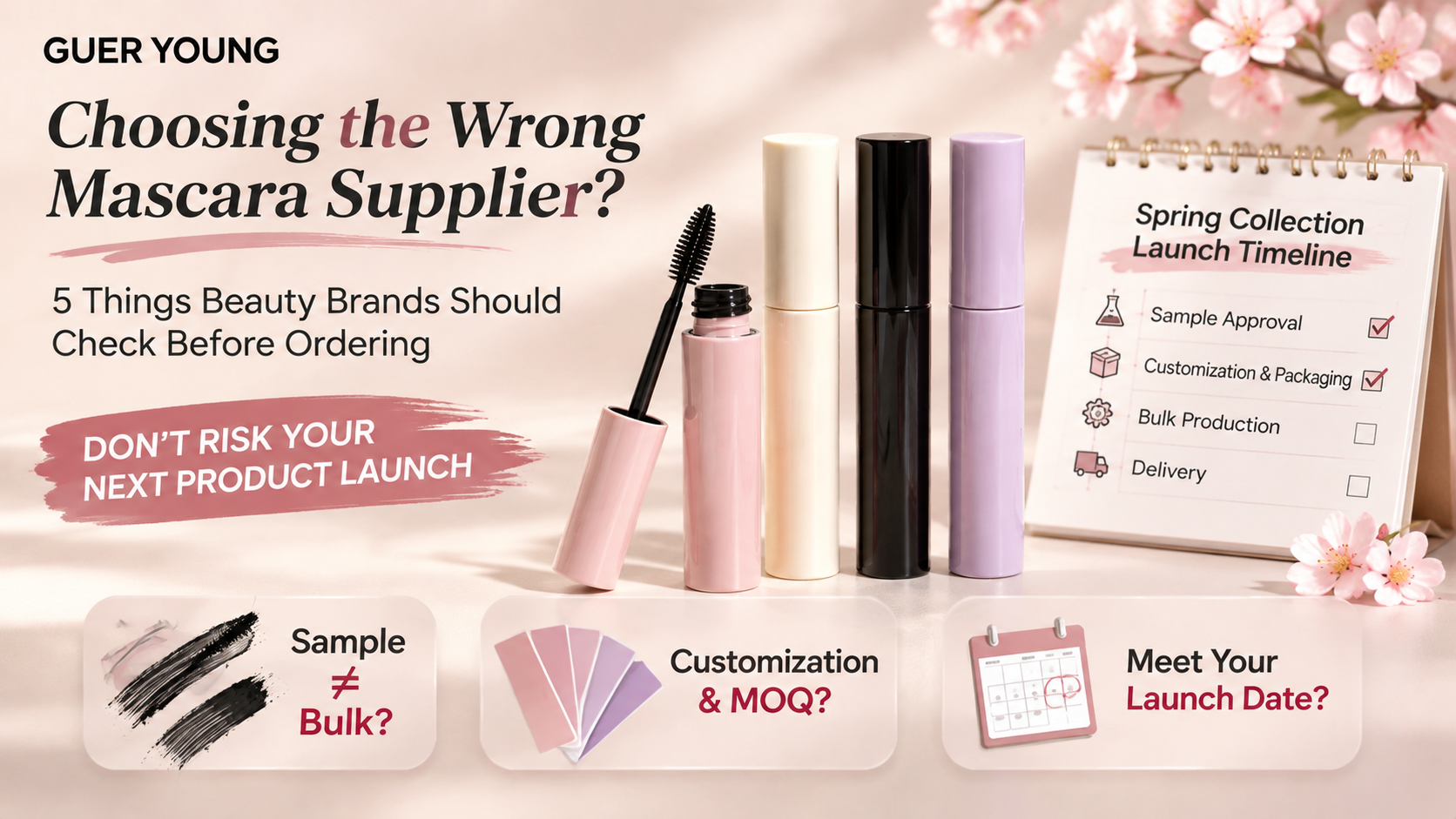
Choosing a finished mascara supplier for a spring collection involves more than finding a suitable product. Brands also need to consider sample approval, customization options, bulk production, and future replenishment. A supplier that cannot meet product specifications, order requirements, or delivery expectations may affect the entire launch schedule.
For beauty brands looking to shorten product development time, sourcing an existing finished mascara can reduce some development work. However, suppliers should still be evaluated based on their products, sample support, customization services, quality management, and communication.
1. Evaluate a Supplier's Existing Finished Mascara Products
Start by checking whether a supplier's existing products match your brand positioning and purchasing requirements. Rather than focusing only on the number of available products, pay attention to product types, specifications, and regular supply conditions.
1.1 Understand the Available Finished Mascara Types
Finished mascaras vary in their intended effects, formulas, and brush designs. Depending on your product positioning, you may want to explore the following options:
Volumizing mascara: Designed to create a fuller-looking lash effect.
Lengthening mascara: Focuses on making lashes appear longer.
Curling mascara: Designed to enhance the appearance of lash curl.
Waterproof mascara: Suitable for brands looking for water-resistant, sweat-resistant, or longer-wearing performance.
Beyond product categories, check the brush shape, bristle arrangement, formula texture, and actual application results. Product names and descriptions do not always reflect real performance, so samples are necessary for a more reliable evaluation.
1.2 Confirm Product Specifications and Supply Conditions
Once you have identified suitable product types, review their specifications and regular purchasing conditions, including:
Product capacity and packaging dimensions;
Formula details and full ingredient information;
Brush structure and application performance;
Waterproof, sweat-resistant, and smudge-resistant properties;
Regular minimum order quantity (MOQ);
Available product documents and target-market requirements.
You should also confirm whether the mascara is an existing standard product or requires additional development or adjustments. These two supply arrangements may involve different order quantities, approval procedures, and lead times.
For brands planning a spring launch, confirming product suitability early can help reduce delays caused by later changes.
2. Assess Sample Provision and Approval Support
Product specifications help narrow down suppliers, but actual performance must be evaluated through samples. A clear sample approval process also helps prevent problems when moving to bulk production.
2.1 Evaluate Sample Availability and Product Performance
When testing samples, look beyond the packaging and initial application results. Evaluate how the mascara performs during actual use.
For mascara products, pay attention to:
Whether the formula is easy to pick up and apply without clumping or sticking;
Whether the brush distributes the formula evenly and controls the amount applied;
Whether the mascara delivers the expected volumizing, lengthening, or curling effect;
Whether drying time and wear performance meet your product requirements;
Whether smudging, flaking, or other issues affect the user experience.
If you plan to change the brush, packaging, or other product details, ask whether a revised sample will be required and confirm the additional time and costs involved.
2.2 Establish a Clear Sample Approval Process
Sample approval should not rely on verbal confirmation alone. Keep a record of the approved product version, including its model, capacity, brush, packaging, formula performance, and any details that must remain unchanged.
If the formula, brush, or packaging is modified later, the relevant sample should be reviewed and approved again. This helps ensure that bulk production follows the agreed specifications.
It is also important to establish a timeline for sample testing, internal review, revisions, and final approval. For a spring collection, delays in sample approval can affect packaging confirmation and production scheduling, so these steps should be planned early.
3. Review OEM/ODM and Brand Customization Services
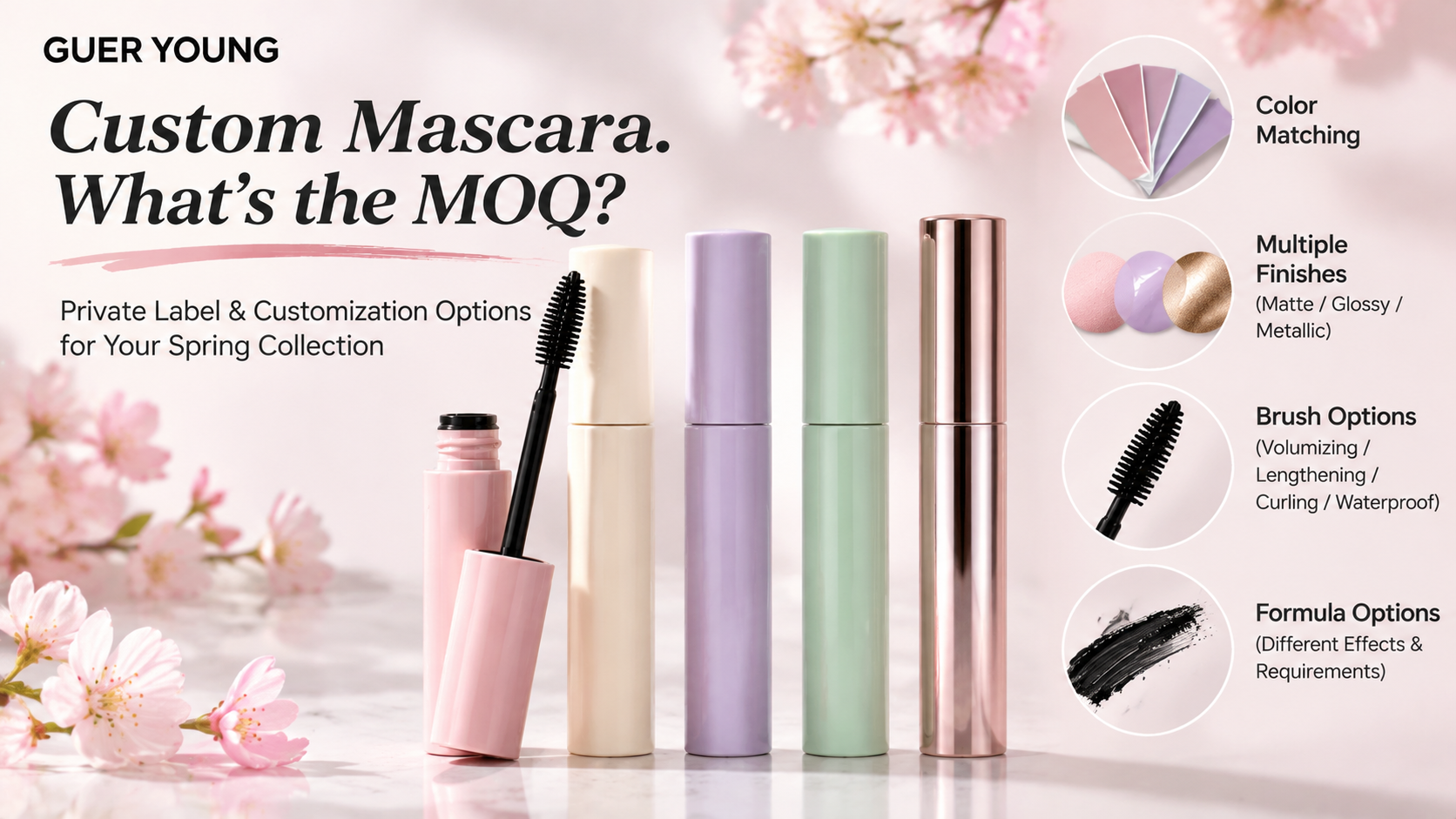
Existing finished products can reduce some development work, but brands often need customized logos, printing, and packaging to establish their own product identity. A supplier's ability to support these requirements should therefore be part of the evaluation.
3.1 Confirm Logo Printing and Packaging Options
Ask which printing and packaging options the supplier can provide, such as:
Silk-screen printing;
Transfer stickers;
Labeling;
Digital printing;
Laser printing;
Heat transfer.
When selecting a printing method, consider the packaging material, logo size, color, placement, and final appearance. Different techniques may have different requirements for packaging surfaces, production processes, and order quantities.
For special packaging or customized designs, confirm whether additional sampling is needed and how much time is required for sample approval and production.
It is also important to clarify the actual scope of each service. Private Label generally focuses on applying a brand's identity to an existing product, while OEM/ODM arrangements may involve different levels of product or packaging customization. The exact scope should always be confirmed with the supplier.
3.2 Check MOQ Requirements and Customization Conditions
Do not focus only on the regular MOQ for the finished mascara. Logo printing, customized packaging, and special processes may each have separate minimum quantities.
Before placing an order, confirm:
The minimum quantity for the existing finished product;
The MOQ for logo printing;
The MOQ for customized packaging;
Whether different SKUs can be combined in one order;
Whether approved printing and packaging specifications can be reused for future replenishment.
If your spring collection includes multiple SKUs, calculate the quantity requirements for each customization item in advance. This can help prevent unnecessary inventory pressure caused by high minimum quantities for specific packaging or printing processes.
4. Verify Quality Management and Manufacturing Capabilities
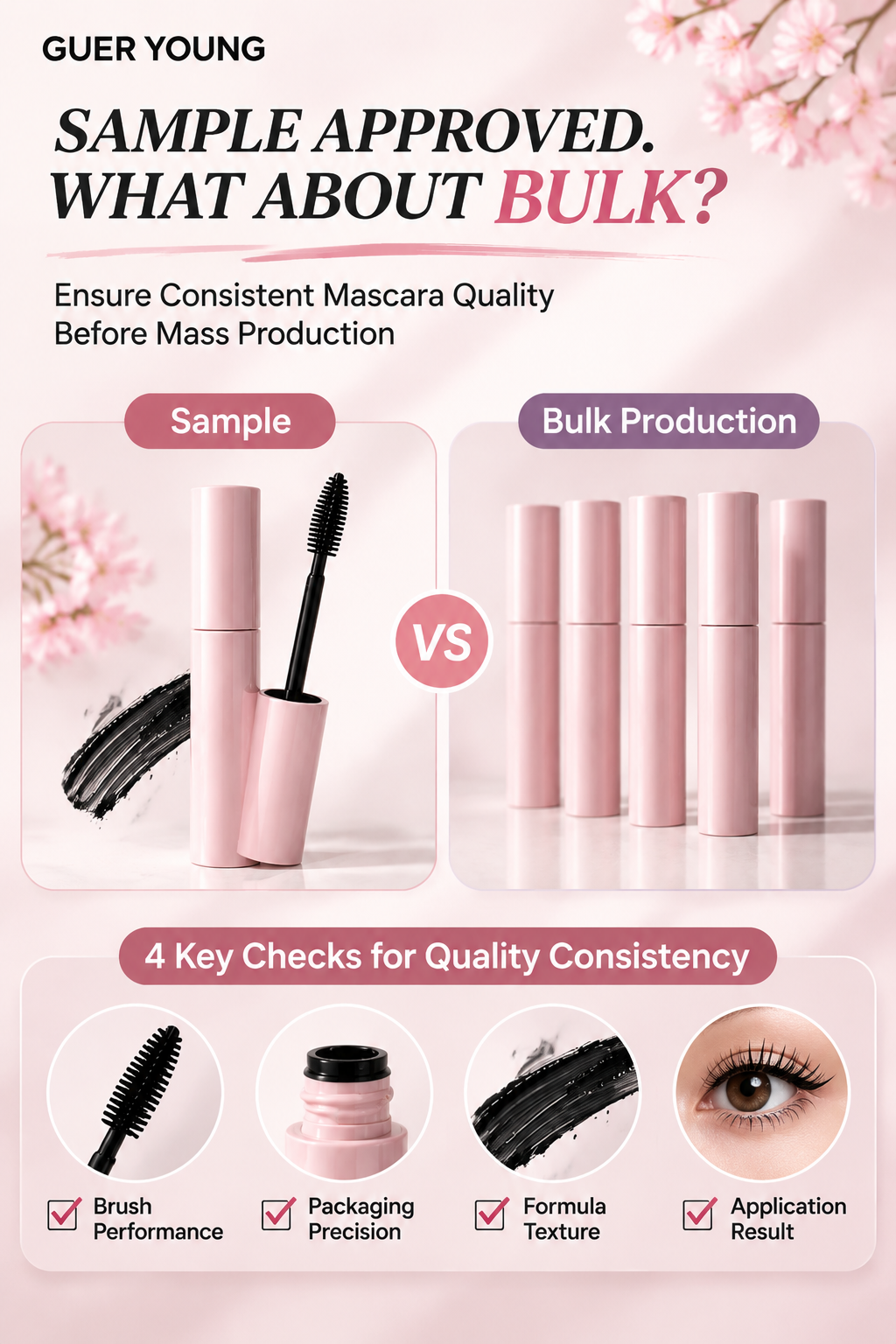
A sample that meets your expectations does not automatically guarantee the same results in bulk production. Brands should also understand how suppliers manage manufacturing quality and whether their production capabilities match the order requirements.
4.1 Understand the Quality Control Process
Start by asking whether the supplier has established quality inspection procedures covering raw materials, packaging materials, production processes, and finished products.
For mascara, several product-specific details deserve attention:
Whether the formula maintains consistent condition and application performance;
Whether the brush and container are assembled correctly;
Whether the bottle opening is clean and the packaging is properly sealed;
Whether product capacity, appearance, and packaging meet the agreed requirements;
Whether bulk products follow the specifications of the final approved sample.
You should also ask how inspection results are recorded and how non-conforming products are handled.
Before placing an order, establish clear acceptance criteria, inspection requirements, and procedures for addressing quality issues. This helps both parties understand the expected standards and provides a reference for future production batches.
4.2 Evaluate Manufacturing Experience and Production Capacity
A supplier's manufacturing experience should not be judged by years in business alone. Brands should also consider whether the supplier understands mascara production and can handle different product specifications, packaging requirements, and order volumes.
Key points to review include:
Experience in mascara manufacturing;
Ability to handle different product specifications and packaging requirements;
Production capacity relative to your expected order quantity;
Experience managing orders involving multiple SKUs;
Ability to maintain consistent product specifications and quality during replenishment.
If the supplier has experience producing similar products, ask how it handles quality issues during manufacturing. Practical production experience can provide a better indication of supplier suitability than operating history alone.
5. Evaluate Communication and Ongoing Supplier Support
Product quality and manufacturing capabilities are important, but communication also affects how smoothly an order is handled. This becomes especially relevant when a project involves sample revisions, logo approval, or multiple SKUs.
5.1 Assess Communication During the Purchasing Process
During the quotation and sampling stages, observe whether the supplier can clearly explain product specifications, MOQ, customization conditions, sample timelines, and available product documents.
Response speed matters, but accuracy is equally important. The supplier should also explain how specific requirements may affect costs and delivery schedules.
For changes involving logos, packaging, or product specifications, keep written records of the agreed details. This helps prevent misunderstandings that could lead to samples or bulk products differing from your expectations.
5.2 Confirm Order Follow-Up and After-Sales Support
Before placing an order, understand how the supplier tracks production progress, confirms packaging details, and arranges delivery. Brands with a fixed spring launch date should discuss production lead times, delivery schedules, and potential factors that could affect timing.
You should also clarify how the supplier handles product quality issues and whether approved product specifications and packaging designs can be reused for future replenishment.
Reliable order follow-up and after-sales support help brands manage not only their first purchase but also future orders with fewer repeated discussions.
Conclusion
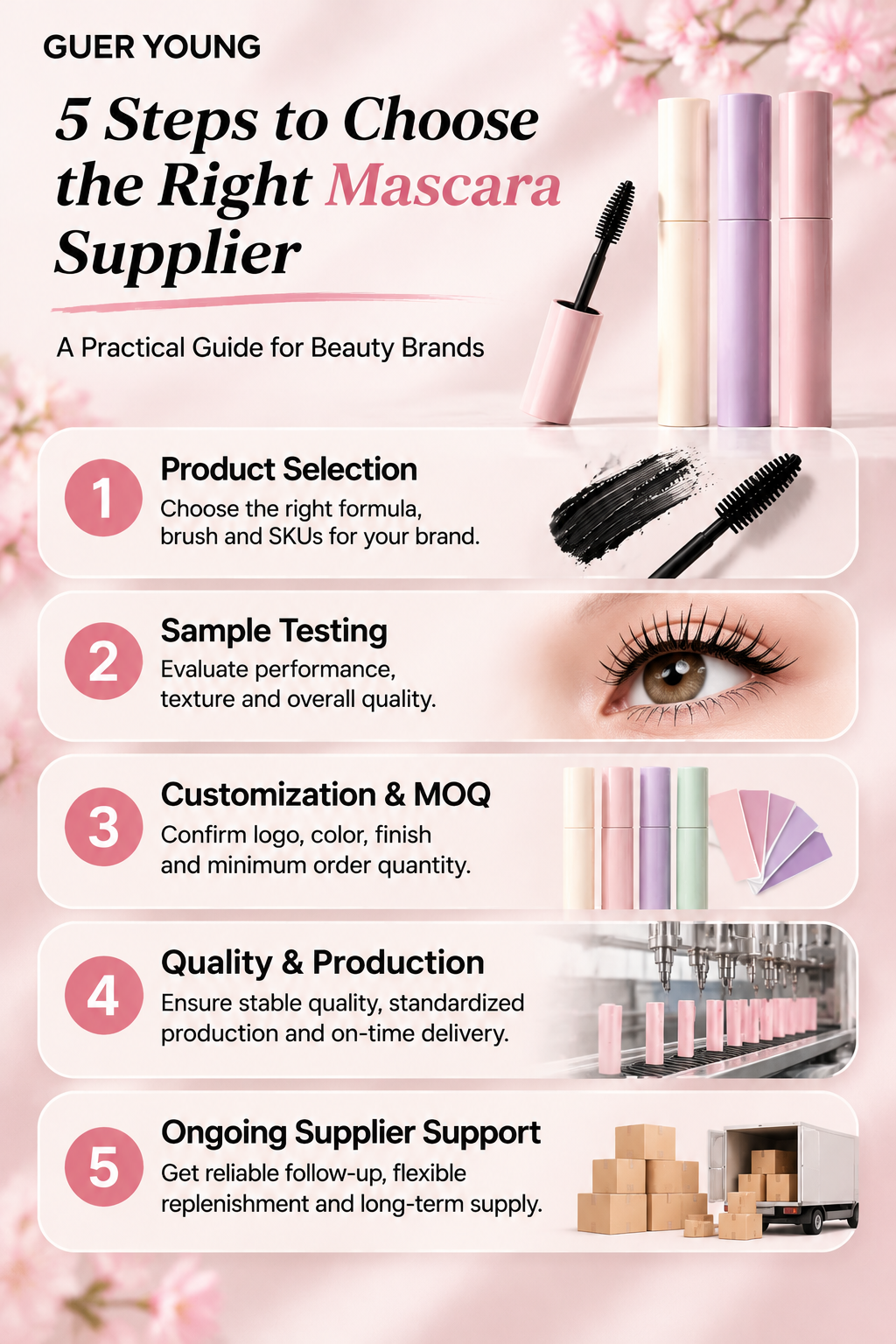
Choosing a finished mascara supplier for a spring collection requires more than comparing product prices and MOQs. Brands should also evaluate product suitability, sample support, customization options, and the supplier's quality management and manufacturing capabilities.
Clarifying these factors in advance can help reduce communication issues during purchasing and prepare brands for a smoother product launch and future replenishment.
If you are exploring finished mascara options for your next collection, you can review the mascara products available from GUER YOUNG and discuss your product specifications and cooperation requirements with the team.


andy.li@gueryoung.com

We have 10 years of experience, focusing on the development and sales of high quality eyelash growth serum, mascara, eyebrow gel, eyebrow color and other products. We also offer custom services, from tube
design to cosmetic fillings and packaging


Room 1, C3 Factory Building, No.8803 Zhuhai Avenue, Lianwan Industrial Zone, Pingsha Town, Gaolan Port Economic Zone, Zhuhai, Guangdong,China
QUICK LINKS
D Zone,5/F, NO.8 CuiZhu 5th Street,
Qianshan Xiangzhou District,Zhuhai,
Guangdong,China,519070

lynn.zhou@gueryoung.com
winnie.zhong@gueryoung.com
niki.xu@gueryoung.com